
Malaysian Prime Minister Anwar Ibrahim's vocal support for Hamas amid the ongoing war in Gaza will help stabilize his fragile government and improve economic sentiment, but the reputational damage risks deterring foreign investment and potentially triggering U.S. sanctions. On Nov. 7, Anwar reiterated that his government would maintain formal ties to the militant Palestinian group Hamas, a position he has vocally staked since the group's Oct. 7 attack on Israel and the subsequent war in the Gaza Strip. The prime minister's remarks were made in response to concerns raised in Malaysia's parliament over a new U.S. bill aimed at imposing sanctions on Hamas' foreign supporters. Anwar said he was closely following the development as it could have implications for Malaysia, which has emerged as the most visible and outspoken supporter of Hamas in Asia (aside from Iran) over the past month. He also stated that U.S. pressure would not alter his government's backing of Hamas, saying Malaysia would not recognize ''unilateral'' sanctions imposed outside the framework of the United Nations.
- Malaysia hosts a Hamas cultural office, which some allege is an unofficial embassy, and does not have normal diplomatic relations with Israel. The Malaysian state has consistently held a pro-Palestine position since the 1960s in line with the Organization of Islamic Cooperation, which as a matter of policy refuses to recognize Israel either formally or informally until an independent Palestinian state is realized. Malaysian passports read ''This passport is valid for all countries except Israel,'' and Israelis are not permitted entry into the country.
- On Nov. 1, the U.S. House of Representatives passed the Hamas International Financing Prevention Act, a bill intended to level sanctions against the Palestinian group's foreign supporters.
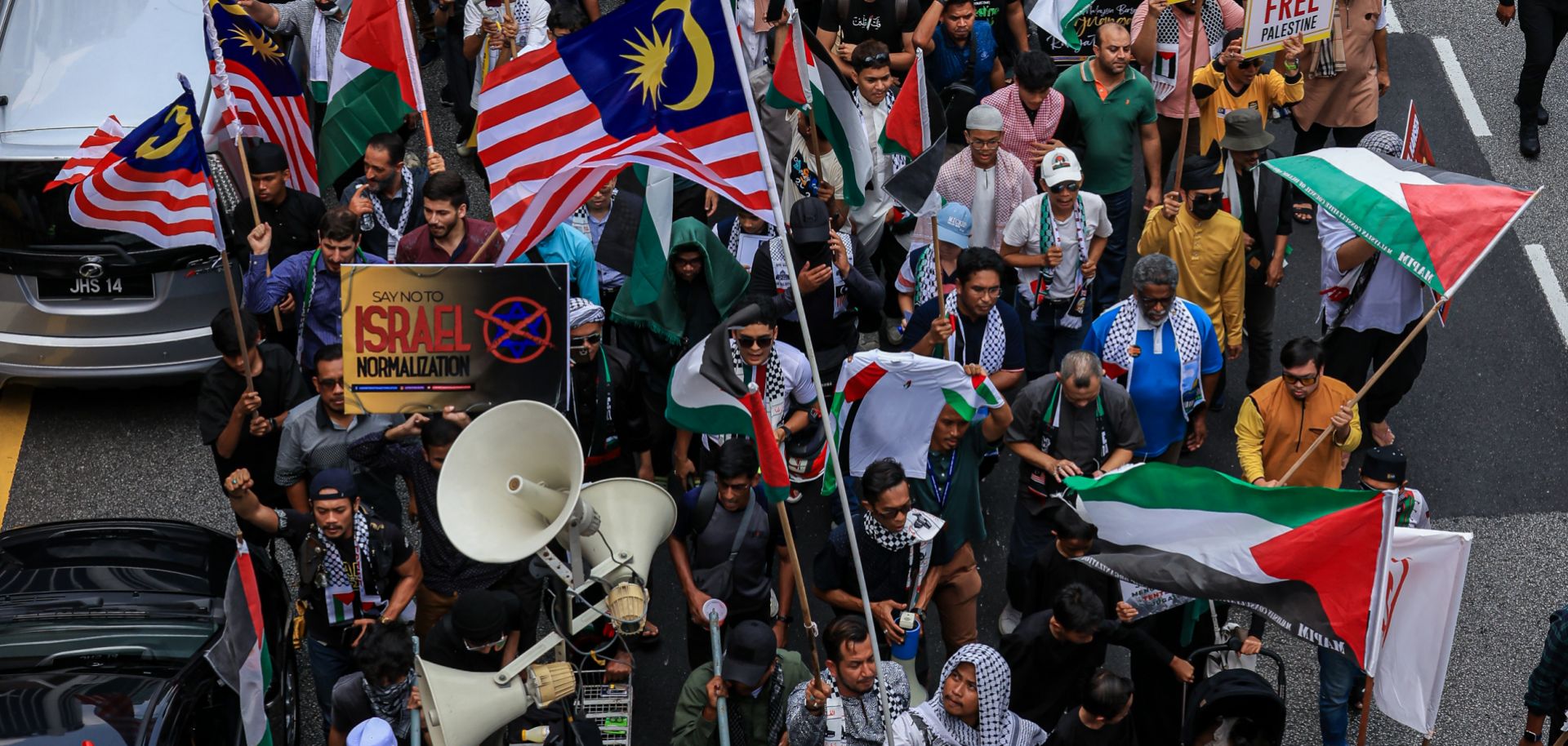
- On Oct. 24, Anwar joined 16,000 protestors in Kuala Lumpur to condemn Israel, calling its retaliatory campaign against Hamas ''the height of barbarism.''
Anwar's staunch advocacy for Hamas is meant to ease tensions between competing ideologies within his government and secure its stability. Upon taking office in November 2022 after a divisive election that yielded a hung parliament, Anwar promised to ease Malaysian society's growing religious tensions amid the rise of Islamist opposition coalition Perikatan Nasional (PN), which alienates Malaysia's non-Muslims. But since Hamas' Oct. 7 attack on Israel and the subsequent war in the Gaza Strip, he has leaned heavily into pro-Islamic rhetoric by pledging full-throated support for Hamas. This change in tone is aimed at accomplishing three political goals. The first is bolstering his multiracial and multifaith coalition's ability to fend off the opposition PN coalition, which is growing rapidly in popularity, particularly among the ethnic Malay Muslim majority; indeed, this could already be working as four BN members of parliament have de facto defected to Anwar's government in recent weeks. The second is consolidating Anwar's ties with his main coalition partner, the Islamic Malay nationalist Barisan Nasional (BN), amid rumors that it could exit the government due to contradicting ideological positions and a long history of deep-seated animosity between the coalitions' main parties. And the third is elevating his government's prominence in the Muslim world as criticism of Israel also lends credibility to Malaysia as a defender of Islam among other Muslim-majority countries and the Global South.
- For Anwar and his Perikatan Herapan (PH) coalition, preserving the alliance with BN, which regards Islamic activism in conjunction with Malay identitarianism as pillars of its agenda, is essential to secure the unity government's parliamentary majority. BN breaking from PH would likely collapse the government by depriving it of a majority, which would be the fifth turnover since 2018, highlighting Malaysia's chronic issue with political instability in recent years.
- In the past year, opposition parties in the PN coalition have gained control over one-third of the seats in Malaysia's national parliament and hold four state governments. This rise has been carried by the youth vote, indicating that Malaysian society is growing more religious and conservative.
- The Palestinian cause is widely popular in Malaysia, as seen by the large pro-Palestinian rallies that have taken place across the country in recent weeks.
- Anwar has proactively taken his message abroad. On Oct. 16, Anwar met with Hamas political chief Ismail Haniyeh in Istanbul where he pledged $21.4 million in humanitarian aid to Gaza. He also met with the Turkish and Egyptian presidents to organize support for Gaza. And on Oct. 20, he raised the issue at the ASEAN-GCC summit in Riyadh.
A common intra-government position on Islamic issues and a placated opposition will contribute to government stability which, if sustained over time, will boost investor confidence and help address Malaysia's currency woes. Anwar's strong anti-Israel stance seeks to gin up support among his country's ethnic Malay Muslim majority, with whom his approval rating stands at a paltry 24%, while reducing suspicions between his PH coalition and its pro-Islam governing partner, the BN. This strategy will enable Anwar to have an easier time in getting his coalition partners that are stridently pro-Palestine to stay the course, thus increasing the likelihood of Anwar finishing a full five-year term — something Malaysia has not had since Najib Razak served as premier from 2009-2018. Anwar's ardent support for Hamas amid the ongoing Gaza conflict will also serve to at least partially placate the PN opposition for a period of time. Both of these factors will contribute to improved political stability in Malaysia, the absence of which has discouraged investors in recent years. Political instability in the form of four prime ministers in as many years has contributed to the tumbling value of Malaysia's currency, the ringgit, which has fallen 7.3% this year and hit a 25-year low in October. The most recent fall was sparked by the Israel-Hamas war and fears of a regional escalation in the Middle East, in turn propelling investors into safer U.S.-dollar-based arrangements. This state of affairs has compounded Malaysia's cost-of-living crisis, another political liability for Anwar that he had promised to address upon taking office. Greater political stability will, in turn, improve investor sentiment in the country, which is key to both strengthening the ringgit and securing the external funding needed to build out Malaysia's high-tech sector.
- Anwar is also seeking to improve on his 42% national approval rating, last polled in August, a major fall from his 68% approval rating in February.
- Anwar has alienated non-Muslims and liberals that make up much of PH's base in other ways in recent months, including his government's crackdown on displays of LGBTQ identity and his decision to preside over the ceremony for a young Hindu's conversion to Islam in August, the imagery of which went viral. This could cost PH votes in the next election as some of its base may stay home, perturbed by Anwar's rightward lurch. However, non-Muslims and liberals typically lack political representation in other coalitions, meaning it is only likely to vote for PH regardless, indicating shrewd calculus on Anwar's part.
However, Anwar risks undercutting these benefits by increasing reputational risk that could hamper foreign investment and ultimately harm the Malaysian economy. The U.S. Hamas International Financing Prevention Act will likely pass the Senate and become law, potentially exposing Malaysia to U.S. sanctions. Anwar moreover claims he has been approached by the United States on three separate occasions following Hamas' Oct. 7 attack on Israel to demand that he withdraw support for the militant group and label it a terrorist organization, which Anwar has very publicly refused to do. This is a problem for Anwar's economic agenda, which relies on courting foreign investment, particularly in building out Malaysia's digital infrastructure. Anwar's fiery defense of Hamas in tandem with growing religiosity and polarization in Malaysian society could spook foreign investors as they will question the country's commitments to environmental, social and governance (ESG) standards, especially when it comes to supporting diversity and inclusion. Appealing to the ethnic Malay Muslim base also means stalling previously promised reforms aimed at leveling the economic playing field by deemphasizing affirmative action that favors the majority in favor of a more meritocratic approach that benefits minorities. Such reputational issues risk constraining Malaysia's business attractiveness, with a higher risk in the tech sector where most know-how is being imported from Western companies. Tensions over its ties with Hamas could also imperil Malaysia's relations with its third-largest trading partner, the United States, with bilateral investment and trade between the two countries totaling $1.6 trillion annually (according to the U.S. Embassy in Malaysia). Any sanctions imposed by Washington would also influence assessments of the U.S. government and U.S. companies looking to do business in Malaysia. Washington will likely slow-walk any Hamas-related sanctions to avoid alienating its allies like Qatar, which hosts exiled Hamas leaders. But if the United States successfully pressures Qatar to expel Hamas, which could transpire over the next six to 12 months, the risk of U.S.-imposed sanctions will grow in Malaysia.
- The U.S. Hamas International Financing Prevention Act seeks to build on previous sanctions, including those targeting individuals with ties to Hamas that the U.S. Treasury issued on Oct. 18.
- Anwar has been wooing U.S. tech companies. He met with Elon Musk in August to try to draw his electric vehicle company Tesla to the country. During a trip to the United States in September, he courted Google parent company Alphabet Inc. and Boeing. He will again seek to meet with Alphabet Inc. as well as Microsoft at the Asia-Pacific Economic Conference taking place in San Francisco on Nov. 15-17.
- U.S. companies are already feeling the ill effects of rising anti-Israel sentiment in Malaysia, which Anwar's pro-Hamas rhetoric has helped fuel. In recent weeks, McDonalds and Starbucks, among over 100 others, have both been the target of popular boycotts over alleged support of Israel.
