
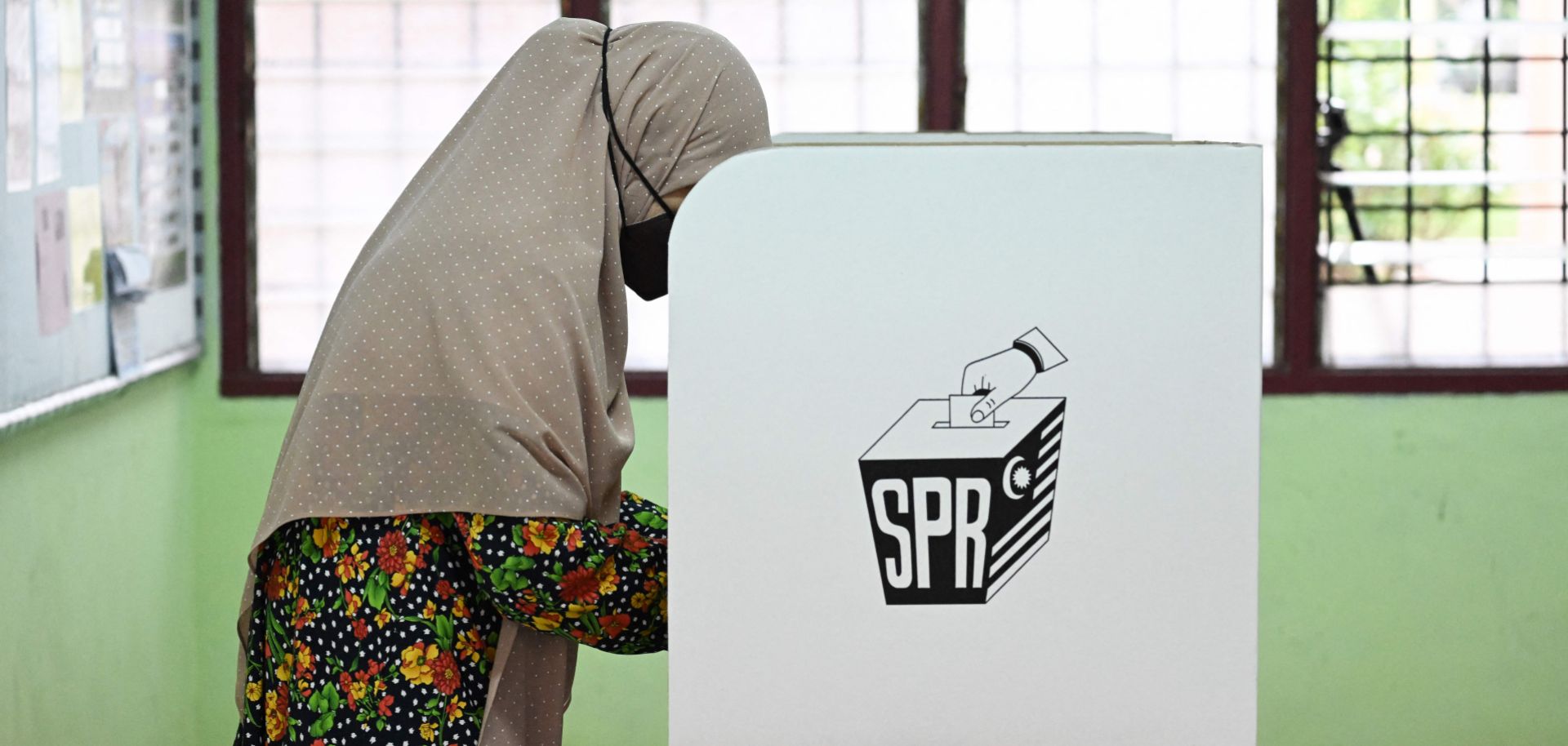
State elections in Malaysia could trigger another political crisis if members of the country's fragile federal government perform poorly, opening the door to political instability that could negatively impact the economy. Six of Malaysia's 13 states, representing roughly half of the country's electorate, will hold assembly elections on Aug. 12. The main contenders are the parties that take part in the federal government, primarily the Perikatan Harapan (PH) and Barisan Nasional (BN) coalitions (though each will run separately), along with the opposition Perikatan Nasional (PN) coalition. Each coalition currently controls three states. While these are only state elections, a poor performance by the government parties would weaken Prime Minister Anwar Ibrahim's heterogeneous coalition.
- PN currently rules over the states of Kedah, Kelantan and Terengganu. PH holds Penang and Selangor, while coalition partner BN holds Negeri Sembilan.
The state elections will take place amid Malaysia's convoluted political environment. The current federal government is Malaysia's fourth in five years, showcasing the country's fractious political environment. In October 2022, then-Prime Minister Ismail Sabri Yaakob dissolved parliament and called for an early general election, expecting his BN coalition to return to power. But the November 2022 election instead resulted in a hung parliament, which led Malaysia's king to appoint the current unity government, led by Prime Minister Anwar Ibrahim from PH, in a coalition with former rival BN. In Malaysia, state elections are typically held concurrently with general elections. But amid seasonal flooding in these locales, state governments opted to finish their terms, which expired in July, instead of holding their regional elections in November.
- In the November election, BN lost not only its parliamentary majority but also ten seats, highlighting a dramatic fall from the political dominance of its main party, the United Malay National Organization, which ruled over Malaysia from 1957 to 2018.
- Despite emerging as the opposition, PN's performance in the November election — and particularly that of its main party, the Pan-Malaysian Islamic Party (PAS), which now holds more seats than any other single party in parliament — catapulted the coalition into the position of flag bearer for the ethnic Malay Muslim majority population, a role formerly held by BN.
- Since becoming the main opposition party, PAS has focused on what it calls the ''three R's'' — race, religion and royalty. To appeal to its base, the hard-line Islamist party has doubled down on its conservative religious rhetoric and strict interpretation of Sharia law, fueling tensions in Malaysia's ethnically diverse society.
The federal government's failure to institute sufficient liberal reforms, address corruption and improve economic conditions are the factors most likely to sink PH and BN's chances in the upcoming elections. Since taking office in November 2022, Prime Minister Anwar has followed through on some of the reforms he promised on the campaign trail. These include repealing mandatory capital punishment as well as enacting new rules to ensure transparency for state procurement contracts (a controversial issue following a scandal involving littoral combat ship procurement that came to light in 2022). However, such actions fall well short of PH voters' expectations for liberal reforms, economic recovery and anti-corruption efforts. Moreover, in recent weeks the unity government has taken assertive action to dispel the notion that it is friendly to the LGBTQ+ community in order to win over skeptical right-wing voters, which risks further irking PH's more left-leaning voters. To compound matters, BN chief Ahmad Zahid Hamidi and his party have very publicly sought to secure a royal pardon for imprisoned former Prime Minister Najib Razak (who was convicted on corruption charges in 2020), a major embarrassment for Anwar. But Malaysia's sluggish economic recovery likely poses the largest threat to BN and PH's electoral prospects, as the unity government struggles to mitigate the cost-of-living crisis it inherited, as well as halt the depreciation of the Malaysian ringgit, which is Southeast Asia's worst-performing currency this year.
- Malaysia's economy expanded by 8.7% in 2022 due to strong domestic consumption and exports after the lifting of COVID-related restrictions. However, its economy is facing headwinds in 2023, driven primarily by the ongoing slowdowns in some of its top trade partners (namely, China, the United States and the European Union), which has dampened demand for Malaysian exports. Malaysia's central bank has also been tightening its monetary policy to fight inflation, which is negatively impacting economic activity.
- On Aug. 10, Malaysia banned the Swiss brand Swatch for its rainbow watch product line in support of the LGBTQ+ community. Those caught with a Swatch product could face up to three years in prison.
A poor electoral performance by the members of the unity government could eventually lead to the coalition's collapse and heightened political uncertainty in Malaysia. The PH-BN unity government has been fragile from the start, as it combines two ideologically opposed coalitions that have a long history of animosity. PH's multiethnic, left-leaning political platform has always been at odds with BN's ethno-nationalist platform that favors protecting the privileges of the Malay Muslim majority. The unity government faces scrutiny from both sides, with the Malay Muslim voter base increasingly regarding BN as failing to protect their collective interests, potentially putting its constitutionally mandated privileges at risk. At the same time, PH's multiethnic, left-leaning base is similarly perturbed by the coalition's willingness to both partner with BN, a former bitter rival, and overlook BN's myriad corruption scandals after PH and Anwar campaigned on inclusivity and clean governance. Thus, should the unity government fail to sweep the states it controls in the upcoming elections, BN or PH may decide that their partnership is counterproductive. Should BN abandon the coalition, it would end the unity government's parliamentary majority. This would trigger another round of political instability that could again result in a dissolved parliament and new national elections, similar to what occurred in 2020 when the defection of coalition partners sank the government. This raises the possibility of Malaysia electing its fifth government since 2018. Such political uncertainty would deter foreign investment and impede Malaysia's ability to achieve its economic and green energy goals, as the country seeks to develop its digital economy, electronics, aerospace, chemicals and pharmaceuticals sectors. A prolonged period of government instability could also damage Malaysia's reputation as a global hub for assembling and packaging semiconductor chips by making alternative hubs more attractive by comparison.
- The decision to form a unity government with PH sparked a backlash among BN members due to the two coalitions' history of animosity and ideological differences. BN chief Zahid, who currently faces dozens of corruption charges, ultimately suppressed the internal unrest by purging the disgruntled BN members.
