
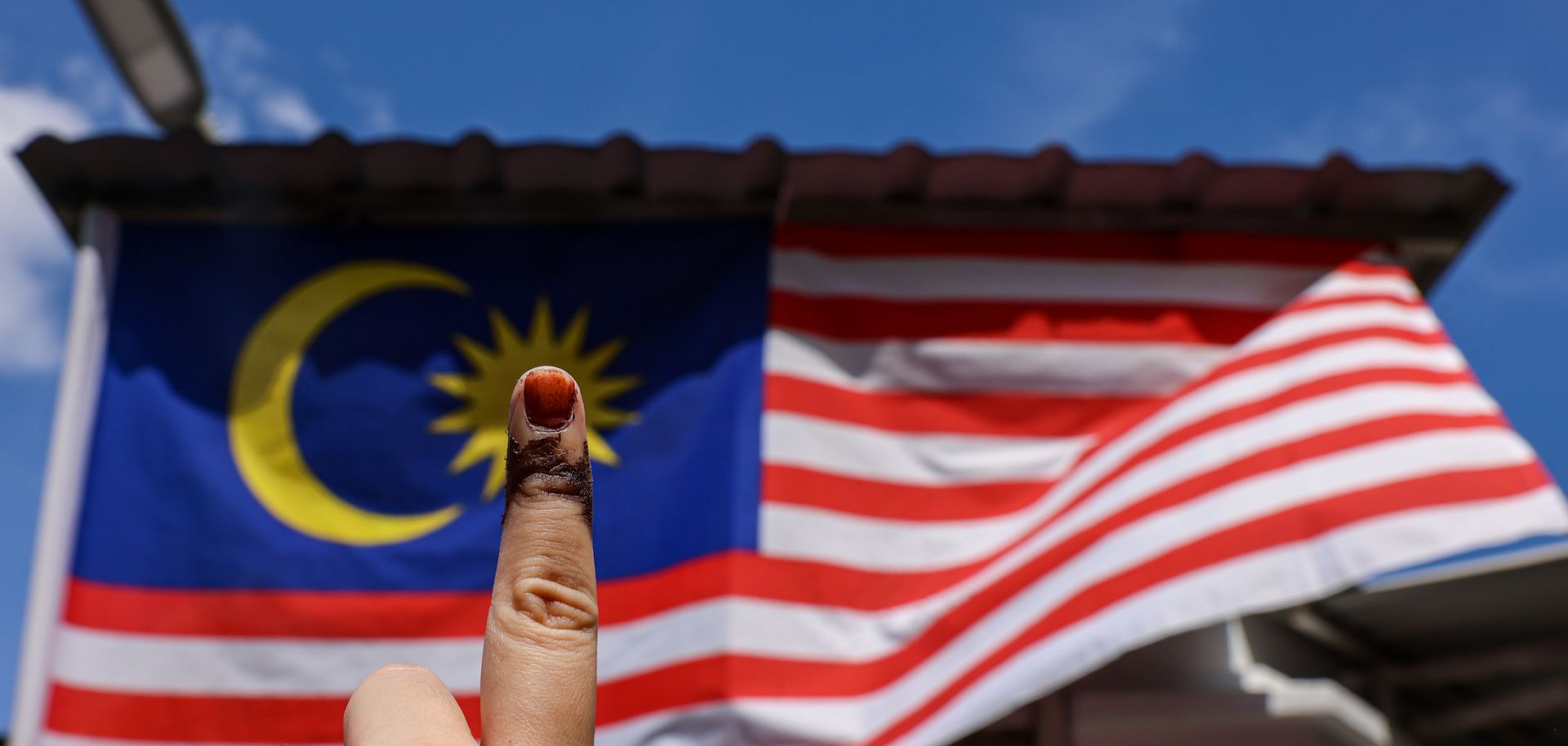
A voter shows a fading inked finger from casting a vote during Malaysia's Nov. 19 general election on Nov. 22, 2022, in Petaling Jaya, Malaysia.
In Malaysia, a snap general election resulting in a hung parliament and subsequent political crisis portends further political instability. Whatever governing coalition emerges victorious will struggle to engage in major domestic reforms and foreign policy initiatives as it contends with a weak mandate. Voting in the country's 15th general election on Nov. 19 resulted in a hung parliament, the country's first, as no coalition was able to secure a simple majority of 112 out of 222 seats needed to form a new government. The opposition coalition Pakatan Harapan (PH), led by longtime reformer Anwar Ibrahim, won the most seats at 82. The upstart nationalist coalition Perikatan Nasional (PN), formed in 2020 and led by former Prime Minister Muhyiddin Yassin, secured 73 seats. The incumbent coalition Barisan Nasional (BN) won only 30 seats in a major blow to its political standing. Each was given the opportunity to negotiate with other parties to attempt to form a majority, but as of Nov. 23 none has been successful. Both PH and PN claim to have secured majorities through negotiations, but have been unwilling to disclose which parties supposedly backed them. Thus, in line with the rules of the country's constitutional monarchy, the issue now goes to King Al-Sultan Abdullah Sultan Ahmad Shah to select a new prime minister. In the event of political crises, the country's constitution gives the king the power to appoint a prime minister that he believes can command the loyalty of the majority of parliament. The king's selection as the new prime minister will then finalize a new government, even if the new prime minister's party ends up in the minority.
- This is the third time the king will select a prime minister since 2018, but this is the first time the process was needed following an election. The king chose Muhiyddin in 2020 and outgoing Prime Minister Ismail Sabri Yaakob in 2021 after government collapses precipitated royal intervention.
- PH and PN refuse to work together; the former comprises a multiethnic coalition and the latter leans heavily into ethnic Malay nationalism and Islamic politics. On behalf of PN, Muhyiddin rejected the king's urging to form a unity government with PH on Nov. 22.
- BN declined to partner with either PH or PN, denying both coalitions 30 potential seats for now.
- The king on Nov. 23 called a special meeting of the country's nine hereditary sultans, who will meet on Nov. 24 to discuss who should become prime minister.
The election, called early at the behest of the largest party in the BN coalition, highlights how far the formerly dominant coalition has fallen as Malaysia's era of political instability continues. With federal elections constitutionally scheduled every five years, the next was set for July 2023. But BN, which is led by the United Malay National Organization (UMNO), sought to secure a larger majority than the four-seat advantage it had enjoyed alongside its coalition partners in the country's 14th parliament. This led BN chairman and UMNO president Ahmad Zahid Hamidi to call on Prime Minister Ismail Sabri Yaakob to dissolve parliament, which he did Oct. 10 as he seemingly lost out in a power struggle with Ahmad Zahid. The results of the Nov. 19 polls show this to have been a major miscalculation, as BN lost 10 seats and Ahmad Zahid barely held on to his seat. The only potential upside is that UNMO could conceivably play kingmaker by forming a coalition with PH or PN, despite its initial indications of refusing to cooperate. More broadly, however, BN has seen its once unassailable political dominance disappear, especially as the electoral results show that PN has seemingly taken BN's Malay ethnic majority and Islamic support base. This is probably due to corruption and infighting within UMNO. In August, former UMNO Prime Minister Najib Razak was jailed for 12 years following convictions related to the 1MDB scandal, a major bribery and money laundering scheme involving embezzlement from the country's sovereign wealth fund. Meanwhile, Ahmad Zahid, BN's current chair and UMNO's president, faces dozens of pending corruption charges, and UMNO is widely seen as meddling in the country's judiciary to protect its members from investigation and sentencing. At the same time, in the run-up to the election, Ahmad Zahid sacked several UMNO members ostensibly loyal to Prime Minister Ismail and subsequently replaced them with loyalists as he appeared poised to try to unseat Ismail. After the election, calls for Ahmad Zahid's resignation are thus intensifying.
- BN held 133 seats at the beginning of the 13th parliament in 2018, but fell to 40 at the beginning of the 14th (when it was forced to partner with other coalitions such as PN, a situation calling the early election was intended to remedy) and is now down to 30 seats.
- With 26 seats, UMNO now holds only the fifth-highest number of seats among the country's political parties. UMNO led every governing coalition from the country's independence in 1957 until 2018, when its defeat by PH ushered in the era of political instability.
The electoral results also confirm that Malay identitarianism and political Islam are rising. Despite being the largest winner with 82 seats, the multiethnic PH coalition actually lost eight seats, down from 90 in the previous parliament. By contrast, PN's brand of Malay identitarianism and political Islam, more hardline than UMNO's, saw the biggest gains of the election. The second place vote-getter, PN, expanded its share of seats significantly from 39 to 73 as its dominant party, the Pan-Malaysian Islamic Party (PAS), made inroads in formerly UMNO-dominated areas. PAS is now the single party with the most seats at 44. It secured a large proportion of the youth vote, expanded by a 2019 law to lower the voting age from 21 to 18. Observers had thought this would benefit the more liberal PH, but the strong youth support for PN indicates the opposite. These trends show that ethnic Malay nationalism and Islamic politics still hold significant sway with the electorate, though voters seem to prefer parties without major corruption and other scandals, helping to explain why UMNO's brand of Malay nationalism did poorly by comparison.
As political fracturing intensifies and a minority government becomes increasingly likely, whoever becomes prime minister is unlikely to be able to pass substantial reforms or take advantage of opportunities to increase Malaysia's global presence. If neither PH nor PN can secure BN support, the next prime minister is all but certain to oversee a parliamentary minority, solidifying a recent trend of weak governments incapable of passing needed reforms. This will challenge Anwar or Muhyiddin, the only two realistic options to become the next prime minister, because the new government will be under substantial pressure to address myriad long-standing and recently amplified economic challenges, including the continuing plunge of the ringgit (Malaysia's currency), rising inflation and interest rates, low productivity among small and medium enterprises, a widening development gap between the country's 13 states, stalled green energy reform, and limited gains from diversifying global supply chains as businesses consider new operations in other countries in the region. Meanwhile, the country's persistent struggles with political instability will limit its foreign policy aspirations, likely leading to general policy continuity without any major shifts or the ability to take advantage of new opportunities. Malaysia is thus likely to continue its inward gaze, meaning that Kuala Lumpur will be less able to influence the key strategic region in which it sits through its participation in the Association of Southeast Asian Nations (including concerning the Myanmar civil war and Rohingya crisis, as Malaysia fiercely opposes Myanmar's junta), take full advantage of its strategic resources (rare earth minerals) and supply chain position (semiconductors and green energy) or make significant headway in expanding beyond its seven bilateral free trade agreements to bolster its small and medium enterprises.
- The incoming government will be Malaysia's fourth in four years. PH's and PN's last governing coalitions collapsed after only months of governing in 2018 and 2021, respectively, demonstrating the risks of weak governance and another potential collapse for either likely next prime minister. In PH's case, collapse came even after electoral victory.
- PH campaigned on substantial economic reforms such as eliminating entrenched business cartels to increase economic competition, cutting red tape, creating more free trade zones, and helping SMEs compete through digitalization, but these are now unlikely to pass without broad cross-coalition support that appears unlikely. Political reforms, such as the Fixed Parliament Term Act proposed by PH to eliminate snap elections, are also unlikely to pass for the same reasons.
- Similarly, PN, which supports Islamic reforms, even calling for Sharia, is unlikely to realize its goals without the numbers to back them.
- Regarding foreign policy, which was already a secondary concern as Kuala Lumpur focuses on domestic priorities, Malaysia will likely continue on its foreign policy trajectory, broadly looking to maintain productive relations with larger powers. In practice, this will mean carefully balanced continued security cooperation with the United States and economic partnership with China.
