
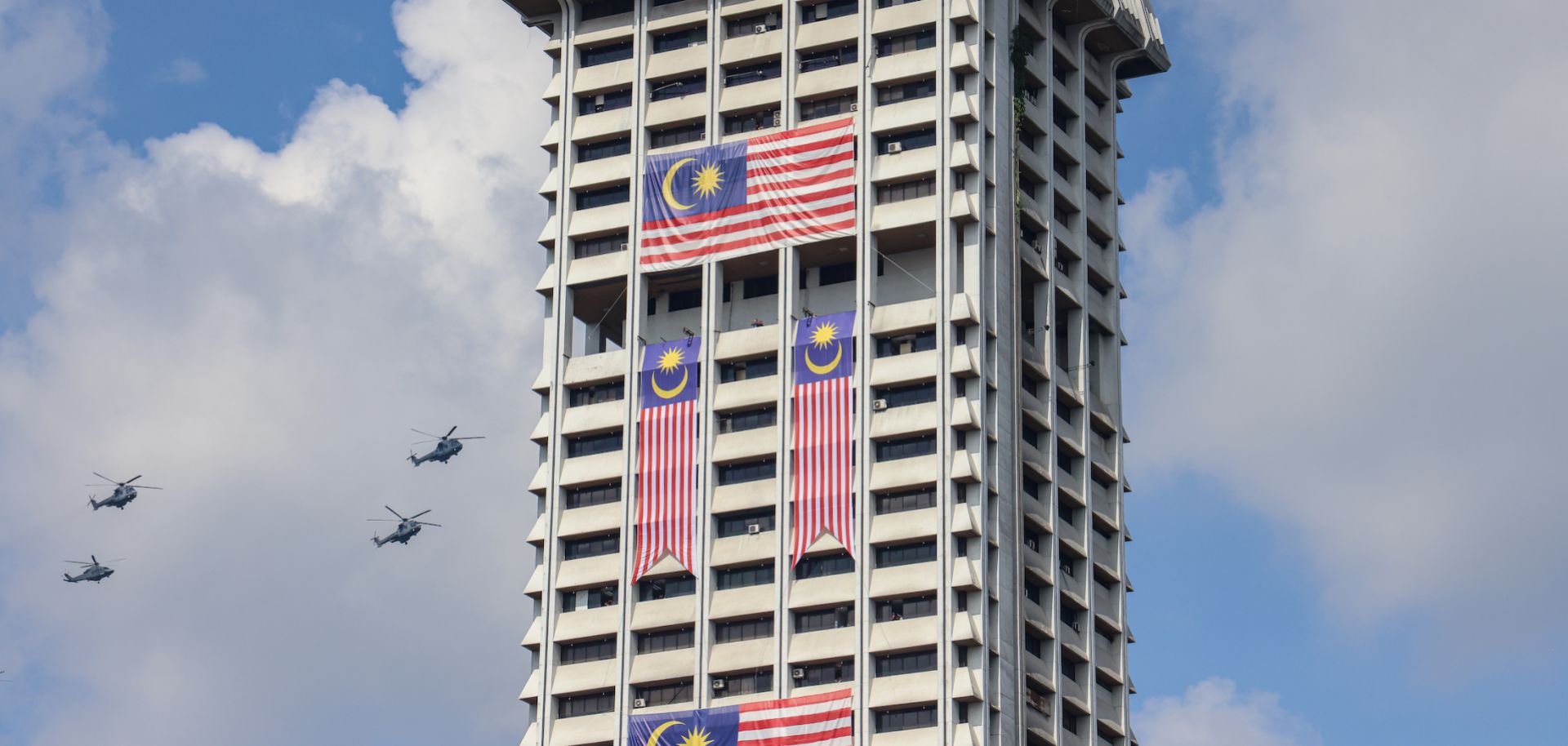
Royal Malaysian Air Force helicopters fly past a building during the 65th National Day parade at Independence Square on Aug. 31, 2022, in Kuala Lumpur, Malaysia.
Malaysia's ruling UMNO party intends to call an early general election this year amid an inter-party schism that may lead to the ouster of the prime minister, likely weakening the rule of law and potentially disrupting ongoing economic recovery efforts. On Sept. 17, Malaysian Prime Minister Ismail Sabri Yaakob said he intends to move forward with an early general election this year, with the final decision and date to be determined at a party meeting on Sept. 30. While the authority to dissolve parliament and call a new election formally lies in the hands of Sultan Abdullah Sultan Ahmad Shah of central Pahang, in practice the ruling United Malays National Organization party's (UMNO) leadership exercises a large degree of de facto control over the decision; however, the party must still convince Ismail to petition the sultan. The majority of UMNO members want an early election to capitalize on the opposition's weakness and UMNO's momentum from victories in recent state elections to gain a stronger parliamentary majority. This sentiment has ratcheted up intensely in the weeks following the jailing of former Prime Minister and UMNO heavyweight Najib Razak, as the window for the party's greater relative popularity has begun to close. Many of UMNO's top leadership, including party President Ahmad Zahid Hamidi, are wrapped up in legal troubles of their own, thus intensifying the urgency. Malaysia's opposition coalition is lobbying to prevent Ismail from calling the snap election, ostensibly because the November and December months will bring monsoons and floods that will imperil voters.
- UMNO dominated Malaysian politics from its founding in 1957 to its electoral loss in 2018. While it has since regained a slim legislative majority, the party now looks to regain a supermajority. The ruling Barisan Nasional (BN) coalition — in which UMNO is dominant — holds only a four-seat majority in the 222-member parliament.
- Ismail is the country's ninth prime minister, but he is the third in as many years, marking a period of recent instability since UMNO's 2018 electoral defeat. During his tenure, Ismail has needed to reach out to the opposition coalition in an effort to bridge political divides given the weak majority, a stance that has been criticized by hardliners in his party.
- UMNO's top five leaders include Ahmad Zahid, party deputy president Mohamad Hasan, and three party vice-presidents Mohamed Khaled Nordin, Mahdzir Khalid and Ismail.
- Ahmad Zahid maintains the authority to name who will serve as Malaysia's next prime minister in the event of a UMNO victory in a general election, putting Ismail's status in jeopardy. Ismail is the first UMNO premier to not also head the party, a dynamic that has caused friction.
The disputes over an early election highlight an ongoing schism within UMNO that will shape the future of the party and the Malaysian government. Ahmad Zahid and Ismail are in a power struggle triggered by the conviction of Najib and his unprecedented jailing. Najib is a scandal-ridden — yet still highly influential — figure in UMNO and Malaysian politics. His imprisonment on corruption charges demonstrated a previously unseen independence streak in the judiciary, made possible by Ismail's compromise with the opposition, which demanded that the judiciary remain independent if Malaysia was to be governed by consensus. Ahmad Zahid's faction represents UMNO old guard loyal to Najib and relies on Malay identitarianism, a political strategy that mobilizes the party's base but will fail to pull in new voters. Ismail, for his part, has maintained distance from Najib throughout the court proceedings, a stance that has boosted his profile with the wider Malaysian public. He hopes to ride support from non-party voters inside and outside the BN coalition with a big tent governing style, institutional reforms to boost inter-party cooperation and rule of law, and economic initiatives, including post-COVID-19 recovery and inflation reduction measures. Ismail has been under pressure to call an early election from Ahmad Zahid for months, and in late August he was reportedly threatened with party expulsion if he refused to do so. However, Ahmad Zahid's recent scandals have put him on the back foot and given Ismail a momentary advantage. The two are conversely motivated: Ahmad Zahid hopes for a quick election that would enable him to exercise his authority to potentially appoint another prime minister in Ismail's place; Ismail hopes to delay the election long enough to see Ahmad Zahid convicted and imprisoned, leaving a vacuum in party leadership that he could fill.
- Ismail signed a rare joint statement with the opposition coalition in August 2021 to achieve a degree of stability in exchange for passing into law several parliamentary reforms sought by the opposition and protecting the independence of the judiciary. He also invited opposition leaders to join two key economic and COVID-19 recovery government bodies.
- UMNO party members booed Ismail's name at an Aug. 27 rally when Ahmad Zahid called on him to abide by the wishes of the party.
- In August, Najib was convicted for his participation in the 1MDB scandal, which was a conspiracy to systematically embezzle funds from the Malaysian sovereign wealth fund 1Malaysia Development Berhad, founded in 2009, and is regarded as perhaps the largest case of kleptocracy ever uncovered. Najib was instrumental in setting up 1MDB and funneled in excess of $700 million into personal accounts.
- Najib was also implicated in the LCS scandal, which refers to the purchase of six naval ships for around $2 billion initiated in 2011. None of the ships have been delivered, and the contractual terms between the ministry of defense and the manufacturer are bloated by a factor of three to four. Ahmad Zahid is implicated in the money laundering and embezzlement scandal, and he is currently standing trial and faces a total of 47 related criminal charges.
- A recent change to UMNO's party constitution has rendered internal party elections impossible until six months after a general election, preventing a challenge to Ahmad Zahid's party presidency in the intervening time period.
In the likely case of an early general election this year, the vote could result in a push to increase political control over the judiciary, which would weaken Malaysia's rule of law. A new election would likely consolidate Ahmad Zahid's control of UMNO, which would result in increased political control over the judiciary and strengthen calls to pardon Najib and possibly Zahid himself. Dissolving the parliament would also enable Ahmad Zahid to replace the members of the Public Accounts Committee in charge of investigating his role in the LCS scandal. These moves would weaken the rule of law in Malaysia and negatively impact the country's appeal as a foreign investment destination. As the current strategic calculus gives UMNO an advantage in a snap election due to the fractured nature of opposition parties, it is likely that UMNO — which is heavily focused on Malay ethnic grievances — would pick up more seats, enabling the party to reorient priorities around identitarian issues that appeal to its voter base. This would likely result in additional support from rural Malays (the ethnic majority) who benefit from ethnically-based affirmative action initiatives. An overwhelming UMNO victory would also likely see Ismail replaced as prime minister by a UMNO hardliner less inclined to work with other parties and more intent on wielding influence over the country's judiciary, which would further degrade the country's rule of law.
- UMNO is currently constrained by its razor-thin parliamentary majority, rendering focus on identitarianism untenable. A new parliament with a larger UMNO majority would enable the party to renew appeals to the country's ethnic majority by reintroducing identitarian Malay-centric sentiments characteristic of the party's "Malay supremacy" ideology.
- Ahmad Zahid has repeatedly declared the COVID-19 crisis over, undermining Ismail's economic recovery initiatives, such as inflation and food price reduction measures.
- Ismail is well-liked by non-UMNO members of the BN coalition, a fact that prevented a no-confidence vote last year. If the coalition puts enough pressure on Ahmad Zahid — particularly given that his intention to weaken the judiciary is unpopular outside his party — or UMNO fails to secure a supermajority, Ismail could retain his position even in the case of early elections.
In the unlikely case that an early general election does not take place, Ismail will push forward bills to boost his profile and buy time against his rivals. Ismail has several bills in the pipeline on healthcare, political funding and a constitutional amendment to limit the tenure of the prime minister to two terms that would be able to proceed if he has more time in the premiership. He has also maintained a firm stance of not intervening in the judiciary and would allow the Public Accounts Committee investigation to continue unfettered, likely leading to Ahmad Zahid's prosecution. If Ahmad Zahid is convicted before an election can be called, he would lose his position as party leader, and his status as BN chairman would likely default to Ismail, who would then not only be able to maintain his position but also secure his status for the longer term. Forestalling the election would also mean a continuation of Ismail's signature economic policies, such as the Bantuan Keluarga Malaysia initiative, which provides direct cash aid to wage earners in the bottom 40 percentile, and a continuation of a rule by consensus governing style.
- Ismail is constrained by his relatively low place in the party hierarchy and his government's slim majority in parliament, which allows little space to maneuver. In a relatively weak governing position, his only chance to stay in power is to deliver on economic issues and make concessions to the opposition, whereas UMNO traditionally has relied on ethnic favoritism for electoral support.
- Despite public statements to the contrary, Ismail may still not call an early election.
