
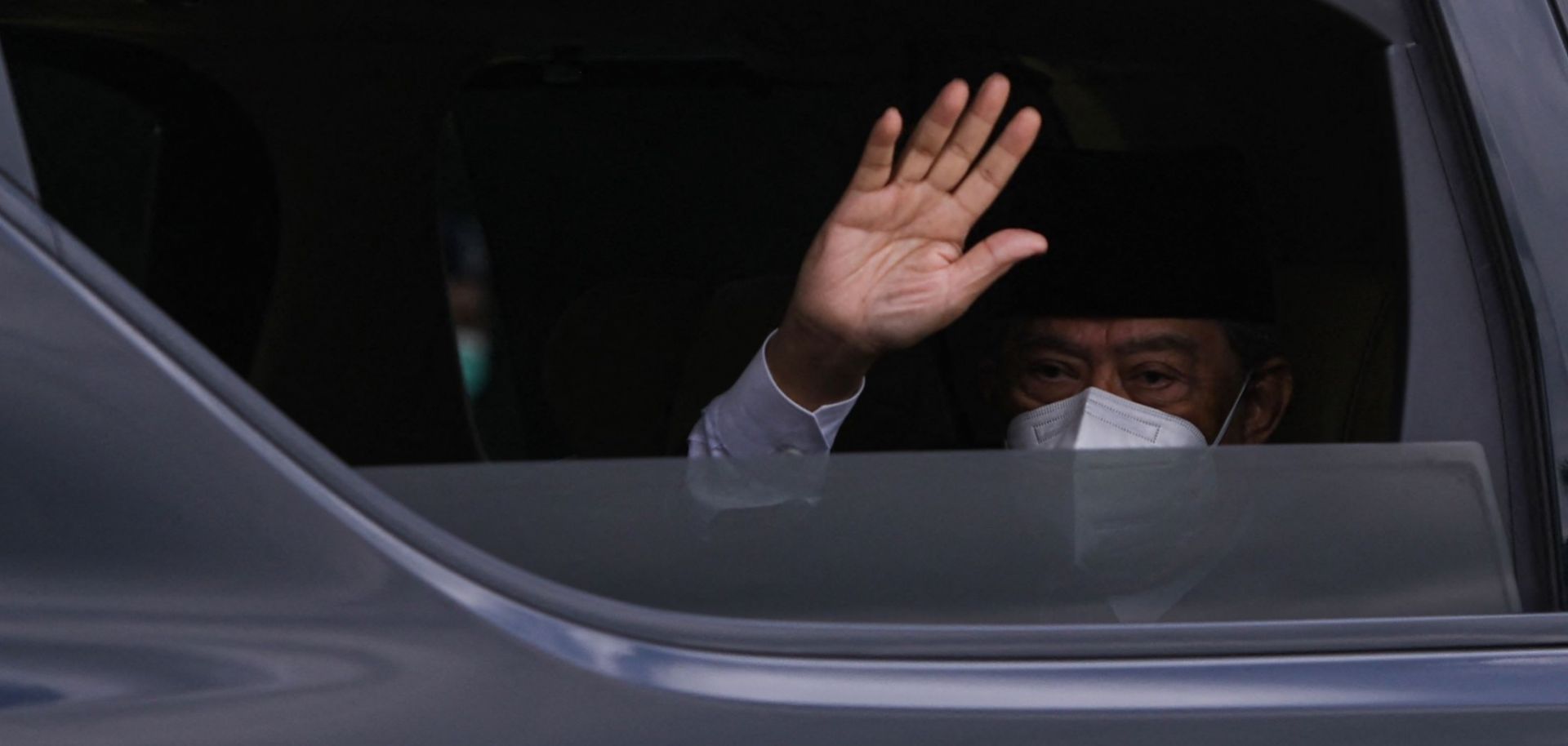
Malaysian Prime Minister Muhyiddin Yassin waves as he arrives at the national palace in Kuala Lumpur on Aug. 16, 2021.
Malaysian Prime Minister Muhyiddin Yassin’s resignation will heighten political uncertainty as competing forces try to muster a majority under the caretaker government. On Aug. 16, Muhyiddin stepped down from his post following a meeting with Sultan Abdullah Ahmad Shah, formally ending his 18-month rule at the helm of the fragile and embattled Perikatan Nasional coalition. However, with the constitution containing no provisions for a minority government and with no majority bloc yet assembled, Muhyiddin will serve as caretaker prime minister for an interim period. Malaysian politicians will now move quickly to try to negotiate a new political balance with few prospects for a new election to extend any faction’s advantages.
- Malaysia’s monarch has the constitutional power to select a prime minister who he’s confident commands a majority. The sultan said that given the COVID-19 situation, it was not the "best option" to hold elections in the near future, alluding to the 2020 Sabah State local polls partly responsible for Malaysia's successive and ongoing waves of the virus.
- Malaysia’s two largest coalitions will likely serve as the foundations for any majority government to emerge. Muhyiddin’s Perikatan Nasional bloc remains the largest coalition in parliament with 100 out of the legislature’s 220 seats, followed by the opposition Pakatan Harapan at 88. The opposition will face particular challenges given pledges among unaffiliated lawmakers not to work with PH leader Anwar Ibrahim and/or the Democratic Action Party (DAP).
- The fragmented United Malays National Organization (UMNO) party will be key to any government, with 15 UMNO lawmakers unaffiliated with either the ruling or opposition bloc. UMNO Vice President Ismail Sabri Yaako has called for these unaffiliated lawmakers to rejoin the Perikatan Nasional, which still contains other UMNO members, with himself as prime minister.
- There is also the possibility of the emergence of a unity government under uncontroversial and long-serving lawmaker Tengku Razaleigh Hamzah, a UMNO member who remains in Perikatan Nasional. This is favored by the UMNO Youth wing of the party, which wants the next government to form a "war cabinet" focused on Malaysia’s COVID-19 crisis and pledge to “hold elections after herd immunity is achieved, potentially in late 2021 or early 2022.”
An extended caretaker period under Muhyiddin could lead to disruptions in policymaking and challenges with pandemic management. Malaysia’s rising COVID-19 numbers and need for continued lockdowns saw the central bank downgrade its annual growth forecast on Aug. 13 to 3-4% from its previous 6-7.5%. However, with significant procurements and an efficient bureaucratic oversight, Malaysia’s inoculation campaign is set to achieve its target of 50% of the population fully vaccinated by the end of August, crossing the 40% threshold Aug. 14 with 400,000 administered per day. This has seen optimistic GDP outlooks projected for the second half of 2021 and early 2022. The passage of a $36 billion stimulus package in late June will help undergird Malaysian growth amid sustained pandemic restrictions. But Malaysia ordinarily debates and passes a new Supply Bill in the fourth quarter of every year — a process that a caretaker government would unlikely be able to oversee successfully unless the monarch allowed a state of emergency.
- Malaysia has seen a continued uptick in COVID-19 infections since early July, exceeding a record 21,000 new daily cases on Aug. 16.
Regardless of the next steps in Malaysian politics, the medium-term outlook for the emergence of a sustainable political balance is dim. This has been the case since the country entered a new and uncertain era in its history with the 2018 defeat of the Barisan Nasional coalition, which had dominated politics for three decades. This new and shaky political order means that Malaysian governments will continue to need to rally diverse elements, subjecting coalitions to dealmaking and collapse — as evidenced by Muhyiddin’s downfall so close on the heels of the February 2020 downfall of his predecessor.
