
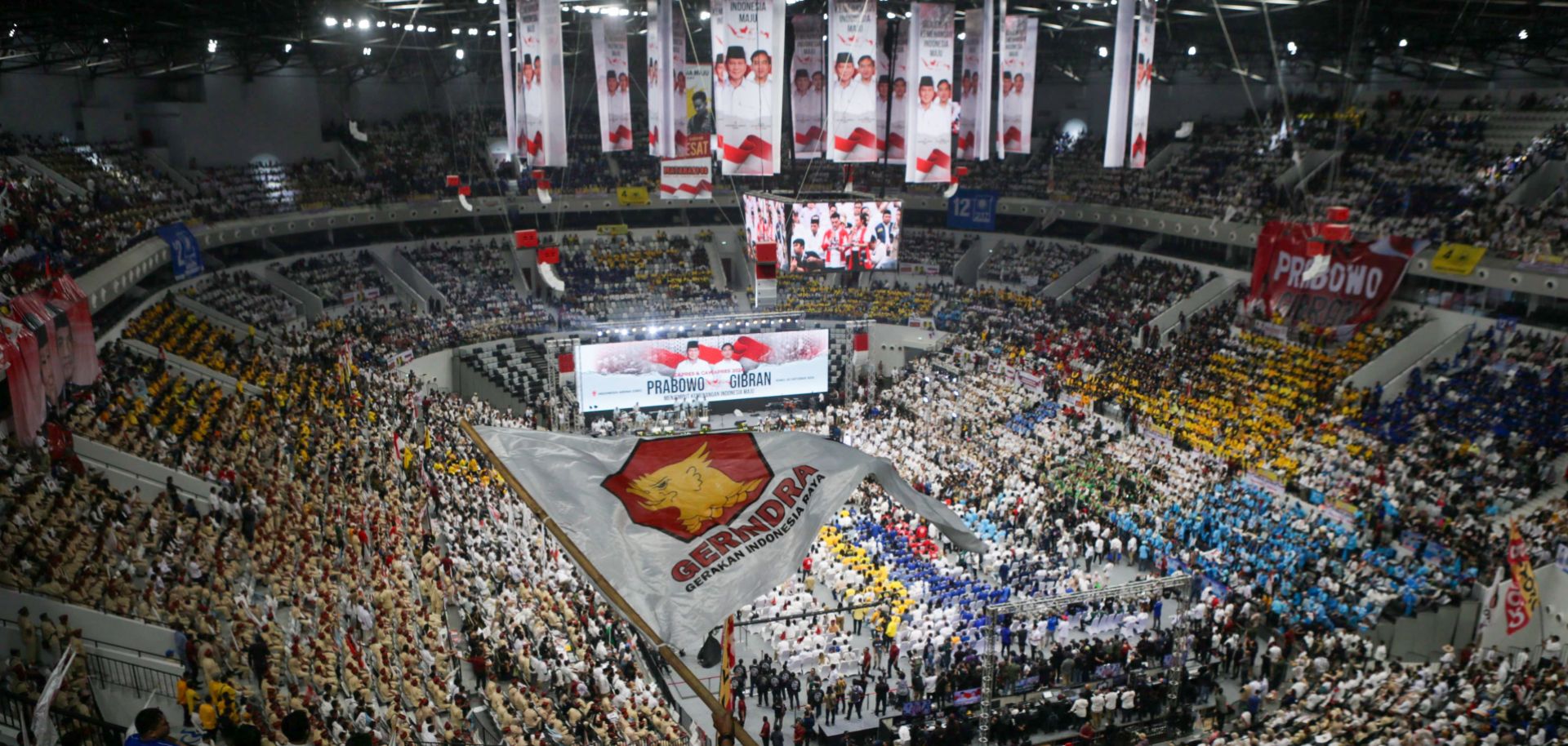
As campaigning for the February 2024 election kicks off in Indonesia, victory for a ticket including the current president's son would likely result in policy continuity, meaning further resource nationalism, the development of a new capital city and continued military modernization. On Oct. 25, Indonesian Defense Minister Prabowo Subianto and Surakarta city Mayor Gibran Rakabuming Raka (who is also the eldest son of Indonesian President Joko ''Jokowi'' Widodo) formally registered their ticket with the country's Election Commission for next February's general elections as presidential and vice presidential candidates, respectively. Former Jakarta Governor Anies Baswedan along with vice presidential nominee Muhaimin Iskander, as well as Central Java Governor Ganjar Pranowo and his vice presidential choice Senior Security Minister Mahfud MD, similarly registered in the preceding days. The race will likely be tightly contested between these three tickets.
- Indonesia, the world's third-largest democracy, will have around 205 million eligible voters for the 2024 election. The ballot will mark the end of an era for the country, as Jokowi has been in power for a decade but is ineligible for a third five-year term. Jokowi will stay in office until October 2024.
- The Feb. 14 elections will be for president, as well as national parliament seats and legislative representatives at all administrative levels in the country.
- Subianto lost close elections to Jokowi in 2014 and 2019, the latter of which led to riots by his supporters claiming election fraud and sparked the deadliest political violence in Jakarta in decades. Nonetheless, Jokowi eventually invited Subianto into his cabinet as defense minister, and the two have since consistently stated publicly that reconciliation is in the national interest.
- An Oct. 20 poll shows Subianto with a slight lead (37%) against Pranowo (35.2%) and Anies (22.7%).
Subianto and Gibran formed their ticket amid high approval ratings for Jokowi, along with a landmark court decision allowing Gibran to run, though this decision could be reversed. Jokowi has not yet endorsed a candidate, but the selection of his son as Subianto's running mate suggests that he will eventually endorse this ticket; Subianto has also attempted to position himself as Jokowi's logical successor. Jokowi is enjoying high popularity, registering 86% approval according to an October survey conducted by Indikator Politik. He has consistently maintained an approval rating between 60-80% for the entire year. This means his endorsement, should he offer it, will likely carry substantial weight in the upcoming election. However, Gibran's run as vice president was only made possible by an Oct. 16 ruling by Indonesia's top court allowing candidates under 40 years old (Gibran is 36 years old) to run for president or vice president if they already have governing experience (which Gibran does as mayor of Surakarta, elected in 2022). This decision — which came only nine days before the Oct. 25 deadline to formally register candidacy for next year's presidential election — has stirred controversy by suggesting that Jokowi is using his influence to build a political dynasty and stay highly involved with the presidency after he departs. As a result, the Constitutional Court is launching an ethics investigation into itself for nepotism, bias and conflict of interest. Depending on the investigation's findings, the ruling could be reversed. However, this is unlikely given the influence Jokowi seems to wield over the court, where his brother-in-law Anwar Usman serves as chief justice.
- Under Indonesia's constitution, presidential and vice presidential candidates must be at least 40 years old to run for office. On Oct. 23, the Constitutional Court also rejected a petition to institute a 70-year-old age limit for presidential candidates, which would have disqualified 72-year-old Subianto.
A victory by Subianto and Gibran is the most likely to result in policy continuity in Indonesia — especially if Jokowi endorses their ticket, though the former president may find himself with less influence over the new administration than he had initially hoped for. Subianto's partnership with Gibran is aimed at attracting voters from Jokowi's party, the Indonesian Democratic Party of Struggle (PDI-P). Jokowi has frequently sparred with those at the helm of the PDI-P, where he himself lacks a leadership role after entering politics as a total outsider in 2005 when he was elected mayor of Surakarta city (a post his son now occupies). So far, Jokowi has made only token statements of support for the PDI-P candidate, Ganjar Pranowo, in the lead-up to the 2024 presidential race. If, however, Jokowi officially endorses Subianto and his son's ticket in the coming months, it would represent a break from the PDI-P and suggest that Jokowi intends to establish a political power base independent from the party. But such a move would be a risky gambit as it would effectively leave Jokowi without a party and turn the PDI-P against him. Subianto, for his part, has his own power base to draw from, thanks to his status as a well-known military figure from the days of the Suharto dictatorship (which fell in 1998), as well as Jokowi's efforts to expand the military's political influence in recent years. If Subianto and Gibran are elected in February, Jokowi may thus find himself with less sway over the new administration than intended. But party politics and political dynasty building aside, Jokowi's prime ambition is likely to ensure that his policy vision is faithfully carried forward by the next administration. Against this backdrop, a victory by the Subianto-Gibran ticket would be the best chance (even if not a guarantee) for policy continuity in Indonesia, including following through on Jokowi's signature policies like the Nusantara new capital city project, resource nationalism, continued military modernization (particularly as Subianto has played a key role in this as defense minister), and stepped up international engagement on the foreign policy front as Indonesia emerges as a regional leader.
- After his bid for the vice presidency was announced, Gibran remarked that he and his running mate Subianto's ''task'' was to ''continue existing programs and refine them.'' Gibran also made reference to his father's so-called ''Golden Indonesia'' pledge to raise the country's per capita GDP to $25,000 by 2045 and create 10 million jobs.
- In 2019, Jokowi announced an ambitious initiative to move Indonesia's capital from the aging and overcrowded city of Jakarta to a new city named Nusantara that would be built on the island of Borneo. Jakarta is located on the island of Java and is increasingly suffering from sinkage, traffic congestion and environmental hazards. By establishing the capital in a more centralized position in the archipelago, the Nusantara new capital city project also aims to account for economic disparities as much of Indonesia outside Java is underdeveloped, with some of Indonesia's 13,000 islands lacking even basic amenities. This creates an extra challenge to reach Jokowi's stated economic goals.
- Jokowi's signature resource nationalism policies include banning exports of unprocessed nickel and forcing foreign companies to refine it in Indonesia, particularly important given nickel's role in battery and electric vehicle supply chains. Indonesia has similarly banned exports of unprocessed bauxite, tin and copper for the same reason and may ban up to 20 additional commodities, including gold, silver, crude oil, natural gas, palm oil and coal.
- After a decade of declining military spending, Jokowi and Subianto have undertaken comprehensive military modernization efforts, cooperating with the United States, the United Kingdom, France and Turkey to acquire dozens of modern armaments this year, including 24 F-15 fighter jets, 24 Blackhawk helicopters, a naval frigate and 12 ANKA drones. Rising geopolitical tensions in the region and beyond will further compel Indonesia's next president to maintain this modernization effort.
