
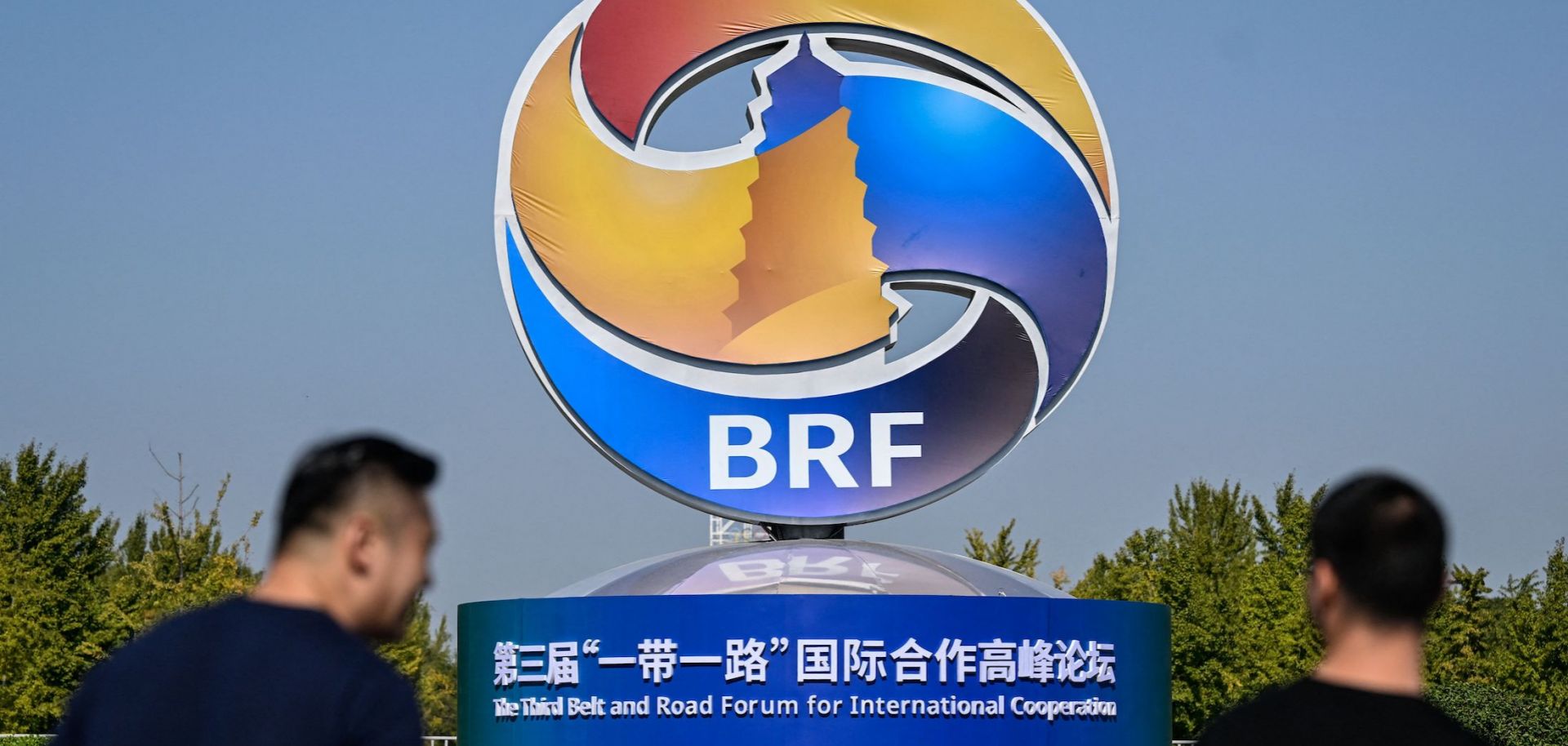
China's third Belt and Road forum will inform the future geographic and industrial focus of its overseas engagements, as well as Beijing's efforts to use the program to supplement China's economic development and wage strategic competition with the West. From Oct. 17-18, China will host its third Belt and Road Forum since it launched its Belt and Road Initiative (BRI) global infrastructure development strategy in 2013. Ahead of the forum, which will be held in Beijing, China's State Council published a white paper for the BRI on Oct. 10, which positioned Beijing as a defender of trade globalization, champion of Global South development, and bulwark against Western ''protectionism and hegemonism.'' That same day, China's Foreign Ministry announced that the Export-Import Bank of China (one of China's two largest BRI lenders) had reached a preliminary deal with Sri Lanka's government to restructure $4.2 billion of the country's debt, much of which stems from BRI projects. Weeks prior, Russian officials revealed that President Vladimir Putin would visit Beijing to attend the forum, which will only be Putin's second time leaving Russia since being issued an arrest warrant from the International Criminal Court in March 2023 for his alleged war crimes in Ukraine, with his first departure being a trip to Kyrgyzstan on Oct. 12.
- China's first BRI forum was held in 2017 and welcomed 29 heads of state, along with over 1,600 representatives from more than 140 countries, and over 80 international organizations. According to the State Council's white paper, the 2017 summit also resulted in 279 deliverables, including many memoranda of understanding (MOUs) on BRI projects.
- China's second BRI forum was held in 2019 and welcomed 38 heads of state, along with over 6,000 representatives from over 150 countries, and over 90 international organizations. The 2019 summit resulted in 283 deliverables.
- For China's third BRI forum, representatives from over 130 countries and 30 international organizations have confirmed their attendance as of Oct. 10, according to state-run outlet China Daily.
- Bloomberg reported on Oct. 11 that a number of European countries that sent representatives to the 2019 forum were not expected to attend this year's forum, including Germany, France, Greece, and the Czech Republic.
Since its inception, the BRI has served to accelerate China's economic development and status as a world power, as well as deepen Beijing's trade and political ties with other countries, especially those in the non-Western world. Chinese President Xi Jinping first revealed his vision for the BRI in September 2013 in Kazakhstan, including a Silk Road trade route across Eurasia and a Maritime Silk Road that connected China to the Mediterranean Sea via the Indian Ocean. The BRI has since served as both a continuation of previous leader Jiang Zemin's ''Go Out'' policy of foreign investment from 2000 and a unifying policy umbrella for modern China's disparate investment and construction engagements abroad, with the goal of positioning the country as a leader in global development. In addition to broadening China's access to strategic resources, the BRI is also aimed at enabling China to outsource excess construction and heavy industrial capacity (thus staving off domestic unemployment and the downsizing of state-owned enterprises), create and strengthen trade relationships with the non-Western world, and secure political support for Beijing's agendas in international fora, like the United Nations.
- Over the past 10 years, nearly 150 countries have signed onto BRI projects, on which Beijing has already spent around $1 trillion. But the initiative has not been without its problems. Accusations of Chinese companies not following through on local hiring pledges, polluting local environments, and facilitating political corruption are rampant, especially in African locales. Land rights disputes, as well as policy shifts that accompany government leadership transitions, have also delayed many cross-border projects, including the Pan-Asian Railway. Moreover, Western governments have accused China of buying votes in organizations like the United Nations by providing BRI projects to many poorer governments in the Global South.
Though Chinese investment in BRI peaked in 2018, there are signs it's picking back up. Beijing's recent BRI engagements remain focused on industries that can facilitate Chinese trade and access to strategic resources, but their geographical distribution suggests an intent to avoid containment by the West. Exact numbers on BRI investment and construction are hard to come by, given the extremely broad scope of the initiative and the secrecy clauses in many of the development contracts that Chinese state financiers ink with BRI signatory governments. Private sector efforts to aggregate data have suggested that China's BRI investment and construction activity peaked in 2017-2018. Beijing significantly scaled back project financing through 2021 as losses mounted from COVID-hit governments' inability to repay loans. In the last year and half, however, private sector data suggests BRI investments have started to recover as the pandemic ebbed. Both in the last six months and over the last five years, investment and construction data suggest that BRI projects have facilitated Chinese trade with a focus on extractive industries (e.g. metals and energy) and transportation (e.g. railways and ports). The geographical distribution of recent BRI engagements corroborates this goal, with resource development projects largely concentrated in resource-rich countries like Russia and those in the Arab Gulf. But this distribution also highlights China's strategic goal of avoiding containment by the West, as exemplified by BRI projects providing overland access to the Indian Ocean through Pakistan and the Pan-Asian Railway across Southeast Asia.
- U.S. think tank American Enterprise Institute's (AEI) Global Investment Tracker estimates that China's total annual pledged investment in BRI projects, based on corporate disclosures, topped out at $55.7 billion in 2018 and bottomed out at $23.8 billion in 2021. But investment has since started to pick back up, with 2022 seeing $30.5 billion and the first half of 2023 alone registering $23.8 billion. BRI construction project engagements, however, have lagged behind project investments in recent years; the total annual value of signed construction projects for BRI projects topped out at $73.3 billion in 2017, before declining to $38.2 billion in 2022 and $15.9 billion in the first half of 2023.
- According to AEI, the value of BRI investments totaled $152 billion between 2019 and mid-2023, while the total value of BRI construction in that period hit $202 billion, for a combined total of $354 billion. In that same time period, AEI classified just under $26 billion of those projects (7% of the total) as ''trouble transactions,'' in which investment or construction was inhibited after deals were signed. Broken down by industry, investments and construction projects in the energy sector comprised 36% of China's total BRI spending (or $128 billion) between 2019 through mid-2023, followed by transportation with $91 billion (26%), metals and mining with $46 billion (13%), and real estate with $29 billion (8%).
- The Green Finance Development Center of Fudan University (affiliated with China's education ministry) estimates that China's BRI activity has remained concentrated in the Middle East and North Africa, East Asia, and sub-Saharan Africa, both overall (2013-2023) and since 2020. The center's data also suggests that while West Asia (e.g. Pakistan) used to be a major destination, BRI investments in the region have tapered off substantially since 2019. In the first half of 2023, Indonesia was the largest BRI recipient with $5.3 billion worth of construction and investment, followed by Saudi Arabia ($3.3 billion), Peru ($2.9 billion), Tanzania ($2.8 billion), and the United Arab Emirates ($1.2 billion), according to AEI.
Chinese President Xi Jinping aims to use the upcoming forum to rejuvenate the BRI's image and China's engagement with the Global South, while casting the initiative as a tool in strategic competition with the West. In addition to being a cornerstone policy for Xi, the BRI is critical to many of his government's strategic goals, including expanding China's access to resources and trade. The decade-old initiative will thus continue and evolve with Beijing's needs. To that end, recent trends in investment pledges suggest China's BRI activity will recover even as the country's economic growth slows. They also indicate that Beijing will leverage BRI investments to both diversify China's energy trade partners (with Saudi Arabia and the United Arab Emirates being among the largest BRI recipients this year), as well as facilitate China's development into a world leader in renewable energy (with BRI investments in solar, wind and hydropower projects surpassing that of fossil fuels in the first half of 2023). In addition, BRI investments may augment China's efforts to bolster its tech dominance, despite Western export restrictions, by finding new consumer markets (and massive data sets) in the Global South, particularly via newer aspects of the BRI like the Digital Silk Road and Space Silk Road. BRI will be a primary vector for President Xi Jinping's global initiatives as well, including those focused on enhancing China's security ties, promoting its development model abroad, and increasing its soft power.
- President Xi aims to bolster three diplomatic initiatives with the BRI: the Global Security Initiative, the Global Development Initiative, and the Global Civilization Initiative. Together, these initiatives are aimed at establishing a global network of security partners that eschew Western ideas about universal human rights, welcome China's no-strings-attached development model, and increase China's soft power via media, language, and tech — particularly in less developed countries in Africa with underfunded media environments.
This third forum will inform the direction of BRI and how it serves to fulfill China's strategic ambitions under Xi, including China's ideological and economic competition with the West, but BRI's ability to alleviate China's geographic containment, amid growing tensions over Taiwan, remains limited. The MOUs that come out of the third BRI forum will inform the direction in which Beijing wishes to take the BRI in the coming years (in terms of both geographic location and industry focus), as well as the top areas of interest by signatory countries. Debt trap diplomacy — whereby China wields onerous debt to acquire strategic assets at bargain prices from BRI signatories — still seems to be a relatively minor phenomenon, with the most potent example being Sri Lanka's Hambantota Port. Nonetheless, Beijing is aware of this predatory reputation, which may be why China's preliminary debt renegotiation deal with Sri Lanka was announced the week before the start of the third BRI forum. The West, and especially the United States, still largely lacks a reciprocal response to China's BRI for global infrastructure development — and that's partly by design, given Western market-based economies. Thus, China's ability to be the dominant player in infrastructure development (and influence) in the Global South, and especially Africa, looks set to continue. The third forum may also reveal new Chinese initiatives to address BRI's challenges, particularly those related to environmental damage and local employment and skills transfer, which could help China combat criticisms of Beijing's ''new colonialism.'' Beijing's ability to wield the BRI to bolster China's political influence in international fora, like the International Monetary Fund and United Nations, will remain limited by Europe, the United States, and Western-allied Asian countries, which have outsized roles in these institutions and are increasingly skeptical of China's ability to serve as a responsible international stakeholder. Lastly, local bureaucratic gridlock and financial difficulties will remain a major obstacle to strategic, transcontinental BRI projects. However, China's transcontinental projects through less democratic regions, including Central Asia, may make more progress on this account, assuming security risks are kept in check. If Beijing opts to invade Taiwan in the next decade, China's limited progress so far on transcontinental transport corridors will perpetuate China's geographic vulnerability to Western maritime containment via the restriction of Chinese trade routes.
- In 2017, Sri Lanka leased Hambantota Port, a project financed by China Exim Bank (one of China's two primary lenders for BRI projects), to China Merchants Port Holdings Company Limited for 99 years in return for $1.12 billion. Colombo used the funds to cover its balance of payments issues, which were exacerbated by the country's BRI projects. As of 2023, 52% of Sri Lanka's $46.9 billion in foreign debt was owed to China.
- Putin's attendance at the upcoming summit in Beijing could suggest that Russia will play a larger role in BRI projects during Xi's third term, which could result in possible movement on Moscow and Beijing's long-stagnated gas deal via the Power of Siberia 2 pipeline. But it could also merely indicate that Russia remains the junior partner in its partnership with China, especially amid Moscow's ongoing diplomatic and economic isolation following its invasion of Ukraine; indeed, Putin may be attending the summit in the hopes of securing more BRI developments, rather than out of some already agreed expansion with Beijing.
