
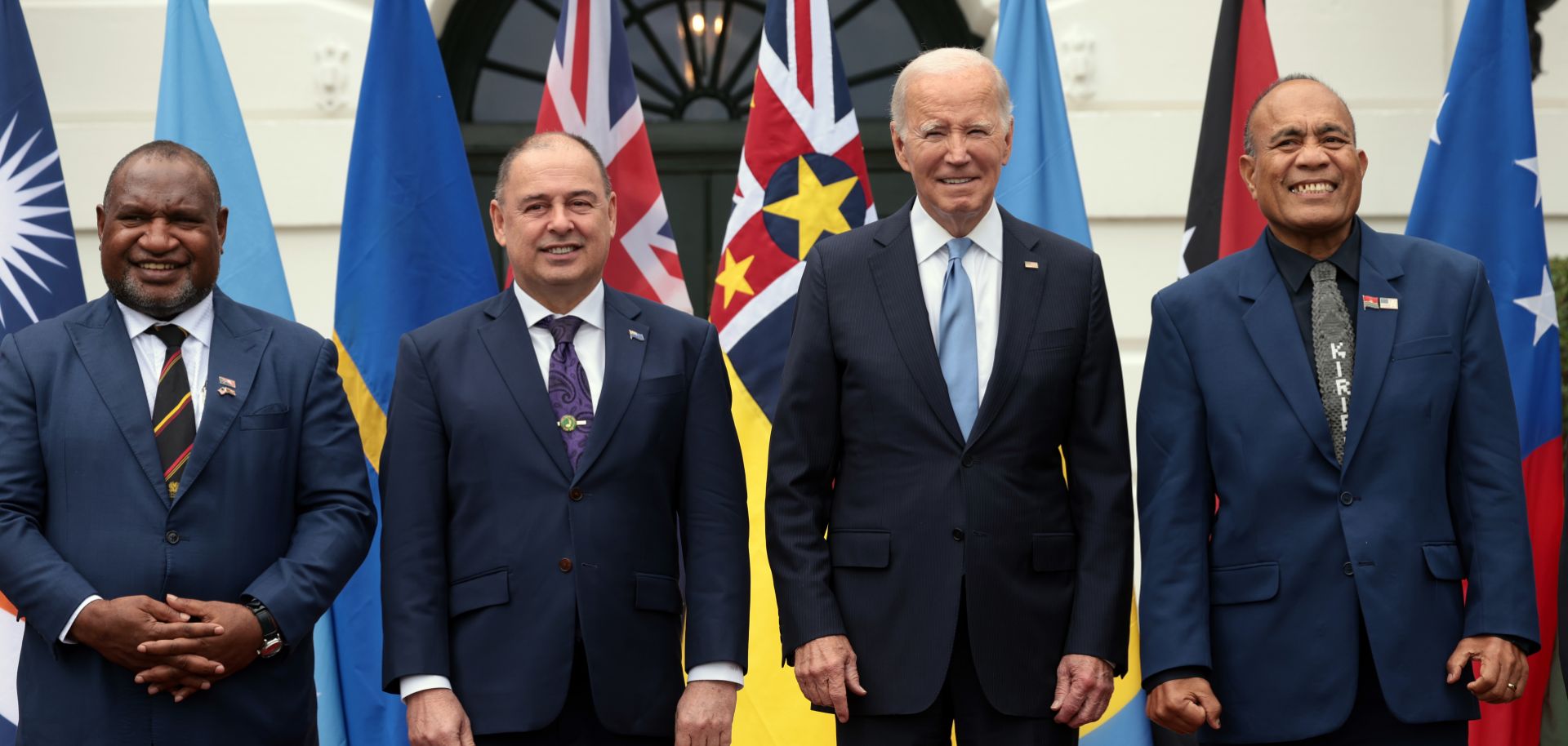
Papua New Guinea's Prime Minister James Marapeand, the Cook Islands' Prime Minister Mark Brown, U.S. President Joe Biden and Kiribati's President Taneti Maamau at the Pacific Islands Forum (PIF) as part of the U.S.-PIF summit at the White House on Sept. 25, 2023, in Washington, D.C.
The United States will continue taking steps to expand its economic, political and military influence in the Pacific islands, but delays caused by political deadlock could forestall further gains. The United States and the Pacific Islands Forum (PIF) concluded their second annual summit in Washington, D.C., on Sept. 25. At the summit, the U.S. government promised development and infrastructure aid packages totaling $200 million in new funds, a relatively large sum even when spread across 18 countries given these states' small economies. Most notably, the package includes $64 million in development aid and $40 million in infrastructure aid. The United States also announced its formal recognition of the Cook Islands and Niue, two small island countries that outsource their defense to New Zealand, as independent nations. According to Washington, its cooperation with countries and territories in Oceania is aimed at addressing climate change, protecting maritime boundaries and marine resources (a reference to illegal, unreported and unregulated fishing, specifically by China), and promoting "a free and open Indo-Pacific region." During the Sept. 25 summit, the countries also reaffirmed the 2022 U.S.-Pacific Partner Strategy, the flagship document that codified the U.S.-PIF partnership and the key deliverable of last year's inaugural U.S.-PIF summit. Moreover, on Sept. 28, media reports revealed that the United States is backing the construction of the Central Pacific Cable, an undersea internet cable covering thousands of miles that will link U.S. territories American Samoa and Guam before extending to 10 Pacific island countries and territories.
- The PIF is a multilateral organization encompassing 18 member states in the Pacific islands. The U.S. territories of American Samoa, Guam and the Northern Mariana Islands have observer status, demonstrating preexisting U.S. interest and involvement in the region.
- Solomon Islands Prime Minister Manasseh Sogavare was in the eastern United States for the U.N. General Assembly the week prior but skipped the 2023 U.S.-PIF summit in Washington. His government joined the China-backed Asian Infrastructure Investment Bank days later on Sept. 27. Vanuatu Prime Minister Meltek Sato Kilman Livtuvanu also skipped the summit.
- The countries that will connect to the Central Pacific Cable are the Cook Islands, the Federated States of Micronesia, Fiji, Kiribati, the Marshall Islands, Nauru, Papua New Guinea, Samoa, Tuvalu, and Wallis and Futuna.
Continued U.S.-PIF engagement gives PIF countries access to economic and environmental aid and enables the United States to counter Chinese influence. The current combination of great power competition in the Pacific islands and increased unity among the PIF's 18 members grants the bloc a strong negotiating position that will likely enable it to reach more robust agreements with Washington on trade, air travel and access to climate finance. Meanwhile, Washington perceives its influence in the region to be eroding as China makes regional inroads, highlighted by the Solomon Islands' and Vanutu's no-shows at the summit. In terms of infrastructure, China is ahead of the United States, as it has funded and constructed roads, ports, telecom towers and other assets in a variety of Pacific island countries. However, Chinese influence in the region is new and almost entirely channeled through its relationship with the Solomon Islands' Sogavare, meaning the relationship is not structurally deep. The United States, on the other hand, has deep, long-standing ties with several PIF countries. Chief among these ties are Compacts of Free Association (COFAs), which outsource participating countries' defense to the United States and gain them significant aid in return for exclusive maritime and basing access, with the Marshall Islands, Micronesia and Palau. These relationships give the United States a head start over China in terms of regional influence, and sustained U.S. attention on the region will be key to forestalling additional Chinese inroads.
- The United States fears that the Solomon Islands' 2022 security pact with China could eventually lead Beijing to station warships in the country. This could threaten U.S. holdings in the Pacific, as well as U.S. allies like Australia and the Philippines. These fears galvanized U.S. efforts to woo the PIF's 18 members in early 2022 with the U.S.-PIF summit and the U.S. Pacific Partnership Strategy.
- U.S. anxieties have grown since Aug. 26, when China sent police experts and equipment to Vanuatu to help keep the peace amid a controversial no-confidence vote that ousted the prime minister. New Prime Minister Kilman has often been accused of being too cozy with China, though he insists his intentions are neutral. This police agreement could signal that China is looking to enter into deeper security partnerships in the region, though Vanuatu has a military pact with Australia and not China.
Washington will seek to capitalize on its relatively advantageous position by offering climate assistance, opening new embassies and pursuing security pacts. On the heels of this summit, the United States will continue focusing on climate financing. This vector of assistance is strategically valuable to the United States and provides an advantage over China's infrastructure and investment projects in the region because rising sea levels pose an existential threat to Pacific island nations. The United States will also advance its efforts to expand its diplomatic footprint by opening more embassies in the region, most likely in Vanuatu and Kiribati. The U.S. initiative to connect the region via subsea internet cables will also provide needed critical infrastructure, in addition to being another emerging vector of geopolitical competition. Beyond the agreements made at the summit, the United States will aim to improve its regional strategic outlook by pursuing additional security pacts after signing one with Papua New Guinea in May. For example, the United States is negotiating with Palau to station Patriot air defense systems in-country, which Palau has requested.
- In addition to the 2022 reopening of an embassy in the Solomon Islands, the United States also opened an embassy in Tonga. However, these diplomatic missions are understaffed and have no ambassadors, limiting their intended impact thus far.
- The United States is reacting to years of alleged neglect in the region and regards "showing up" (having an active and permanent presence) as key to its ambitions, meaning each successive summit should produce additional measures intended to cement the U.S. regional presence.
However, U.S. politics risk halting or even reversing recent gains, which would open the door to greater Chinese influence. The U.S. Congress has yet to approve the majority of the $800 million in promised funding from the 2022 summit, sinking confidence among PIF countries that the additional $200 million pledged in 2023 will speedily arrive on their shores. Moreover, Congress has not ratified the Biden administration's agreements with Micronesia and Palau to renew their COFAs, which expire on Sept. 30. (The Marshall Islands is still holding out for additional compensation before agreeing to a renewal.) Congress' resistance to approving the Biden administration's promised funding and agreements is likely due to dysfunction amid budgetary standoffs, and the likely impending government shutdown in the United States would cause the COFAs to lapse, denying the United States exclusive access and basing rights across a massive swath of the Pacific Ocean. While there is no mechanism preventing these countries from signing new COFAs in the future, a prolonged government shutdown and attendant absence of funding (on which these countries economically depend) would damage the three Freely Associated States' economies as well as U.S. credibility. Over the long term, these impacts could open the door for more substantial Chinese economic aid to fill the void, which would lead to greater Chinese political and military influence.
- COFAs last 20 years at a time, and U.S. renewal negotiations with the Marshall Islands, Micronesia and Palau have been ongoing since March 2022.
- The 2022 U.S.-Pacific Partnership Strategy refers to the COFAs as the "bedrock of the U.S. role in the Pacific."
- Biden was set to become the first sitting U.S. President to visit a Pacific islands country when he was to attend the signing of the U.S.-Papua New Guinea security pact in May, but a federal debt ceiling crisis prevented him from going.
