
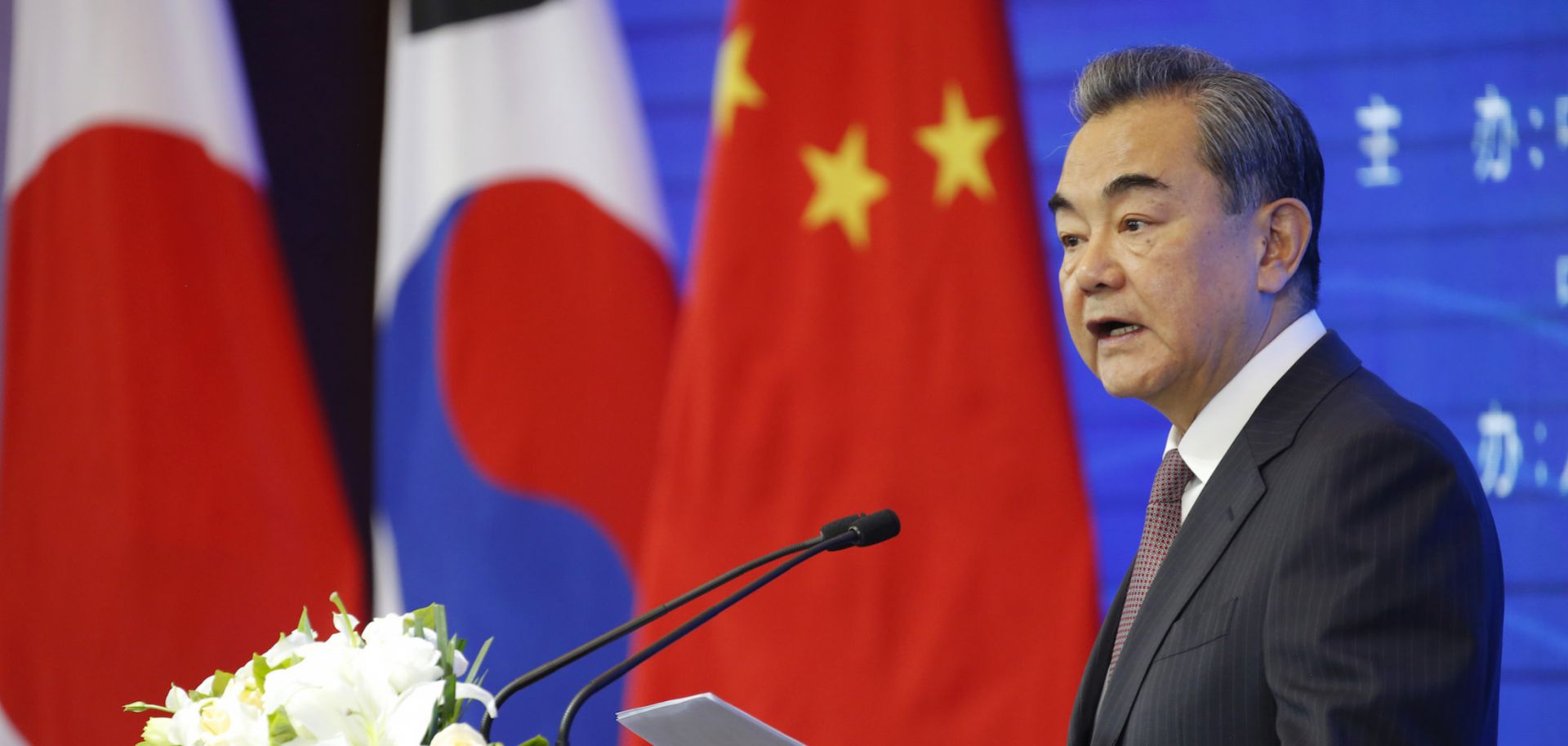
Chinese Foreign Minister Wang Yi speaks at the opening ceremony of the International Forum for Trilateral Cooperation that commemorated the 20th anniversary of trilateral cooperation among China, South Korea and Japan, in Beijing, China, on May 10, 2019.
Upcoming talks between China, Japan and South Korea confirm their interest in keeping communication channels open, but the talks are unlikely to spark larger moves that alter recently established regional security dynamics. Representatives from China, Japan and South Korea will meet in Seoul, South Korea, on Sept. 26 to review the status of their trilateral consultative body, the Trilateral Cooperation Secretariat, and reinstate the trilateral heads of state summit format. The meeting will be at the deputy foreign minister level, suggesting that the main purpose of the talks is to resume high-level in-person dialogue following the suspension of the secretariat and summit since the outset of the COVID-19 pandemic in 2019.
- Since the decline of the COVID-19 pandemic, regional tensions and disagreements have forestalled the summit's reconvening. These disagreements include a row between Japan and South Korea over compensation to wartime victims and a dispute between China and Japan over the latter's decision to empty treated nuclear wastewater into the Pacific Ocean.
- China's top diplomat, Wang Yi, urged the secretariat to reconvene at a high level during a more informal gathering of the group in Qingdao, China, in July, indicating China's eagerness for a partial diplomatic reset. Wang's South Korean counterpart backed these efforts in a phone call in August, and South Korean President Yoon Suk Yeol has also been active in putting the talks together. The three countries finally decided to move forward with formal talks after Kishida agreed to participate on the sidelines of the Group of 20 meeting in India in early September upon Yoon's urging.
As it emerges from its COVID-19-era isolation, China is reacting to U.S. efforts to deepen security ties with Japan and South Korea. Japan and South Korea held a trilateral summit with the United States at Camp David in August during which the three forwarded their security partnership by making progress on instituting real-time intelligence-sharing mechanisms, collaborating on ballistic missile defense and agreeing to conduct annual joint drills. The three countries also openly denounced China's assertiveness in the region. The United States has also pressured Japan and South Korea to curb or restrict high-tech exports to China (though only Japan has agreed). In addition, since coming to office in 2022 Yoon has pursued more hawkish policies toward China than his predecessor, aligning with Japanese Prime Minister Fumio Kishida's regional security goals. The ongoing rapprochement between Japan and South Korea has likely startled policymakers in Beijing who now perceive a need to counter U.S. alliance-building in northeast Asia while forestalling more disruptions to high-tech trade.
South Korea and Japan, for their part, are interested in keeping a dialogue open with China for security and economic reasons. For example, the trilateral summit will give Japan and South Korea the opportunity to discuss their concerns about expanding joint China-Russia bomber drills in the Yellow and East China Seas, as well as push China to discourage North Korean weapons tests. In such discussions, Japan and South Korea will have more leverage than usual due to their rapprochement and deepening U.S. ties. For Japan, this enhances its bargaining position by boosting its deterrence capabilities, and it will look to mitigate the fish import restrictions China instituted on Japan in August. Japan will also look to repair communication channels with China on the heels of establishing a military hotline in March, as well as maintain access to Chinese raw materials and rare earth elements. For South Korea, increased leverage will enable Yoon to carry on reversing the "three nos" policy of his predecessor, which Seoul used to gain China's favor in 2017 by promising to halt deployments of U.S. Terminal High-Altitude Area Defense systems (THAADs), participate in U.S.-led missile defense networks, or form a trilateral security partnership with the United States and Japan. The meeting will also boost South Korea’s international profile, a top priority for the Yoon administration, since it will host the event. Additionally, deep economic ties likely mean all parties are keen for a partial diplomatic reset. China is still the top trade partner of both Japan and South Korea, meaning neither country is eager to abandon ties with or unnecessarily antagonize their powerful neighbor.
- President Yoon recently broached the topic of North Korea with Chinese Premier Li Qiang at the Association of Southeast Asian Nations summit in early September, asking him to pressure Pyongyang to reel in its missile tests.
- Yoon has also been loudly broadcasting the aggressive actions and human rights abuses of North Korea as a core matter of his administration's foreign policy, rendering it highly likely that this will be a priority for South Korea as it reinvigorates dialogue with China.
The upcoming talks will likely succeed in reviving the trilateral heads of state summit format, but this avenue will not reverse recent Japanese and South Korean security initiatives down the road. If the three countries reinstate the summit, their primary avenue toward thawed relations will be economic, focusing on trade relations, tourism and manufacturing supply chains, among others. These economic negotiations will likely increase Japan's and South Korea's economic dependence on China, which could reel in some U.S. diplomatic gains. However, the three Asian countries are beginning to emerge as competitors in sectors such as automobiles and shipbuilding, and "friendshoring" initiatives are likewise reordering supply chains within emerging geopolitical camps. This means South Korean and Japanese businesses may want some assurances that China will not exercise significant economic coercion against them, which, if granted, could limit China's ability to force their hands. Regardless of their economic futures, Japan and South Korea are unlikely to diverge from their revamped national security policies, which are directly at odds with China's designs on Taiwan and the South China Sea. This means they will continue to modernize and upgrade their militaries, as well as seek more security cooperation with the United States. If the summit format unexpectedly falls through, it would signal that China's military threats and economic coercion are having serious diplomatic consequences that will keep tensions high between the three countries for the foreseeable future.
- China is Japan's and South Korea's top trade partner, totaling around $357 billion and $360 billion, respectively, in two-way trade in 2022. However, Japanese and South Korean exports to China have been declining in recent months, demonstrating their slowly diverging economic paths.
