
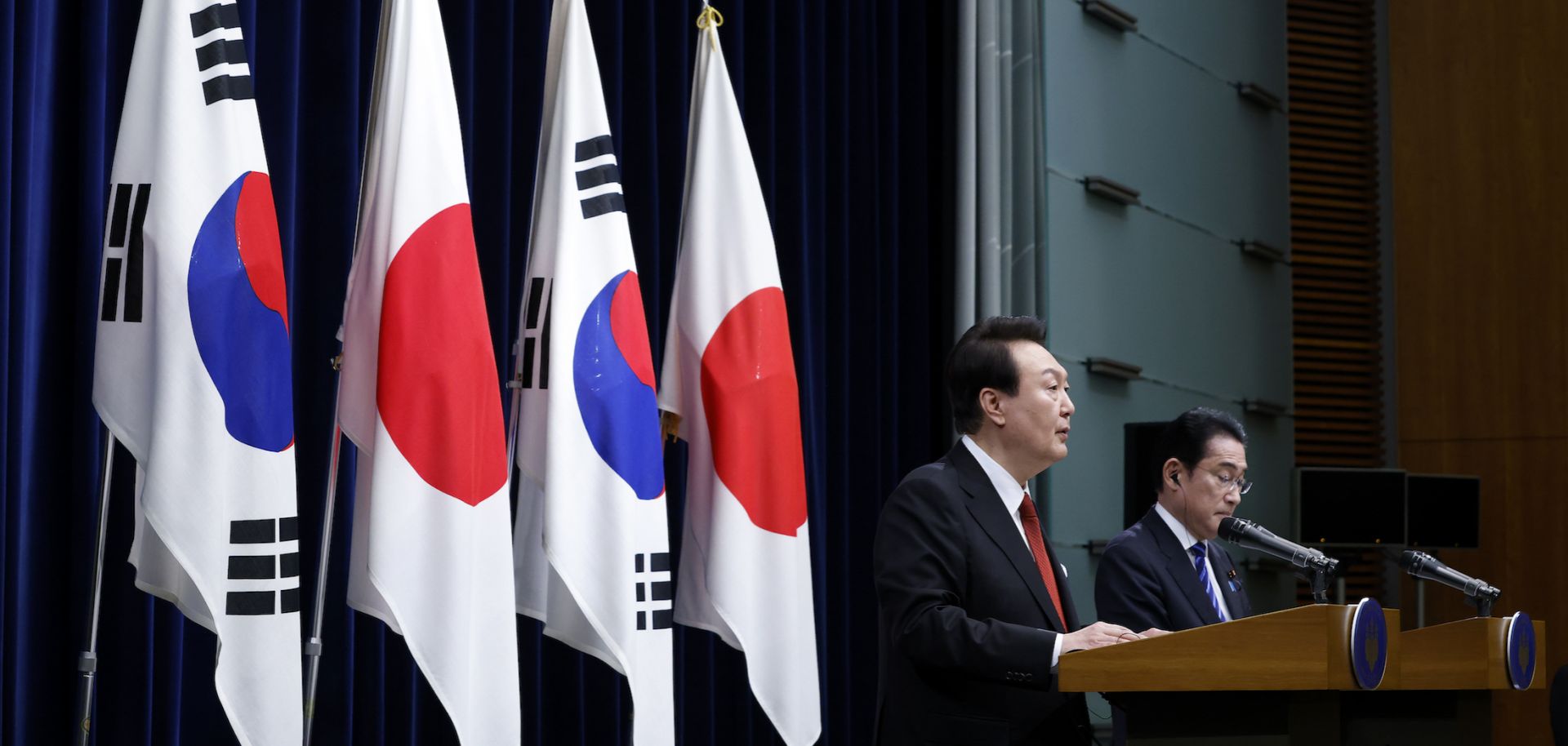
South Korean President Yoon Suk Yeol (left) and Japanese Prime Minister Fumio Kishida (right) attend a joint press conference on March 16, 2023, in Tokyo, Japan.
A recent summit between the leaders of Japan and South Korea marks a breakthrough in bilateral relations that is deepening their economic and security cooperation. However, unresolved issues and the prospect of a less amicable South Korean government may dim the long-term prospects for rapprochement. On March 16, Japanese Prime Minister Fumio Kishida and South Korean President Yoon Suk Yeol concluded a three-day summit in Tokyo that resulted in the signing of several economic and security cooperation agreements between the two traditionally acrimonious neighbors. Among other things, Japan pledged to remove curbs on its exports to South Korea of critical materials for smartphone displays and semiconductor chips. In exchange, Seoul promised to drop a World Trade Organization complaint against Tokyo about the export restrictions. The two also said they would restart the previously halted ''shuttle diplomacy'' of regular top-level visits between the countries and ''complete normalization'' of a military intelligence-sharing pact.
- Yoon is the first South Korean president to meet with a Japanese prime minister since 2011.
- On March 17, business leaders in high-tech sectors from the two countries pledged cooperation on chips and technology.
- South Korea and Japan plan to continue talks to reinstate each other to their ''whitelists'' of trusted trading partners. The two were each other's fourth-largest export markets in 2021, according to the International Monetary Fund; Japanese exports to South Korea totaled $52 billion, while South Korean exports to Japan totaled $30 billion.
The summit comes as the Kishida and Yoon administrations are trying to improve bilateral ties in the face of growing regional security concerns, despite the South Korean public's skepticism of their country's warming relations with Japan. Since taking office in May 2022, Yoon has prioritized mending ties with Tokyo, which shares Seoul's concerns about growing Chinese and North Korean aggression. However, the South Korean public remains skeptical of rapprochement with Japan due to long-standing grievances regarding the abuses conducted by Japanese troops during their occupation of the Korean Peninsula from 1910-1945. Yoon's predecessor, former South President Moon Jae-in, previously tried to force Japan into redressing these abuses, but Tokyo has largely refused to acknowledge any wrongdoing. In an attempt to resolve this standoff, the Yoon administration announced on March 6 plans to establish a foundation to distribute payments to wartime Korean laborers who filed lawsuits seeking compensation from Japanese companies, thereby releasing Japan from compensatory obligations and facilitating improved relations.
- The restrictions on South Korean exports that Japan recently agreed to lift were first imposed in 2019, after the South Korean Supreme Court ruled that Japanese companies must compensate South Korean victims of Japanese forced labor.
- The day after being elected in March 2022, Yoon said it was ''critical to find out what is in the best interests of Korea and Japan by restoring our ties in a future-oriented way instead of lingering in the past.''
- Despite the recent thaw in diplomatic relations, the South Korean navy will remain reluctant to collaborate with its Japanese counterpart, representing a particular security constraint. This is because the Japanese navy still flies the controversial Rising Sun flag that the Imperial Japanese Army and Navy used during its 1910-1945 occupation, which South Koreans see as emblematic of historic Japanese crimes.
The recent summit will bring near-term economic and security benefits to both countries, and forthcoming talks will likely build on this momentum. Of the agreements signed at the summit, those promoting trade will have the most immediate impact by bolstering supply chain resiliency. Additionally, the lifting of restrictions on Japanese materials for smartphones and chips will benefit South Korea's tech industry and economy, as well as open the door to collaboration with Japan on critical technologies. From a security perspective, the two countries' intelligence-sharing agreement will improve their ability to confront a multitude of challenges from China and North Korea, particularly the latter's missile program. Spurred by these developments, the recent thaw in relations portends more agreements between Seoul and Tokyo, with further talks on national security and economic security frameworks set to begin shortly after the summit, along with a potential reciprocal visit by Kishida to South Korea. Moreover, closer relations mean that the two countries should be able to deepen trilateral military cooperation with the United States, which has long pushed for closer Japan-South Korea ties to present a united front against China and North Korea.
- In April, Yoon will visit the United States, where he will likely push for considerations for taking the initiative to tear down barriers to Japan-South Korea cooperation. Among other things, Yoon will likely ask Washington to ease the negative impact of the U.S. Inflation Reduction Act on South Korean industries and to assist South Korea's developing space program.
- Following the March 16 summit between South Korea and Japan's leaders, the White House said it marked a ''groundbreaking new chapter of cooperation and partnership between two of the United States' closest allies.''
- The recent thaw in South Korea-Japan relations has already irritated North Korea and China. Pyongyang conducted multiple missile launches during the summit in Tokyo in a show of disapproval, while Beijing said it ''opposes attempts by certain countries to form exclusive circles.''
However, continued disagreements over wartime grievances will limit the extent of cooperation between South Korea and Japan in the long term. Yoon has openly expressed that he hopes Japan will reciprocate his compromises regarding compensation for forced labor victims (by, for example, having Japanese companies voluntarily contribute to forced labor compensation schemes). But while some small concessions are likely to materialize, Tokyo is unlikely to acknowledge historic wrongdoing to the extent Seoul desires, which would threaten to arrest momentum toward rapprochement and turn the South Korean public even more firmly against Yoon's efforts to restore ties with Japan. Yoon's conservative People's Power Party (PPP) is currently the only force that could push for rapprochement, as other South Korean political forces, including the main opposition Democratic Party (DP), have criticized Yoon's efforts to reconcile with Japan before Tokyo makes amends for its wartime abuses. For this reason, a future DP government would likely backtrack on gains in South Korea-Japan relations made by Yoon's government — constraining the long-term prospect of increased cooperation. The trajectory for South Korea-Japan rapprochement will thus remain strong for as long as Yoon is in office, potentially until 2027, but threatens to unwind should political sentiments among the South Korean public lead to returning the DP to office.
- Yoon was greeted with criticism immediately following the March 16 summit, with DP leader Lee Jae-myung calling the events ''the most shameful and disastrous moment in our country's diplomatic history.'' He added that Yoon is like ''a business owner selling his country.''
