
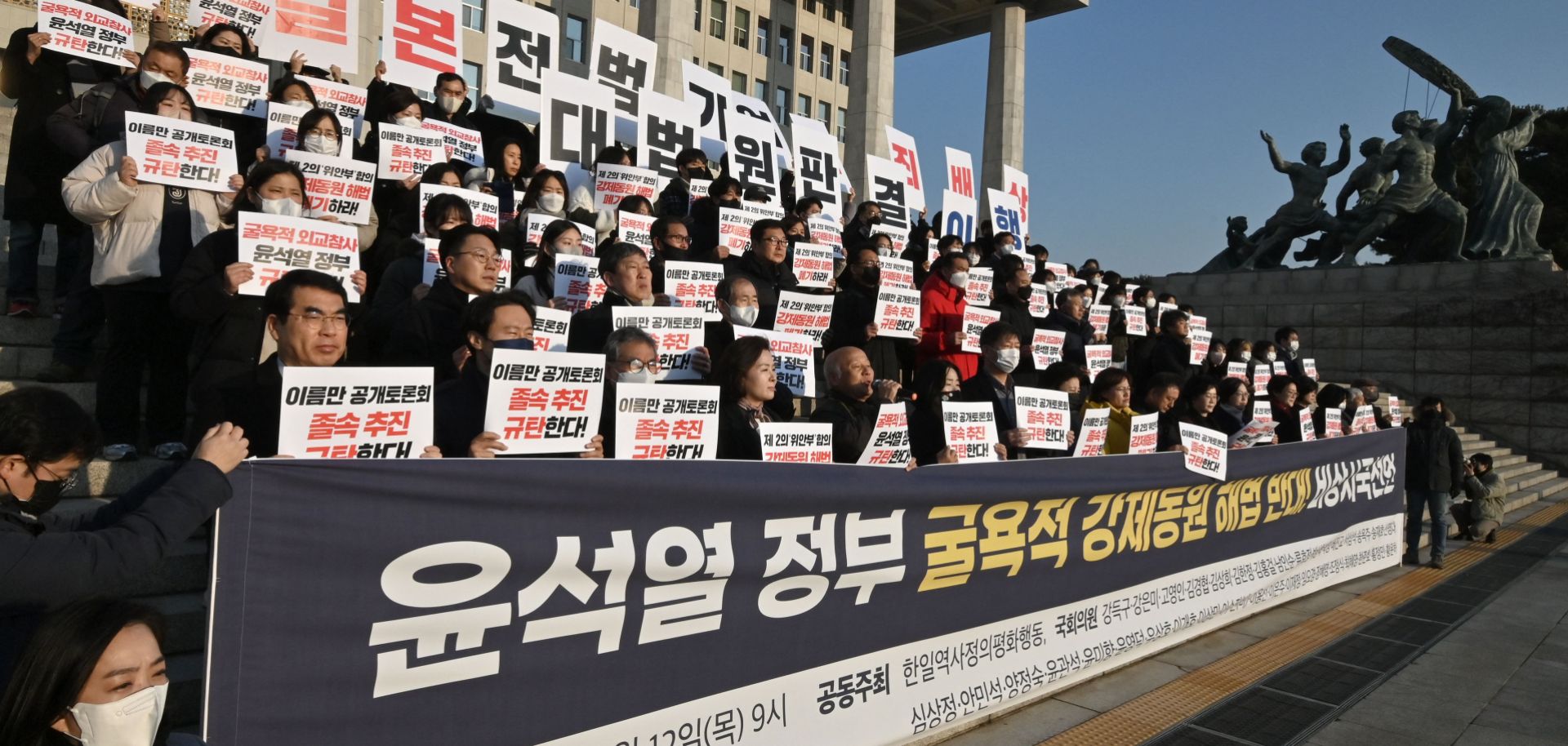
South Korean opposition lawmakers and supporters of the victims of Japan's wartime forced labor hold up placards during a protest against a public hearing on the issue at the National Assembly in Seoul on Jan. 12, 2023.
Seoul's push to have a Korean private entity compensate victims of Japanese labor violations will help South Korea and Japan to mend bilateral relations, facilitating cooperation on military activities against North Korea and China. On Jan. 12, the South Korean government announced that it was considering compensating wartime victims of Japanese forced labor through an independent South Korean fund to which relevant Japanese firms may voluntarily contribute. This workaround follows years of lawsuits that culminated in a 2018 South Korean court ruling. The ruling found Mitsubishi Heavy Industries and Nippon Steel guilty of forced labor violations during Japanese colonial rule (1910-1945) and ordered financial compensation, which could include seizing assets to pay the victims. The Japanese government and firms heavily protested the court decision, claiming the issues over forced labor were resolved in 1965. But the issue remains unresolved in the eyes of many South Koreans. The fallout from the 2018 ruling triggered a trade war between the two countries in 2019 that continues to this day.
- Japan claims all problems stemming from forced labor and human rights violations during the colonial and wartime era were resolved under the 1965 Treaty of Basic Relations, which saw Japan pay $300 million in aid and provide $500 million in loans to the South Korean government and South Korean companies, like POSCO Steel. However, South Koreans disagree and say that the treaty was signed under a dictatorship and thus is not necessarily valid and must be renegotiated.
- South Korea and Japan have been in a trade war since 2019 that started when Japan removed South Korea from its ''whitelist'' of favored trading nations following the 2018 South Korean court ruling. Seoul then dropped the term ''partner'' from its description of Tokyo in a defense white paper in 2021, which downgraded how much Seoul was willing to cooperate with Tokyo. Japan has also been whitewashing history in some textbooks, downplaying the occupation of Korea, which has further angered Seoul.
The proposal will be acceptable to Japan but unpopular in South Korea, and it may not last if South Korea's 2027 election yields a liberal president. Japan will likely approve the creation of an independent fund to compensate South Korean victims, as long as the requirements for compensation from Mitsubishi Heavy Industries and Nippon Steel are dropped. But it is likely the two companies will voluntarily contribute some money to the fund as a gesture of goodwill. This would enable the firms to save face and appear sympathetic to the victims without admitting guilt or responsibility. Since South Korea his government was the one that suggested it, President Yoon Suk Yeol's administration likely considers this to be an acceptable workaround to the 2018 court decision, despite opposition from influential domestic civic groups' who support the ruling. As long as South Korean courts do not deem the workaround illegal or unconstitutional, the plan will stand regardless of domestic opposition. There's a chance the agreement could be scrapped if the conservatives are unseated by a liberal presidential candidate in 2027 (which is when South Korea will hold its next general election) — similar to how in 2018 former liberal President Moon Jae-in scrapped a deal with Japan brokered by his conservative predecessor Park Geun-hye. But as the years go on, there will also be even fewer living victims and thus less political expediency to continue pursuing the issue, as it is more difficult to press legal claims on behalf of the deceased for financial compensation. This means that by the time a new prospective liberal government could take office in Seoul, there will be less political appetite to rehash South Korea's wartime grievances with Japan — increasing the likelihood of the workaround remaining in place, regardless of whether a conservative is elected president.
- In 2015, after negotiating with South Korea's then-president Park Geun-hye, Japan paid $8.3 million to settle the longstanding complaints from former South Koren ''comfort women,'' who the Japanese army used as sex slaves during World War II. Shortly after taking office in 2017, former President Moon Jae In refused to renew the agreement, effectively killing it.
- Liberal politicians in South Korea (like former President Moon) tend to be more hawkish toward Japan and more dovish toward North Korea, whereas conservatives (like current President Yoon) tend to be the opposite. During his time in office (2017-2022), Moon ramped up outreach with North Korean Leader Kim Jong Un and also sought to have Japan take more responsibility for its World War II-era atrocities (as evidenced by his move to scrap the 2015 deal on ''comfort women''). Yoon, by contrast, has sought to mend ties with Japan since taking office in May 2022, viewing Tokyo as a key strategic partner in the face of growing North Korean and Chinese threats (as evidenced by the Jan. 12 deal on forced labor).
Settling the wartime labor issue is the first step to restoring Japan-South Korea relations and increasing bilateral cooperation on shared strategic interests. Seoul and Tokyo have other outstanding issues that are unlikely to be resolved anytime soon, including their territorial dispute over an island chain known as Dokdo in South Korea and Takeshima in Japan. But if implemented, the new deal on forced labor could significantly help mend Japan-South Korea ties by easing what has been a major pain point in their relationship. Warmer ties would enable South Korea to start working with Japan's rapidly expanding military on bilateral naval exercises and/or a cohesive North Korea missile defense policy. Seoul could also use Japanese radar or satellite imagery for real-time intelligence sharing and targeting to support its ''decapitation'' strategy of destroying key North Korean military targets and leadership before Pyongyang can order a nuclear attack. Even if traditional military activities do not take place, increased intelligence-sharing on North Korean missile launches and real-time maritime territorial surveillance would help both countries better shape their respective defense strategies, and prepare for a Northeast Asian security situation that is not entirely directed by the United States.
- In light of North Korea's escalating weapon tests, South Korean Foreign Minister Park Jin on June 14 stressed the importance of repairing and continuing the General Security of Military Information Agreement (GSOMIA) between Japan and South Korea, which facilitates information-sharing on maritime activities and missile launches. GSOMIA has been in danger of being scrapped in recent years amid declining bilateral relations.
