
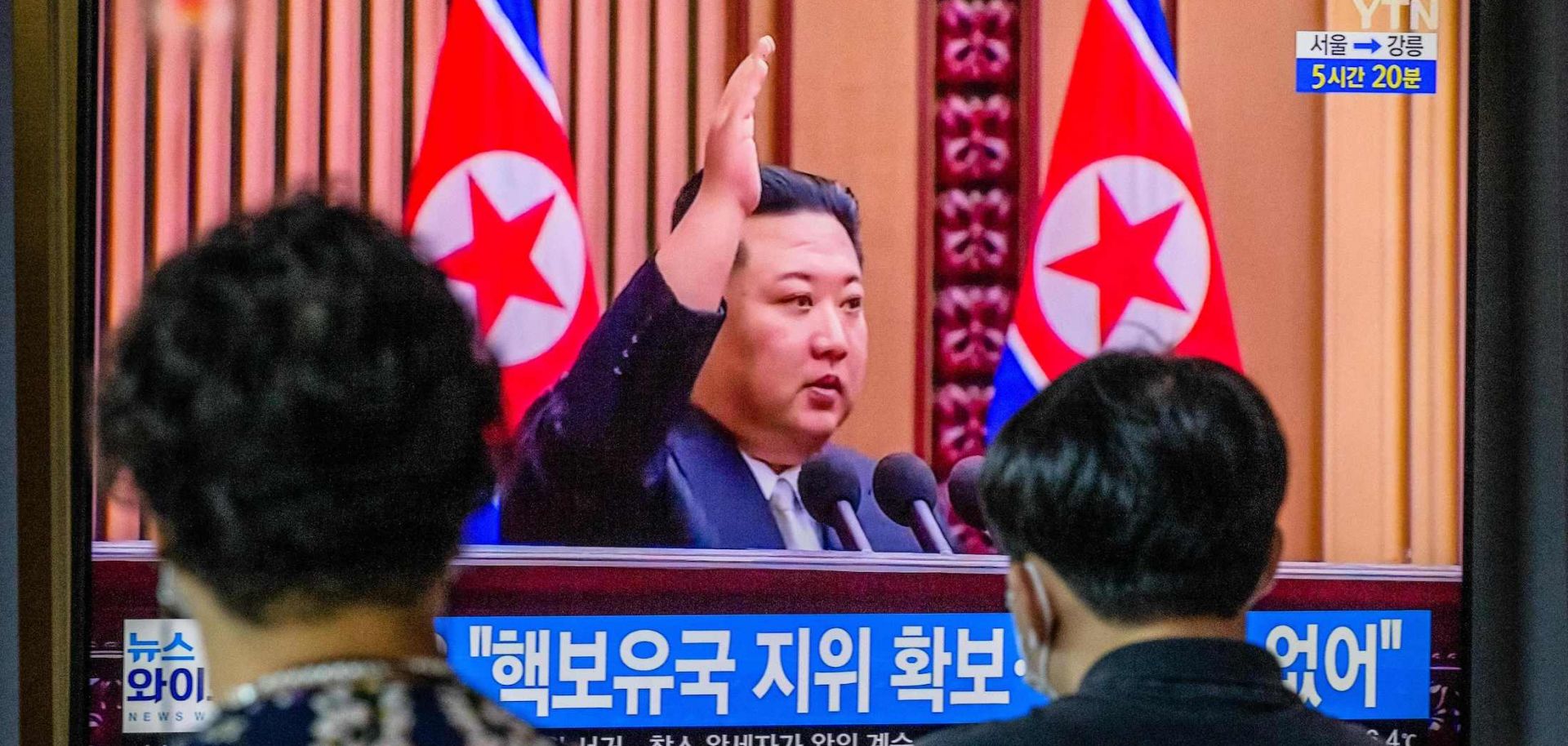
File footage of North Korean leader Kim Jong Un is seen on a television screen at a train station in Seoul, South Korea, on Sept. 9, 2022.
South Korea will likely react to North Korea's upcoming nuclear test with its own show of force, but the risk of Chinese retaliation and triggering another war with Pyongyang will limit how far Seoul can go in its response. Late last month, South Korea's National Intelligence Service (NIS) said it expected North Korea to conduct a nuclear test between Oct. 16 and Nov. 7. It's highly unlikely that South Korean authorities would have made this timeline public if they weren't extremely confident in their intelligence and had a response prepared. Since the test hasn't occurred yet, it's widely expected to happen within the next two weeks per the NIS timeframe. North Korea has not tested a nuclear weapon since it began a self-imposed moratorium on such tests in 2017 amid increased outreach to South Korea and the United States. But while notable, the restarting of North Korean nuclear tests does not inherently alter the security situation in the region since Pyongyang has already demonstrated it is a nuclear power with advanced, high-yield devices. This means that barring an exceptionally unlikely scenario in which North Korea conducts an unprecedented above-ground or atmospheric nuclear test, tensions on the Korean Peninsula will remain high but will not become critical. But while the test may not significantly alter the North Korean nuclear threat, South Korea's response will still be key in gauging the greater trajectory of Seoul's national security policies and relationship with Pyongyang.
- The last nuclear weapon that North Korea tested in 2017 was a supposed hydrogen bomb with an estimated yield as high as 250 kilotons. The bomb the United States dropped on Hiroshima in 1945, by comparison, had a 20-kiloton yield. The current U.S. arsenal of nuclear weapons includes the W80 and W87, which have yields of up to 150 kilotons and 300 kilotons, respectively.
South Korea will react to North Korea's upcoming nuclear test with an immediate display of force, while increasing military cooperation with the United States and Japan in the medium-to-long term. While North Korea hasn't tested a nuclear device despite signs it is fully prepared to do so, it has conducted over 40 tests of other weapons since the beginning of this year. South Korea has reacted to these recent weapons tests with proportionate demonstrations of military force, including by testing its own homegrown ballistic missiles. For South Korean President Yoon Suk Yeol, failing to react to North Korea's upcoming nuclear test with an even greater show of force than demonstrated in response to North Korea's ballistic missile tests would convey a major sign of weakness that would have disastrous domestic political effects, with Yoon's approval ratings likely sinking even further below its current 32%. It would also give North Korean leader Kim Jong Un a major propaganda victory by enabling him to claim that his Juche (or ''self-reliance'') strategy is working. In response to North Korea's nuclear test, Seoul will thus seek to showcase its military's capacity to conduct ''decapitation'' strikes against North Korean leadership from all sides with conventional weapons — likely by having South Korean naval vessels deploy airstrikes, ballistic missiles and/or long-range artillery against either island targets or dummy targets in the East Sea/Sea of Japan. In the medium-to-long term, South Korea will also look to speed up the development and deployment of a localized missile defense program similar to Israel's Iron Dome, and will seek to increase the size and scope of bilateral military drills with the United States. In addition, South Korea will look to potentially conduct bilateral military drills with Japan, which likely also use the nuclear test to further justify its own remilitarization efforts. Tokyo may even use the common threat of North Korea to broach new bilateral military cooperation with Seoul (though this could be complicated by the two countries' ongoing tensions over World War II-era grievances, like the use of forced labor and sexual slavery during Imperial Japan's occupation of South Korea).
- South Korea maintains a ''decapitation'' strategy as a conventional way to counter North Korea's nuclear weapons. This would see Seoul launching fast, precision airstrikes, bombing raids, surface-to-surface missile attacks and/or potential commando raids aimed at taking out North Korean leadership and key military installations before North Korea could react, if South Korean leadership believes that a nuclear attack is imminent.
- On October 4, North Korea tested a missile over Japan for the first time in five years. In response, South Korea conducted long-range rocket artillery and air strike demonstrations, and also tested one of its own homemade ballistic missiles.
- In 2021, Reuters reported that South Korea was developing its own indigenous missile defense system, using a combination of Patriot Missile batteries and Terminal High Altitude Area Defense (THAAD) batteries, with an expected completion date of 2035.
Fears of provoking painful Chinese retaliation, however, will ultimately limit the scope of South Korea's response to the North Korean nuclear threat. A growing number of South Koreans support an increase in deterrence against the North, which includes nuclear weapons. According to recent polls, roughly 70% of South Koreans support the development of a domestic nuclear weapons program, and more than half (56%) support rehosting U.S. nuclear weapons in South Korean territory. The placement of such deadly warheads so close to China's border, however, would infuriate Beijing, given the extremely grave security threat it would pose. Should Seoul make such a decision, China would retaliate more swiftly and painfully than it has to previous transgressions, like South Korea's deployment of THAAD batteries in 2017. For example, instead of boycotting a single South Korean industry (as it did in 2017), Beijing could introduce a blanket boycott on most South Korean goods. Alternatively, China could ban its nationals from traveling to South Korea, which would severely harm the South Korean economy. South Korea is also limited in its ability to conduct physical military actions against North Korea, as even a low-level shelling or strike on a military base or infrastructure could restart the Korean conflict by breaking the unsigned cease-fire. In addition, the United States remains highly unlikely to support a direct attack on North Korea, which would give China a stronger casus belli to build up its military forces and potentially speed up the timeline for an invasion of Taiwan by labeling the West as the aggressor, in addition to renewing the Korean war. And South Korea remains highly unlikely to conduct such an attack without first consulting the United States, since doing otherwise would cause irrevocable harm to Seoul's alliance with Washington. Given these risks, South Korea will thus refrain from taking any actions that could destabilize the region, despite mounting domestic pressure for a more hawkish approach to North Korea.
- Before COVID-19 disrupted travel, Chinese tourists in South Korea spent an average of $3,000 per person. In 2020 alone, the loss of Chinese tourists cost South Korea an estimated $2 billion in revenue.
- China has directly supported the development of the North Korean nuclear program and the impending test by continuing to send Pyongyang economic aid in violation of U.N. sanctions. This means that China will likely vote against any additional U.N. sanctions proposed in response to North Korea's upcoming nuclear test.
