
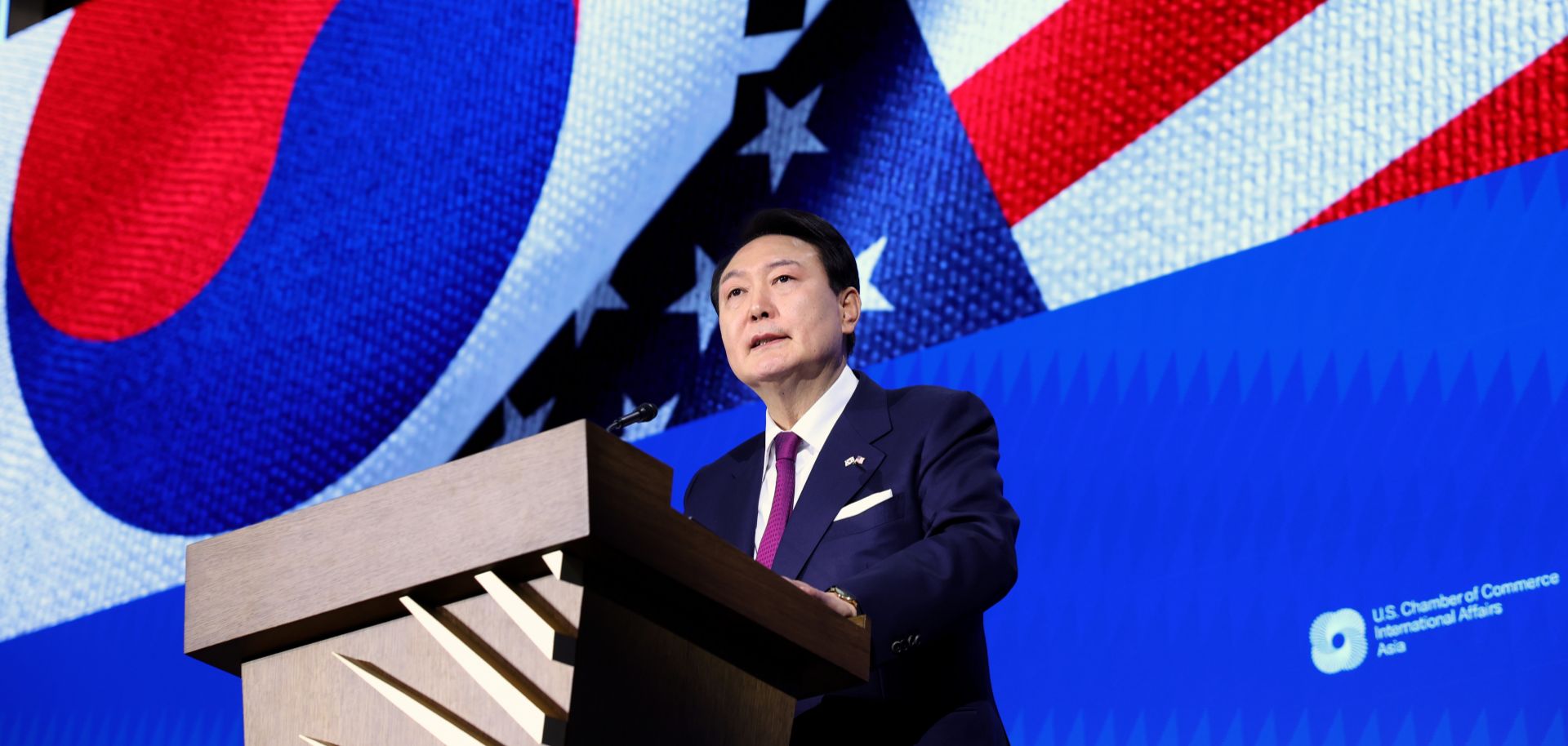
South Korean President Yoon Suk Yeol delivers remarks during a U.S.-Korea Business Forum at the U.S. Chamber of Commerce on April 25, 2023, in Washington, D.C.
South Korean President Yoon Suk Yeol's visit to the United States (which started on April 24) highlights his initiative to move the country from a passive to a more active international policy role. Despite ranking as the 10th largest economy by GDP in 2022, South Korea has long played a relatively low-key role in international politics and security. Seoul has instead largely focused on its domestic security (i.e., the threat from North Korea) and allowed the strength of the U.S. regional security presence to focus its attention inward on domestic economics. Yoon's first year in office marked a change in direction for the South Korean government, one that exceeded the initiatives of earlier conservative leaders but has not been without its challenges regionally and at home.
Since taking office in May 2022, Yoon has reinvigorated large-scale defense exercises with the United States, eased strained relations with Japan, and angered Beijing and Moscow with comments on Taiwan and Ukraine. Transitions from progressive to conservative governments in South Korea often see policy shifts aimed at strengthening relations with the United States and reconciling ties with Japan. Yoon, however, appears to be moving further and faster than his conservative predecessors. There is concern in Seoul that, as the U.S.-China strategic competition heats up, South Korea could find itself not only caught in the crosshairs, but also falling behind Japan as a strategic priority in the region.
The Passivity of the Past
South Korea has long played a relatively passive role in both regional and international relations. For much of the past 70 years, Seoul's primary security concern has come from North Korea. Until 1991, when the United Nations recognized both Koreas as sovereign states, Seoul had viewed tensions with the North as both the result of the lingering impact of the Korean (Civil) War, and the exploitation of North Korea by external Communist forces. As a frontline in the Cold War, South Korea counted on the large U.S. military presence to defend the nation. And in return, by the 1970s, Seoul used that security guarantee to focus on its internal economic development, similar to Japan's strategy during much of the Cold War. South Korea continued to play a more active role in its own national defense and in assisting U.S. military operations in Vietnam (unlike Japan). But as its economy grew, its willingness to engage in overseas military activity waned.
Over the past two decades, South Korea has emerged not only as a leader in heavy industry, shipbuilding and automobiles, but as a pioneer in the high-tech industry and, more recently, as a global cultural phenomenon (the so-called Korean Wave). Yet the country has done little to translate economic and soft power into regional influence, much less a proactive global role. South Korea's regional policies have often been couched in terms of how Seoul can help other countries learn to grow economically and evolve as democracies by studying South Korea's example. Even as Japan began taking a more active role in regional security and economic dynamics, Seoul remained largely focused on the Korean Peninsula, comfortable in a more passive role. In some ways, at least as far as foreign policy was concerned, South Korea continued to live under the old moniker for earlier Korean Kingdoms — a hermit.
What's Changed
The intensification of the U.S.-China rivalry has shifted the calculus in Seoul, at least as far as the Yoon administration is concerned. The government is no longer confident it can walk the line between strong economic ties with China and strong defense ties with the United States. Washington's targeting of the Chinese economy, particularly its focused actions against China's high-tech industry, has serious ramifications for South Korea's economic development and opportunities. Companies are being forced to make decisions between the Chinese and U.S. markets, and Yoon appears to be more willing than his predecessors to risk Chinese ire in favor of closer U.S. ties. South Korean companies may even be positioned to gain as the United States constrains Chinese firms and products — as a treaty ally with a free trade agreement in place, South Korean companies can take the place of Chinese suppliers and potentially bypass some of Washington's nascent protectionist policies.
Seoul, however, is driven not only by the broader economic implications of souring U.S.-China relations. It is concerned that Japan has finally broken from its economic malaise and self-imposed pacifism, and is repositioning itself as the regional counterpoint to China and the key U.S. ally in Northeast Asia. From a simplistic perspective, Japan and South Korea occupy nearly the same position: they both sit in Northeast Asia, they are both U.S. allies with large standing U.S. military forces and numerous bases, and they both compete in roughly the same industrial sectors. Both countries also depend on the United States for their national security, and are equally dependent upon the U.S. regional presence to secure key energy import routes and product export routes.
But unlike South Korea, Japan has steadily reshaped its military (officially its Self-Defense Forces) to take a more active role in regional security. In recent years, Tokyo has developed light aircraft carriers (which Japan designates as destroyers), expanded the range of its aircraft, and pursued longer-range missile systems. Japan has also expanded its defense equipment donations and sales, stepped up joint training, and taken a more active and intentional role in using its foreign aid and assistance to shape regional politics. Meanwhile, South Korea's focus on North Korea and fears of antagonizing China have limited its regional engagement, and Seoul's new Southeast Asia strategy remains constrained in concrete ambition. The Yoon administration is concerned that as China takes center stage in U.S. regional attention, North Korea will be relegated to a secondary or tertiary concern (similar to the waning though still present U.S. military attention in the Middle East), leaving South Korea less an ally in broader U.S. strategic interests than a place where U.S. forces are tied down and unable to be used for the broader regional strategy.
Yoon's frequent calls for extended deterrence from the United States highlight this concern that Washington may deprioritize South Korea. His rapid (and domestically controversial) reconciliation with Japan is also being driven by the need to strengthen South Korea's importance to the United States. Washington has long been frustrated by Seoul's apparent reticence to move beyond the era of the Japanese occupation of Korea, and the issue has concretely impacted trilateral intelligence sharing and training.
Yoon's comments to the Washington Post just before his U.S. visit reinforce this idea. In his interview with the U.S. outlet, the South Korean president highlighted the ability of European nations to move beyond World War I and II to work together now and move beyond history, and said he didn't agree with the idea that Japan ''must kneel because of our history 100 years ago.'' Through his actions and his words, Yoon is trying to convince the United States that South Korea has moved beyond history, that the problems of the past will not come back to interfere with trilateral economic and security cooperation, and that South Korea is not only a reliable ally but can also play a more active role in U.S. regional initiatives.
Weighing the Risks
Yoon's strategy is, of course, not without risk. As Australia, Japan and South Korea have already experienced, even small political, economic or security adjustments can lead to significant economic retaliation from China. When Yoon's predecessor, Moon Jae In, went ahead with the deployment of THAAD (an anti-missile system targeting North Korea but raising concerns that its radar system could also target China), it had lingering repercussions for the South Korean economy — from attendance at the Seoul Winter Olympics to the ultimate withdrawal of Lotte, a South Korean chaebol (conglomerate), from the Chinese market.
China is by far South Korea's largest trading partner, accounting for more trade than with the United States and Japan combined. And Beijing has grown adept at using both formal and, more often, informal means to add friction or disrupt market access and company operations. Seoul also risks being drawn into other economic or security conflicts, something it has sought to resist despite its close alliance with Washington (Seoul's reluctance to deploy forces to Iraq led to a small-scale withdrawal of U.S. forces from South Korea in 2004). Finally, Yoon's policies are not universally popular at home due to these concerns and opposition to his refusal to press Japan for another apology and additional reparations.
Should Yoon be successful, it would mark a significant change not only for South Korean policy, but for the geopolitics of the Asia-Pacific region. South Korea is the bridge between continental and maritime Asia; its economy is large, its soft-power reach is vast and its arms industry is making strides in the international market. For Seoul to live up to a new, more activist foreign policy, it must define a clearer strategy and consider a shift in its military structure and focus, adding impetus to naval and long-range aviation development. While South Korea has long been a U.S. ally, U.S. forces in Korea have been constrained to focusing on the North Korean threat. A change in South Korea's posture could also see a shift in the way U.S. forces are structured and used in the broader Indo-Pacific, changing the composition of forces and equipment. In the long run, it could reinvigorate South Korean support for future unification with the North, as a stronger, more active South Korea feels more confident of its capabilities and future.
