
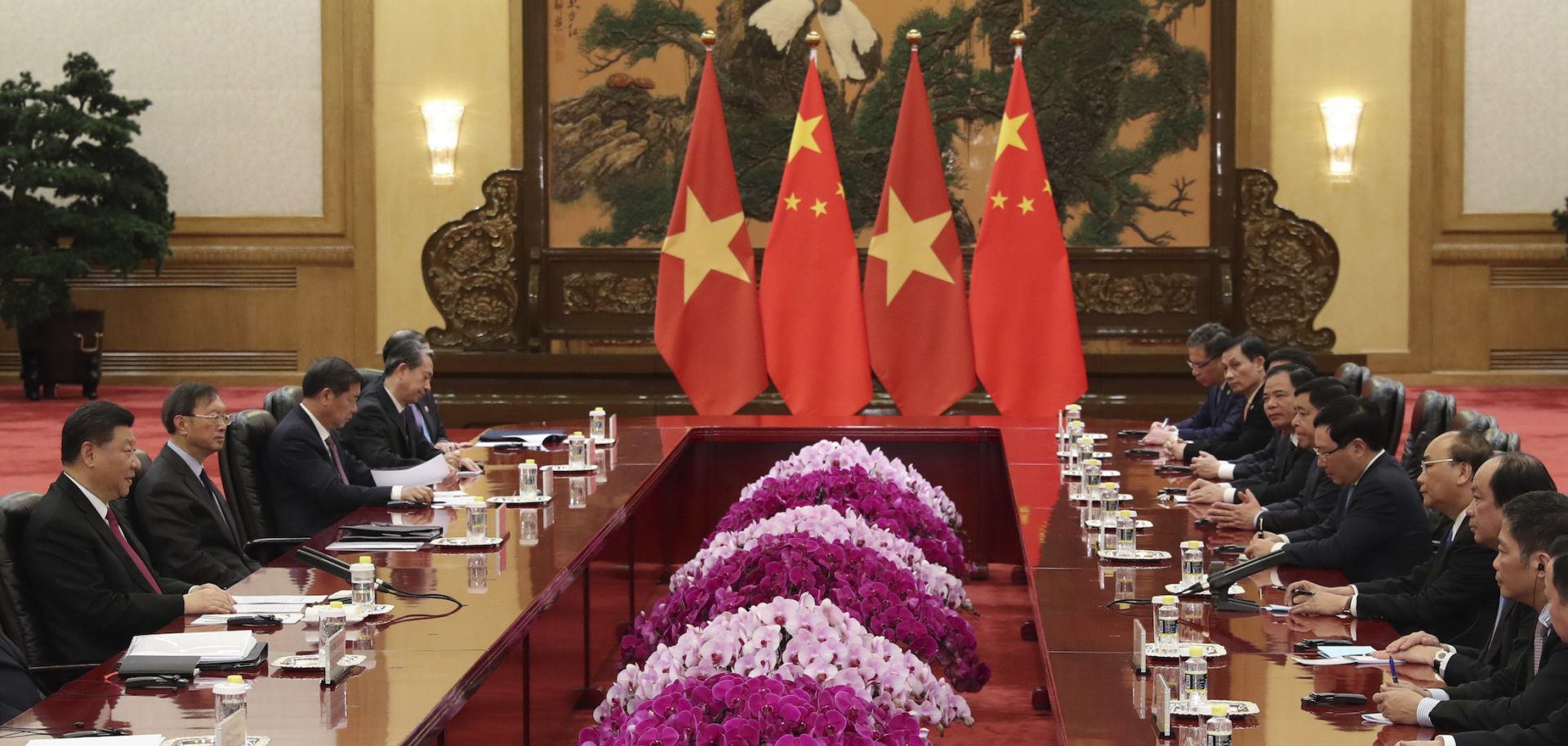
Chinese President Xi Jinping's visit to Vietnam will likely see the two countries agree to further integrate their supply chains and symbolically upgrade their relationship, which will benefit Vietnam amid the growing U.S.-China competition over rare earth minerals. Xi will pay a state visit to Vietnam on Dec. 12-13, his first visit to the country since 2017. During his trip, the Chinese president will meet with Nguyen Phu Trong, the General Secretary of the Vietnamese Communist Party, and, according to the Chinese foreign ministry, will ''discuss bringing China-Vietnam relations to a higher position.'' Chinese Foreign Minister Wang Yi visited Hanoi earlier this month, which likely involved finalizing a joint statement that will be unveiled during Xi's upcoming visit. During Wang's Dec. 1-2 trip, China and Vietnam also agreed to upgrade rail infrastructure and more thoroughly integrate supply chains, with a particular focus on rare earths, which Xi's visit will further iron out as well.
- China and Vietnam have seen a flurry of diplomatic activity since early November, with high-ranking officials holding various meetings in Beijing, Hanoi and Ho Chi Minh City to discuss the land border, trade, maritime issues and Chinese investment in Vietnam's high-tech sector.
- Vietnam holds an estimated 22 million tons of rare earth minerals, the world's second-largest deposits after China, according to the United States Geological Survey. The upgraded rail agreed to during Wang's recent trip to Hanoi will pass through a region in northwest Vietnam that is home to the country's largest rare earth deposits.
- Cambodian Prime Minister Hun Manet will also visit Vietnam Dec. 11-12, raising the possibility of a trilateral summit. It is probably not coincidental that Hun will be in Hanoi at the same time as Xi, as he may try to convince his Vietnamese counterparts to upgrade ties with China, Cambodia's top partner.
China is looking to rebalance its relationship with Vietnam following Hanoi's recent moves to upgrade its ties with Beijing's rivals, while Vietnam is hoping to appease China and forestall its potential coercion while benefiting economically. Vietnam has become the subject of a push by several regional and extra-regional countries for both geostrategic influence and business opportunities in rare earths and other emergent sectors. U.S. President Joe Biden's visit to Vietnam in September resulted in the two countries upgrading ties to a ''comprehensive strategic partnership,'' Vietnam's top-tier diplomatic classification, placing the country's relations with the United States on the same level as its ties with China and Russia. Vietnam also upgraded ties with Japan, a key U.S. ally in the region, to that same level on Nov. 27. These developments are driving a Chinese reaction whereby it perceives the need to manage its relationship with Vietnam, both to keep Hanoi from straying too far into a China containment bloc and to enhance China's own business interests and dominance over the rare earths market. To that end, Beijing is currently hoping that offering increased incentives, like helping Vietnam develop rare earths mining and refining technical knowhow while providing it much needed infrastructure upgrades, will deter Vietnam from developing security ties with its rivals. But if this carrot approach proves successful, China may resort to deploying its stick of overt coercion. Indeed, Vietnam's decision to upgrade ties with China's adversaries is risky in the sense that China has a wide variety of economic and military coercion methods at its disposal that it can use to compel Vietnamese behavior, requiring a balancing act on Hanoi's part.
- Vietnam will become the only country in 2023 to host the leaders of both the United States and China, and Xi's visit to Vietnam will be just his fourth overseas trip in 2023, which together hint at Vietnam's emerging geopolitical importance.
- Vietnam will likely upgrade relations with several other countries to top-tier status in 2024, such as Australia, Indonesia, Singapore and Thailand. The are four main reasons for this: 1) as a middle power, Vietnam is keen to secure relationships with a variety of countries in today's increasingly multipolar world; 2) Vietnam can no longer rely on Russia as its top partner and patron due to Moscow's deepening dependence on China; 3) Vietnam is in a position to extract economic benefits by playing the United States and China against each other; and 4) boosting ties with other regional countries helps bolster Vietnam's maritime security.
- The United States and its allies, such as Japan and Australia, are helping Vietnam develop its rare earths sector, which lacks much of the technical know-how necessary to fully capitalize on the country's rich reserves. For example, Washington is supporting a plan where Vietnam will auction off its main rare earths mine for investors in 2024, potentially enabling the mine to be bought by a U.S. (or Japanese, Australian or European) company, an example of ''friendshoring.''
- The United States currently mostly exports its own raw rare earths to China for processing and wants Vietnam to develop the metallurgy sector necessary to serve as a replacement. Relatedly, South Korea signed a rare earths agreement with Vietnam in June. Japan has stepped up rare earths exploration efforts in conjunction with Vietnam's General Department of Geology and Minerals.
- China has over 90% of the global rare earth supply. This situation has raised concerns for businesses that rely on China for such minerals, mainly the United States, Japan, South Korea, Australia and Europe. In August, China issued export restrictions on gallium and germanium (which are not rare earth minerals but are still needed for many of the finished products relevant to the rare earth supply chain). In October, China also banned the export of some graphite products, further crunching global supply.
Upgrading ties will deepen China and Vietnam's economic interdependence and keep the two countries' South China Sea dispute in a holding pattern. Upgraded ties will likely come in the form of Vietnam joining China's ''Community of Common Destiny'' as Vietnam's Mekong neighbors Laos, Cambodia and Myanmar have done in recent years. During Xi's last visit to the country in 2017, Vietnam reportedly rejected an invitation to join a Community of Common Destiny, which is a foreign policy concept that actively forwards the notion of Southeast Asia being firmly within China's sphere of influence. Since confirming their commitment to China's vision for a Community of Common Destiny in 2017 and 2018, respectively, Laos and Cambodia have also tended to oppose Vietnam (and other South China Sea claimants) on issues related to the disrupted waterway within the Association of Southeast Asian Nations (ASEAN); and in exchange for their political support within ASEAN, China has offered Laos and Cambodia continued economic and diplomatic support. Vietnam had previously been cautious about upgrading its ties with China for fear that it would enable Beijing to gain too much influence in the country, which could also risk triggering civil unrest given the Vietnamese population's general antipathy toward China, as evidenced by prior large-scale protests against Chinese business interests in the country. Hanoi had previously been cautious about elevating ties with the United States for similar strategic reasons (i.e. not drawing China's ire). As Vietnam has moved on from its skepticism of upgrading ties with the United States, it likely has calculated a need to make a corresponding move with China. This means that, practically speaking, Vietnam forming a Community of Common Destiny with China will provide a more streamlined mechanism for economic cooperation and implies that China will be more active in large-scale Vietnamese infrastructure projects. This includes the upgraded rail line, which, if the two countries formally upgrade ties, will likely fall under China's Belt and Road Initiative and come in the form of non-refundable aid, a major concession on China's part. Moreover, China's aspirational Community of Common Destiny framework lacks structural commitments, which implies that Vietnam will seek to reap economic benefits while continuing its multidirectional foreign policy, and holding firm to its South China Sea claims and ongoing land reclamation projects therein. At the same time, the economic incentives will deter China from undertaking economic or military coercion that would risk pushing Vietnam further into the U.S.-led China containment camp (in contrast to the Philippines), thus lowering the risk of confrontations at sea.
- Coined in 1997, China's Community of Common Destiny framework is broadly intended to serve as an alternative foreign policy mechanism for close bilateral relations based on Chinese principles of non-interference in internal affairs. The phrase has taken on new proportions under Xi, which is now China's most important foreign policy formulation.
- The Kunming-Haiphong railway, built by France between 1904 and 1910, is not interoperable between borders, creating a major supply chain inefficiency by forcing passengers and cargo to detrain at the Chinese-Vietnamese border. Other infrastructure projects China can undertake in Vietnam under its Community of Common Destiny framework include a north-south high-speed rail (similar to the ones it has built in Indonesia and Laos) and a north-south highway.
These developments open Vietnam to direct competition for its rare earths between China and the United States, which broadly benefits Vietnam but could expose it to U.S. countermeasures, like trade restrictions. Both the United States and China want to utilize Vietnam's vast supply of rare earths by integrating supply chains for use in electric car batteries, solar panels and other emergent technologies — meaning that in addition to geopolitical competition, the two major powers will also compete for access to Vietnam's rare earths deposits. This competition represents an opportunity for Vietnam by driving each major power to help develop the country's rare earths sector (in addition to other high-tech industries such as semiconductors). Given its current reliance on Chinese rare earth minerals, the United States is looking at Vietnam as a potential alternative supplier to preempt China invoking more trade restrictions or otherwise seeking to cut Washington off from its supply. And as of now, there is no alternative rare earth supply chain for the United States. But Vietnam's attempts to take advantage of the U.S.-China competition by having both countries build out its mining capacity could eventually expose Vietnam's rare earths sector to U.S. trade restrictions. Indeed, the United States already has restrictions on importing rare earths from countries where China is dominant over the sector, and could impose such measures on Vietnam once Chinese mining and refining operations get underway — particularly if former U.S. President Donald Trump secures another term in 2024, given his propensity for protectionism. Such a scenario could also see Washington enact a law banning the import of Chinese rare earths, which could apply to Chinese companies that mine and refine rare earths in Vietnam.
- The upgraded rail line China is planning to help build would enhance mining and processing operations between the two countries and boost Vietnamese exports to China, particularly agricultural products; it would also bolster Chinese tourism to northern Vietnam while synergizing the two countries' manufacturing systems, already complementary in that Chinese components are frequently exported to Vietnam for assembly into finished products.
