
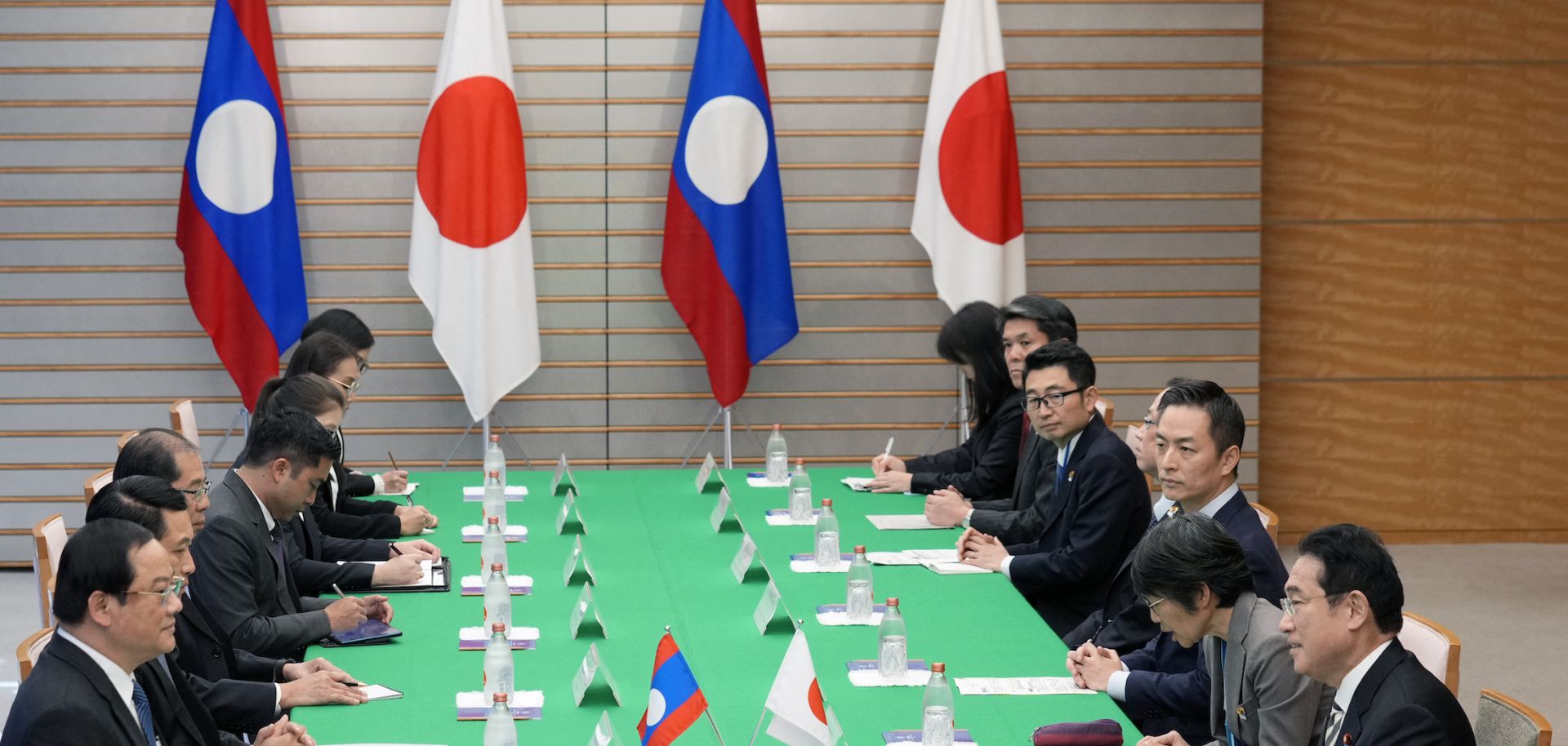
In its term as chair of the Association of Southeast Asian Nations, Laos will likely fail to make significant progress in resolving the civil war in Myanmar or coordinating a unified response to increasingly militarized territorial disputes in the South China Sea. However, Laos will forward the bloc's economic interconnectivity, particularly via digital platforms. Laos became ASEAN's chair on Jan. 1 and will face three primary challenges during its term: the civil war in Myanmar, the South China Sea disputes and the implementation of "ASEAN centrality" doctrine, which broadly refers to the bloc's aspiration to become a geopolitical pole driving its own destiny. Although Laos — like ASEAN's previous chair, Indonesia — will likely struggle to address many aspects of these challenges, the country will use its ASEAN chairmanship to forward its national interests.
- The handover represents ASEAN's wealthiest and most capable member, Indonesia, transferring the chairmanship to the bloc's poorest and least capable member (excluding Myanmar), Laos.
- The first major event after the handover will be the ASEAN foreign ministers' retreat from Jan. 28-29.
Laos' institutional weakness will likely prevent it from taking a firm stance on Myanmar's civil war, but it could organize police action against organized crime groups in the region. In contrast to all other ASEAN chairs since Myanmar's 2021 coup, Laos borders Myanmar, making it particularly vulnerable to the ill effects of the war, including the rapidly growing narcotics trade, as well as to the ruling junta's discontent. As a result, Laos will be careful not to upset the Myanmar junta, likely leaving the ASEAN-backed five-point consensus peace plan to which all sides agreed in 2021 unenforced. Laos also has another reason not to push the plan, as doing so could offend influential ASEAN member Thailand, which maintains friendly relations with Myanmar's junta. If that were not enough, Laos is unlikely to be sympathetic to ethnic Myanmar resistance fighters given its extensive efforts to suppress Hmong separatism within its own borders, and its one-party dictatorship has little to no interest in restoring democracy abroad. Nonetheless, Laos could organize collective action to combat organized crime emanating from Myanmar and increasingly rooted in Laos, including scam centers and the drug trade. However, these efforts would likely fall well short of comprehensive peace, meaning if Myanmar resolves its civil war in 2024, ASEAN is unlikely to be the cause.
- Laos has supported Thailand's unilateral diplomatic engagement with the Myanmar junta. However, ASEAN members Indonesia, Malaysia and Singapore claim such engagement undercuts ASEAN centrality, Indonesia-led efforts to isolate the junta and the unanimously established peace process.
- Laos appointed a special envoy to Myanmar on Jan. 1 but has consistently upheld the ASEAN tenet of non-interference in member states' domestic affairs, likely rendering the envoy's appointment insignificant.
Additionally, Laos' indebtedness to China will impede any efforts to resume negotiations over competing maritime claims in the South China Sea. Negotiations between ASEAN and China over the South China Sea Code of Conduct, which would govern behavior in the contested waterway, stalled and ultimately failed under Indonesia in 2023. Though the dispute has gone without a framework for conduct for decades, escalating tensions in the waterway in recent years have led many regional countries to upgrade their navies and other military capabilities to defend their claims, making a final agreement more urgent. Laos is unlikely to make progress on restarting talks over the code of conduct due to its weak negotiating position, as it owes China billions of dollars related to infrastructure projects and is in the midst of an economic crisis, and its neutral stake in the matter as a landlocked country beholden to both China and ASEAN. Laos also does not want to upset its Southeast Asian neighbors, particularly Vietnam with which it has had a treaty alliance and a "special relationship" since 1976, by taking a firm stance. This means the long-negotiated South China Sea Code of Conduct remains unlikely to come to fruition in 2024, and Laos is also unlikely to endorse Philippine-led efforts to craft a separate code of conduct among ASEAN countries that excludes China. Instead, Laos will likely treat disputes as bilateral issues by directing ASEAN to take a neutral stance and allowing claimants to negotiate among themselves.
- Laos has borrowed billions of dollars from China in recent years to finance infrastructure projects such as rail and hydroelectric dams, driving its public debt to more than 100% of gross domestic product. This debt has forced Laos to relinquish a share of its national power grid to China. It is also coping with an inflation crisis, averaging 31.2% throughout 2023, according to the Lao Statistics Bureau.
- In November 2023, the Philippines began courting other ASEAN members to craft a separate South China Sea Code of Conduct without China. Indonesia, Malaysia and Vietnam could be interested, but these efforts will likely stay at the bilateral and minilateral level due to Laos' lack of support.
- In 2016, the last time Laos was ASEAN chair, it promulgated a generic joint communique on the South China Sea that struck a neutral tone, calling on all parties to maintain peace and stability. In practice, this defers the issue to the next chair.
China's influence will also constrain Laos' ability to further ASEAN centrality in terms of hard power. Under Indonesia, ASEAN increased its unified military action, as seen in September 2023's first all-ASEAN joint military drills. The drills were a strong statement of ASEAN centrality in a region where countries fear being forced to take sides in great power competition, and other groupings such as the Quad and AUKUS threaten to eclipse ASEAN's relevance. However, Laos will be less interested in exercising ASEAN's hard power, as doing so could lead to Chinese retaliation that further devastates Laos' economy. Additionally, Laos' motivation to expand ASEAN's maritime military action is small since it is a landlocked country, and its geography renders grand strategic concepts like the Indo-Pacific less relevant to its interests. Therefore, Laos will likely ensure that any ASEAN maritime drills in 2024 keep provocations minimal, likely by holding them outside the contested South China Sea and exclusively focusing on humanitarian missions, if they occur at all.
- The military drills, named the ASEAN Solidarity Exercise, were a maritime exercise primarily focusing on humanitarian assistance and disaster relief, though a logical next step to build ASEAN hard power would be to introduce combat elements, which Laos is unlikely to do.
However, Laos will support the ASEAN centrality doctrine in terms of economic connectivity. Laos chose a theme of "Enhancing Connectivity and Resilience" for its ASEAN chairmanship, underscoring the country's desire to grow economic links between ASEAN members. These links include de-dollarized cross-border trade mechanisms and connected digitalization such as cybersecurity collaboration; easy application processes for e-visas and visa-free travel; stronger digital trade and e-commerce platforms throughout ASEAN; and digital infrastructure such as data centers, high-speed internet, cross-border data flows, and e-government services designed to serve ASEAN citizens. Laos is interested in reaping the benefits of this interconnectivity, which is increasingly critical to Laos' stability amid its economic crisis. Therefore, Laos will likely forward digitalization and connectivity via the ASEAN Digital Economy Framework Agreement, inked in September 2023. It will also look to advance the de-dollarization initiative that began in 2023 by expanding its usage and implementation throughout the region via digital infrastructure networks. Additionally, Laos' geography lends itself to overland connectivity, so it will look to develop more physical infrastructure, such as by beginning construction on the Laos-Vietnam railway, approved in October 2023. Laos will also continue working toward its ambition to become the "battery of Asia" by exporting hydropower to its neighbors, especially given energy market instability around the globe.
- In May 2023 at the 42nd ASEAN summit in Indonesia, ASEAN members unanimously agreed to promote the use of "local currency transactions," a digital mechanism whereby buyers and sellers within ASEAN can conduct cross-border transactions in local currencies.
- Laos announced on Jan. 8 that it will upgrade the Nong Khang Airport to service international flights.
