
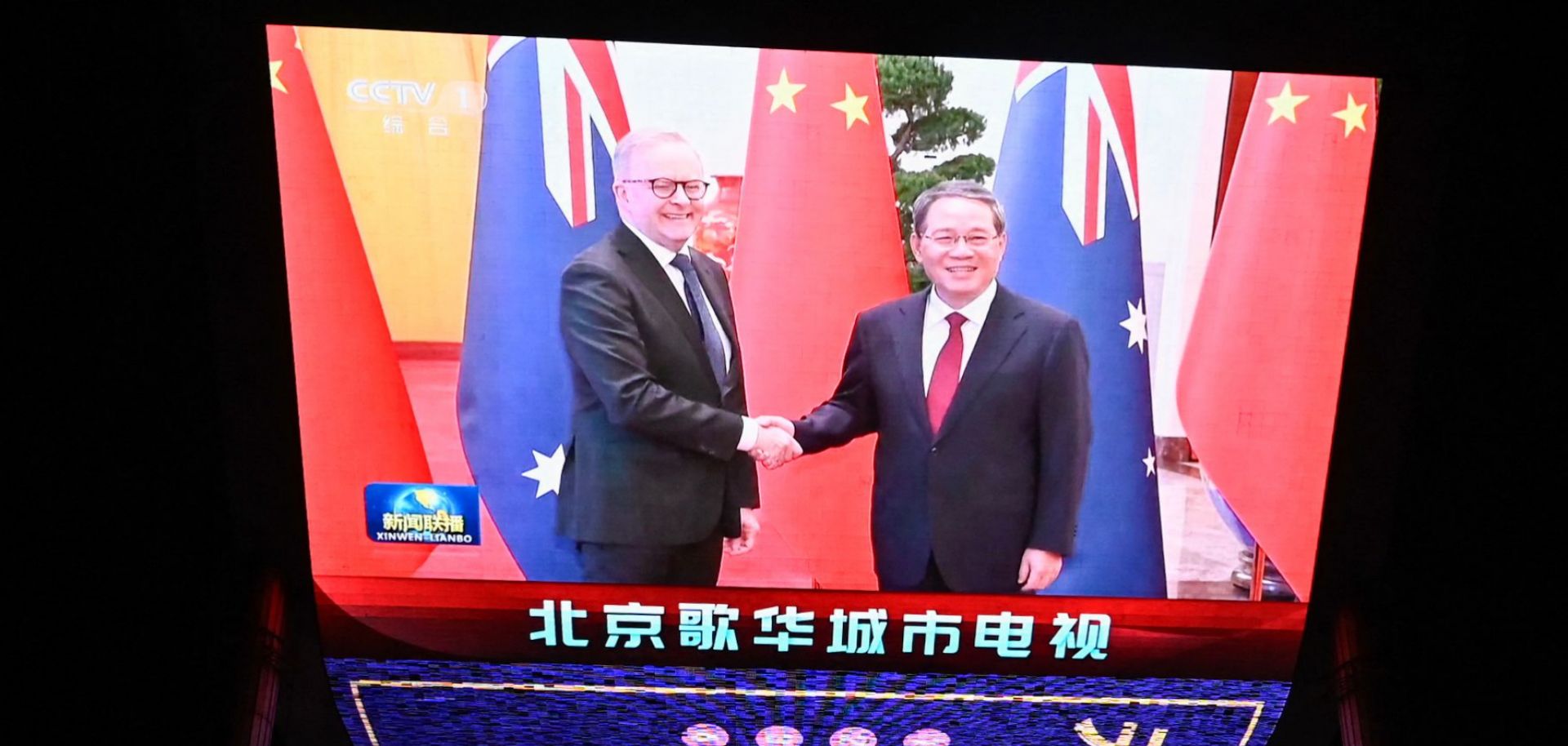
The Australian prime minister's recent visit to China represents the reset in relations both countries have sought since last year, but any gains may be short-lived as constraints to rapprochement abound in the form of contradicting national security policies. On Nov. 6, Australian Prime Minister Anthony Albanese met with Chinese President Xi Jinping in Beijing, becoming the first Australian prime minister to do so since 2016. Both leaders came away from the meeting with glowing reports, with Xi remarking that bilateral relations were now ''on the right path'' and Albanese expressing similar sentiments. Both leaders also affirmed the desire to see each other's economies grow. However, Xi did not miss the opportunity to bemoan the emergence of ''exclusive [geopolitical] cliques, group politics and bloc confrontation,'' references to Australia's position in the U.S.-led China containment strategy as a member of the AUKUS and Quad security pacts. Indeed, the United States will be sending a high-level delegation to Australia the week of Nov. 6 to discuss AUKUS implementation, highlighting Canberra's dual tracks.
The visit is the culmination of an ongoing thaw in China-Australia relations that began when Albanese took office in 2022. The China-Australia relationship has faced increasing tensions in recent years, marking a noted departure from the cooperative ties the two countries had built over the decades, which saw China emerge as Australia's top buyer of foodstuffs and natural resources. Albanese, of Australia's center-left Labour Party, has worked to improve his country's economic relations with China since taking office in May 2022, driven by billions of dollars of losses a year to Australian businesses. Beijing, for its part, has also sought to repair relations with Canberra, driven by the perception that U.S.-led regional security architecture, of which Australia is a key component, is steadily closing in on encirclement. China can also engage with Albanese's friendlier government in a way that it could not with his predecessor's much more hawkish administration. This is particularly the case in the context of the U.S.-led coalition coming together around Chinese waters, which includes Australia as well as Japan, South Korea and the Philippines. China hopes these economic incentives will provide pause for Australian policymakers as U.S.-led regional security architecture falls into place in China's periphery. Beijing likely sees a need to compromise as it engages with potentially hostile, Western-aligned regional countries in order to maintain some degree of influence over them or prevent their complete alignment with the United States. This heavily factored into China's decision to begin lifting trade restrictions on Australia earlier this year, which Beijing did on its own accord without demanding Canberra compromise on or otherwise alter its evolving security initiatives.
- Relations between Australia and China began to sour in late 2017 after the former accused the latter of interfering in its domestic politics. Bilateral tensions continued to mount under Albanese's conservative predecessor, former Australian Prime Minister Scott Morrison. Labor senator Sam Dastyari, who had pushed pro-China policies, was forced to resign in December 2017 after revelations surfaced of his illicit links to Chinese political donors. The Australian government then followed this up by halting a 5G contract for the Chinese company Huawei. Morrison later called for an investigation into the origins of COVID-19, which angered Beijing. This resulted in China slapping punitive trade restrictions on Australian products including coal, wine, beef and barley in 2020, which have hurt domestic Australian producers to the tune of $13 billion thus far (as wine tariffs are still in place).
- Albanese met with Xi on the sidelines of the 2022 Group of 20 (G-20) summit in Indonesia in November 2022, where the Australian prime minister began endeavoring to mend his country's relationship with China.
- China began easing trade restrictions on Australian products in January when it started reallowing Australian coal imports. Beijing similarly lifted tariffs on Australian barley in August and initiated a review of Australian wine dumping tariffs, which currently stand at 218%.
For China, the separation of its economic and security relations with Australia could serve as a prototype to deepen its economic engagement with other regional countries aligned with the U.S.-led coalition. But given growing points of contention with respect to national security between the two countries, there will be an upper limit on Beijing's tolerance. China could view the recent thaw in its relations with Australia as a template to deepen economic engagement with other regional countries aligned against it militarily to maintain a degree of influence in these countries. The key element of this template is to successfully and clearly separate economic relations from national security concerns. Popular sentiment with respect to China has reached historic lows in Australia, Japan and South Korea. Given that relations are unlikely to improve along a national security vector, providing relief to Australia's domestic industries that had for decades relied on the Chinese market could help curb negative sentiment. But while Beijing likely hopes that providing economic incentives will make Canberra think twice before explicitly undertaking policies aimed at countering China's strategic influence in the region, conservative Australian lawmakers in the opposition are unlikely to be swayed. The two countries' ongoing rapprochement, and the general template of separating economic and security issues, will thus be tested by Australia's security commitments to China's containment. This, however, is ultimately more likely to fail than succeed in the long run due to Beijing and Canberra's conflicting national security goals, meaning gains toward mending relations could be short-lived and possibly not even last a full year. Against this backdrop, China could reinstate trade restrictions and deploy other tools of economic coercion — Beijing's primary lever to enforce policies and views favorable to it — if Australia moves too far into the U.S. camp or otherwise acts too provocatively from the Chinese perspective (with Canberra's planned joint patrols with the Philippines in the disputed South China Sea in order to protect Philippine interests against China potentially being an example of the former).
- China could pursue this model to ease tensions with Japan and South Korea as well, though similar results would be less likely to succeed, given Japanese and South Korean defense interests more directly contradict China's, including disputes over maritime territories, security concerns over North Korea, and China-Russia strategic bomber routes over Japan and South Korea. Polling found that 92% of Japanese held an impression that China was ''not good'' in September. In a survey conducted in December 2022, 81% of South Koreans expressed the same sentiment. In Australia, polling in July found that 67% of respondents have unfavorable views of China.
- In terms of trade disputes, China banned all Japanese seafood imports in August. For South Korea, China began easing restrictions on South Korean streaming content in November 2022, but state-sponsored boycotts forced department store chain Lotte to close its China operations in March 2022. Both of these disputes were caused by security concerns, namely Terminal High Altitude Area Defense (THAAD) deployments in South Korea.
- Much of Australia's national security policies are diametrically opposed to China's national security interests. This includes Canberra's move to join AUKUS, a security partnership with the United States and the United Kingdom that will deliver nuclear-powered submarines to Australia's naval fleet in addition to collaborations on undersea capabilities, hypersonic technology, electronic warfare and intelligence sharing. The provision of such equipment and capabilities to Australia under AUKUS undermines China's security interests because they can be used to patrol the waters around Taiwan and the South China Sea. Australia is also a member of the Quad, another security pact with the United States, Japan and India focused on maritime security in the Indo-Pacific, perceived in Beijing as top-level national security challenges. Australia is likewise tightening its security relationship with the Philippines. The two countries intend to initiate joint patrols of the South China Sea, a direct challenge to China's claim in the disputed waterway. On this issue, Australia says it will not budge given the economic significance of the South China Sea, which sees around $3 trillion worth of goods flow through it annually. Additionally, Australia and China are in competition for influence in the Pacific Islands, particularly the Solomon Islands where China has recently expanded its presence after signing a security pact in 2022.
