
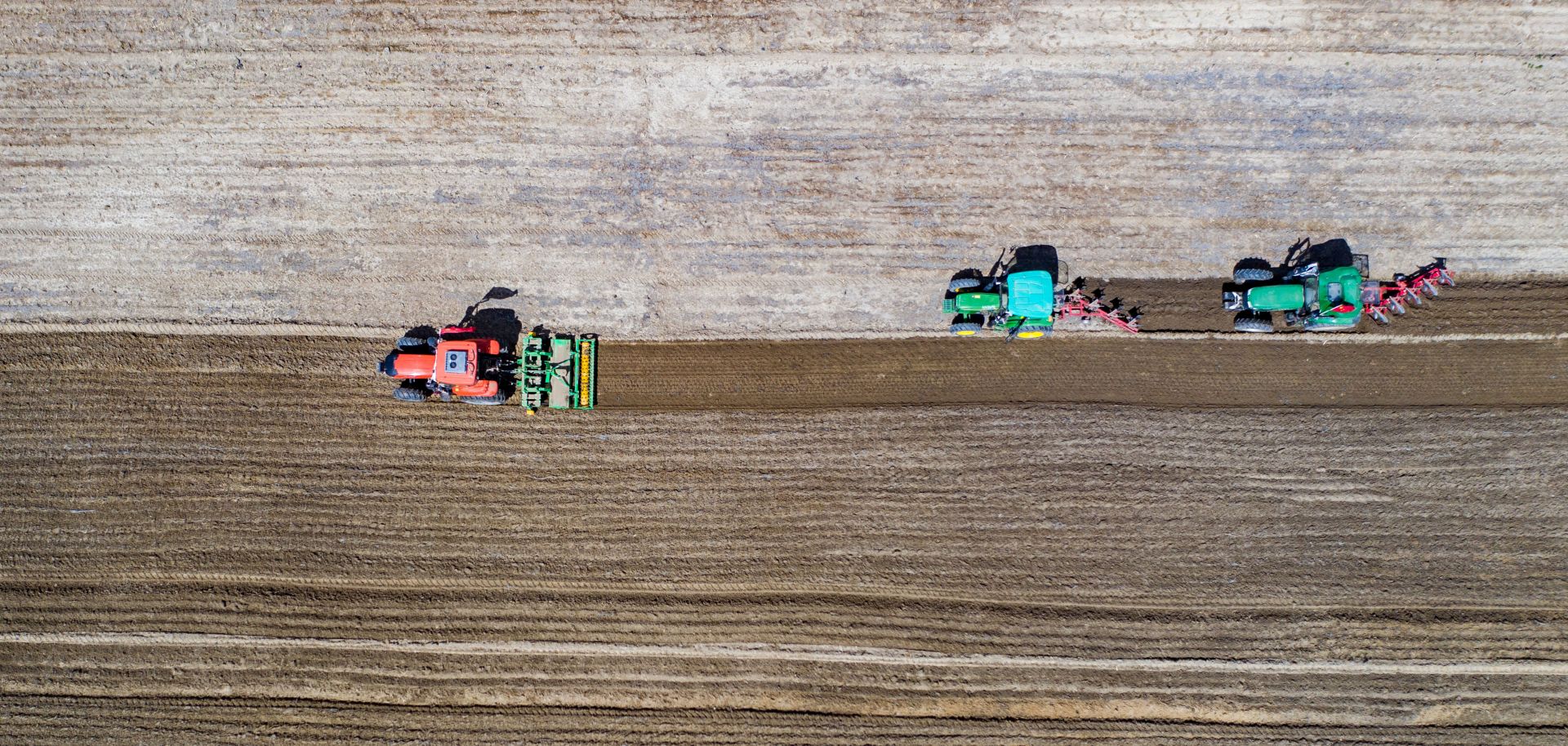
Villagers in Lhasa, the capital of China's Tibet Autonomous Region, sow highland barley seeds with agricultural machinery on April 22, 2020.
China's threat to heavily tariff Australian barley exports will not alone keep Canberra from pushing to investigate Beijing's role in the COVID-19 pandemic. But it will increase the stakes of doing so by making life all the harder for Australia's already struggling farmers. On May 10, Australian grain producers issued a joint statement warning that China has made a provisional decision to impose anti-dumping and anti-subsidy tariffs on Australian barley imports of up to 80.5 percent, effectively shutting down their exports to China. Sources within the Australian government say the timing of these tariffs is linked to the recent uptick in Chinese tensions over COVID-19, though Prime Minister Scott Morrison has publicly since said he does not believe the two are related. Depending on Australia's response, China is expected to make a final decision on the tariffs by May 19. On May 11, Chinese authorities also suspended products from four Australian beef slaughterhouses that comprise 20-35 percent of the country's total beef exports to China, citing health and labeling issues.
- On April 22, Morrison announced he had been consulting with U.S., German and French leaders on an independent international investigation into China's handling of the COVID-19 pandemic, although he has said there is "no evidence" of the virus leaking from a Chinese lab.
- Several days later, China's ambassador to Australia warned that Canberra's call for an international investigation could result in a boycott of Australian goods, citing beef and wine exports in particular, as well as Chinese students enrolling in Australian universities.
- China's anti-dumping allegations against Australian barley first surfaced in 2018 and there has been an anti-dumping investigation open for 18 months, partly motivated by Australia's own measures against Chinese steel. Observers, however, had believed the case would eventually be dismissed.
- In 2017, China shut down imports from the same four meat processors in addition to three others over similar issues, which took months of diplomacy to resolve.
By weaponizing its crucial agricultural exports, China is trying to influence the rural supporters of Australia's ruling conservative bloc. China already accounts for one-third of Australia's total exports, but has recently become an even more vital market due to China's early COVID-19 recovery amid sluggish global demand elsewhere. A record wildfire season and drought have made Australia's agriculture sector, in particular, all the more dependent on Chinese exports.
- Australia's agricultural sector is highly dependent on international markets, exporting 70 percent of its total produce by value between 2014 and 2017. China is also Australia's top agricultural export destination, accounting for one-fifth of its total produce exports.
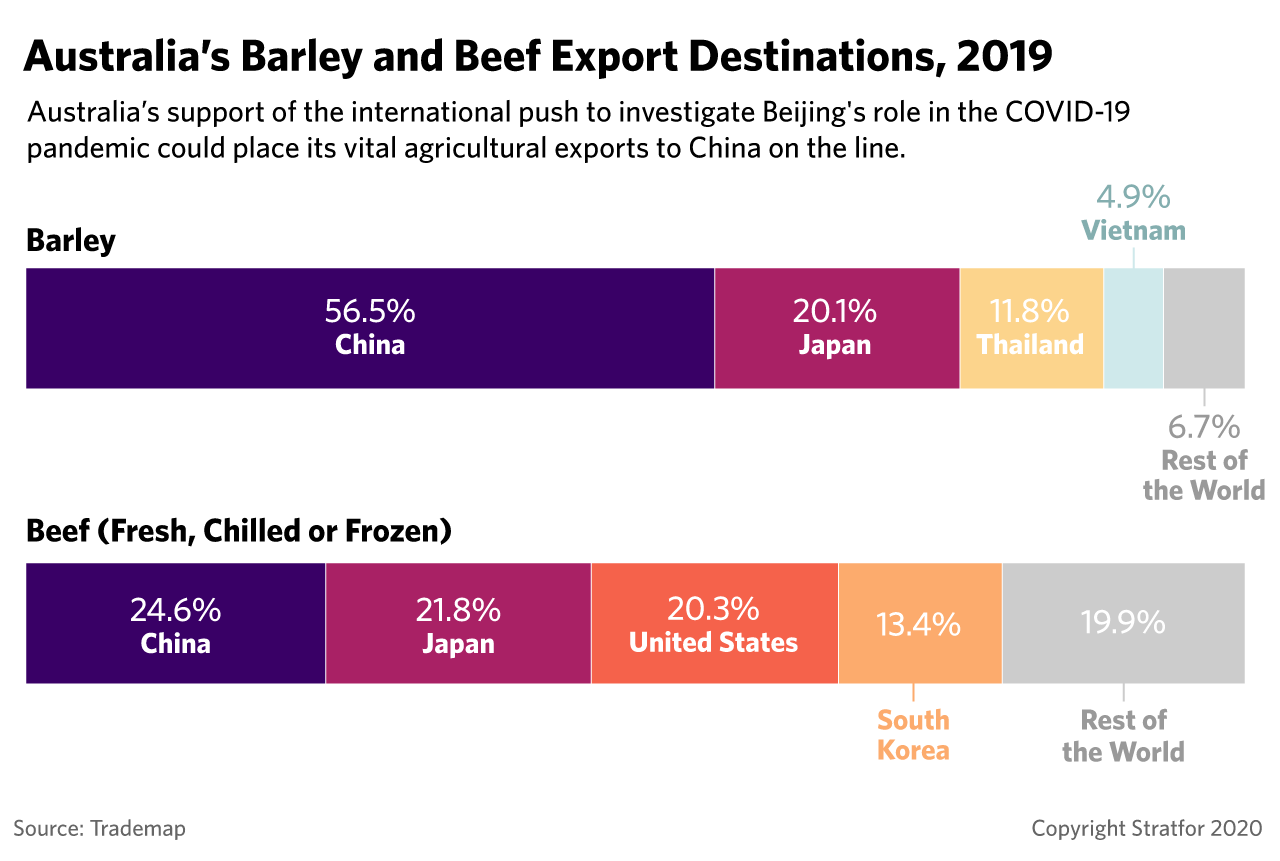
- Decreased barley exports to China would acutely impact Australian farmers, particularly in rural areas of Western Australia. Barley is Australia's largest single grain export to China and its second-largest agricultural export (overshadowed only by wool), accounting for over 11 percent of Australia's $8.06 billion in agricultural exports to the country in 2018. In 2019, China alone received 56.5 percent of Australia's total barley exports.
- The 2019 drought has also badly hurt Australian barley exports, causing shipments to plunge 56 percent. The recent recovery in rainfall, however, had raised hopes of a rebound in barley production.
- China's barley buyers, by contrast, will feel less of a pinch from a drawdown in Australian shipments given higher domestic availability of barley and alternative feeds in 2020 as the Chinese government halts a stockpiling program in place since 2007. Canada, which supplies 26 percent of China's barley, can also help offset any shortfalls.
- Australia has fewer international options to appeal the anti-dumping measures given the current paralysis of the World Trade Organization dispute settlement mechanism over the U.S. refusal to appoint new appellate judges.
China's economic pressure, however, would have to expand beyond barley and the small group of beef slaughterhouses to compel Australia to reconsider its support of U.S. efforts to counter Beijing's rise. If Beijing threatens more sweeping measures against Australian beef, or starts targeting wool exports, Canberra may be prompted to change its approach. But as things stand, barley producers in Australia have other options.
- Barley is less than 1 percent of Australia's overall exports, meaning a Chinese squeeze on the product would not have wide-ranging economic consequences.
- Anecdotally, Australian farmers are already adjusting their ongoing planting plans in favor of wheat instead of barley in preparation for the potential Chinese tariffs, although a great deal of barley acreage has already been sown.
- Australian barley farmers can also soften the blow by reorienting their products toward the domestic beef producers on the country's east coast, who have been struggling amid recent shortages and increased prices of feed barley.
China will also struggle to expand its economic threat against Australia.
- Chinese wool imports may already be down because of slowing textile demand at home.
- Mineral exports will be needed for China's economic rebuilding and infrastructure push, and given Australia's proximity and relative cost, China can't realistically afford to add major restrictions.
- Virus travel restrictions will depress rates of Chinese tourists and students for some time regardless, so the threat of their removal/boycott also carries less weight.
Given the political stakes of caving to such overt Chinese pressure, the Australian government will continue to push back against Beijing, while still being careful not to alienate one of its most crucial trade partners. Canberra has long been trying to balance its close economic ties with China against the risk of Beijing's rising influence within Australia and its encroachment within the greater Asia Pacific. The uptick in U.S.-China tensions amid the COVID-19 pandemic has only accelerated this ongoing trend, presenting a stark choice for Canberra.
- Australia has become an important participant in U.S. efforts to ensure freedom of navigation in the South China Sea, most recently joining U.S.-led military exercises in the waterway on April 23.
- In March 2020, Australia's government imposed heightened scrutiny on foreign takeovers of domestic companies to defend against potential increasing Chinese influence amid the COVID-19 downturn. This followed a move in February 2018 that saw Australia put in place intensified scrutiny on Chinese investment into its domestic agriculture and electricity sectors.
- Australia has been increasingly involved in efforts to economically and diplomatically compete against China in nearby Pacific islands as well, particularly in Papua New Guinea, to maintain sway over the strategic region.
- In April 2018, Australia's government banned Chinese company Huawei from providing equipment for its 5G network project.
- Canberra also tightened its foreign agent and espionage laws with an eye to increasing scrutiny on entities and politicians with links to China, including media groups and Confucius Institutes.
- But even before the reported barley tariff threat, Canberra had distanced itself from U.S. allegations that COVID-19 leaked from a Chinese lab in Wuhan — a sign that it is still trying to strike a balance between maintaining Beijing's economic ties and countering its rise as a global power.
