
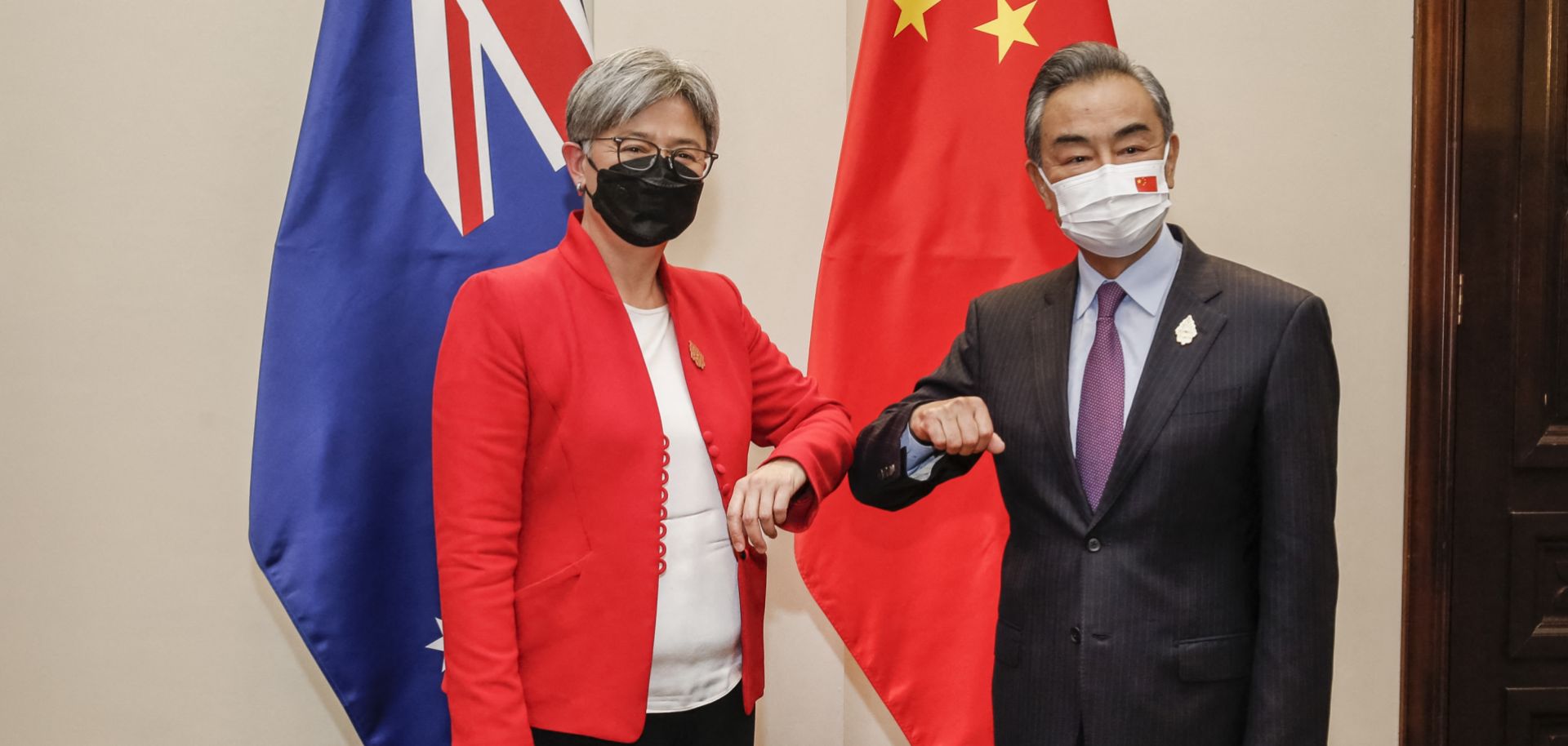
Australian Foreign Minister Penny Wong (left) bumps elbows with her Chinese counterpart Wang Yi on the sidelines of the G-20 Foreign Ministers Meeting in Bali, Indonesia, on July 8, 2022.
The easing of Chinese restrictions on Australian and South Korean exports signals that Beijing is looking to repair economic relations with two key trade partners and slow the creation of a Western-led anti-China coalition in the region. China appears to be extending olive branches to two of its regional rivals after new governments in Canberra and Seoul took office last year. On Jan. 12, Chinese officials in Guangzhou allowed domestic firms to resume importing Australian coal, which had been banned since 2020. On Nov. 22, the Chinese streaming site Tencent also screened a South Korean drama for the first time in five years. Together, these two actions mark a shift in China's approach toward repairing some economic relations that have been damaged in recent years.
- In 2017, China banned streaming South Korean media content. That same year, Chinese citizens also boycotted Lotte, a South Korean department store chain, following South Korea's deployment of THAAD, a U.S. missile defense system that Beijing claimed could spy on Chinese airspace. The boycott eventually forced Lotte to cease its business operations in China in March 2022.
- Australia was one of the first nations to call for an investigation into the origins of COVID-19 in early 2020, prompting Beijing to issue trade sanctions on key Australian exports (like coal, barely, wine, beef, cotton, timber and lobster) in retaliation.
Australia and South Korea have both increased their defense cooperation with the United States in recent years, which has strained each of their relationships with China. Seoul and Canberra's deepening military ties with Washington have fueled Beijing's fears regarding the formation of a broad anti-China coalition in the Indo-Pacific — especially within the context of China's growing strategic rivalry with the United States. Despite Chinese disapproval, South Korea has steadily increased its bilateral military cooperation and drills with Washington in the wake of escalating North Korean threats and weapon tests following the breakdown of U.S.-North Korea relations and the failed 2019 summit in Hanoi. South Korea has also been in talks with the United States to limit China's access to key semiconductor inputs and advanced technology produced by South Korean companies. Australia, meanwhile, has recently adopted a more hard-line stance on China as well — driven by ideological concerns over China's authoritarian government and political interference in Australia's democracy, as well as maritime security concerns around shipping and territorial rights in the South China Sea. These concerns prompted the administration of then-Austrailian Prime Minister Scott Morrison to scrap its submarine deal with France in late 2021 and instead sign a deal with the United Kingdom and the United States (AUKUS) for more advanced nuclear-powered submarines. In recent years, the Australian government has also become more outspoken about the mistreatment of Uyghur Muslims in China's Xinjiang region, among other labor and human rights abuses in China.
Beijing is using the election of new governments in South Korea and Australia as a fresh start to mend its relationships with two key trade partners after a tense few years and, in turn, give the Chinese economy a much-needed boost. China is seeking to improve its economic relations with strategic trading partners in order to restart its flailing economy, which is reeling from an ongoing real estate crisis and a year of disruptive ''zero COVID'' lockdowns. By showing the administrations of Australian Prime Minister Anthony Albanese and South Korean President Yoon Suk Yeol (who both took office in May 2022) the economic promise of improved relations, Beijing is also seeking to compel Canberra and Seoul to more deeply weigh the impact of their policies on China, thereby advancing Beijing's foreign policy goals as well.
- Australian Prime Minister Anthony Albanese and his center-left Australian Labor Party (ALP) took power on May 23 after narrowly defeating former Prime Minister Scott Morrison's center-right Liberal-National Coalition in the 2022 federal election. South Korean President Yoon Suk Yeol, a former top prosecutor from the conservative People's Power Party (PPP), also took office in May 2022 after narrowly defeating Lee Jae-myung, the candidate from former President Moon Jae-in's liberal Democratic Party.
- China continues to grapple with a real estate crisis brought on by the government's deleveraging efforts, which saw sales among the country's largest 100 developers drop 43% in the first 11 months of 2022 and 48 developers default on a total of $65 billion in debt over 2022.
- In December 2022, China abruptly eased its economically disruptive ''zero-COVID'' strategy of tight lockdowns and travel restrictions, which had heavily constrained the country's economic recovery by dampening consumer demand and business activity.
By easing its trade sanctions on Australian goods, Beijing hopes Canberra will face increased pressure from Australian businesses to avoid any provocative actions that could again lock them out of China's massive market. China's government is able to rhetorically justify removing some import restrictions on Australian goods by domestically claiming that Australia has been punished enough, thereby maintaining Beijing's moral high ground. If Canberra takes any actions that Beijing disapproves of (like conducting freedom of navigation exercises with the United States around Taiwan, or issuing unilateral sanctions on goods from Xinjiang), Beijing can then resume the restrictions or even impose new ones. Normalized trade relations will likely influence some of Australia's actions abroad, and could potentially even blunt some of Canberra's security-minded policies (by, for example, detering Australia from fully supporting the United States' expanding export restrictions on China's tech sector), which Beijing would take as a win. The easing of trade tensions won't, however, prompt Australia to tone down its military buildup or end its participation in the Quadrilateral Security Dialogue (also known as the ''Quad'') comprising Japan, Australia, India and the United States.
- Australia has been ramping up its military's missile capabilities and manpower in response to growing Chinese encroachment in the Pacific Islands. On April 5, the Australian government announced it had moved up its self-imposed deadline for rearming the country's fleet of fighter jets and warships with long-range strike missiles from 2027 to 2024. The next day, then-Prime Minister Morrison also said Canberra would boost Australia's defense troops by roughly 30% to 80,000 personnel by 2040.
- In July, current Australian Prime Minister Albanese said he would not comply with Chinese demands to patch up their bilateral relations unless China removed its trade sanctions on Australian goods.
When it comes to South Korea, China hopes that the promise of improved economic relations will factor into Seoul's defense strategy and deepening ties with the U.S. military. Compared with Australia, China's bar for success in influencing South Korean foreign policy is lower because the situation with North Korea makes it difficult for Seoul to remove security cooperation with the United States. Beijing will dangle economic gains in front of South Korean leadership as an incentive, but be equally willing to institute economic constraints or limitations. This strategy was evidenced by China's announcements earlier this month that it would stop issuing short-term visas to South Korean citizens in retaliation for South Korea requiring negative COVID-19 tests for inbound Chinese travelers, which came just two months after Beijing eased some of its restrictions on the distribution of South Korean media content in China. By showcasing its willingness to both crack open (and quickly shut) the door to the Chinese market, Beijing is hoping that business leaders from South Korea's entertainment industry (and other sectors that have the most to gain from accessing Chinese consumers) will pressure the Yoon administration to at least keep relations with China stable. But this strategy is unlikely to advance China's ultimate goal of deterring South Korea from strengthening its ties with the United States, as North Korea's increasing aggression will compel Seoul to maintain close security and political relations with Washington — even if it means damaging its economic ties with Beijing. To that end, Seoul will continue to operate closely with the United States and the reemerging Japan in the interest of its own security. This will see South Korea conduct more missile defense drills and maritime exercises with both countries — much to the chagrin of China. Even so, the domestic business interests pressuring South Korean leadership to keep economic relations with China open will be seen as a success in Beijing.
- South Korean exports to China totaled roughly $162 billion in 2021, around the same as pre-pandemic levels in 2018. Such exports are poised to grow if Beijing continues to ease restrictions on South Korean media, given that China is the largest potential market for South Korean television, movies and music.
- In 2021, the K-Pop music industry generated about $10 billion for South Korea, while the streaming of K-Dramas (like Squid Game) on the U.S.-based platform Netflix generated about $4.7 billion.
But China can easily reimpose restrictions if Australia or South Korea take overt actions that directly oppose Beijing's interests. Beijing wants to prevent Australia and South Korea from moving toward the U.S. camp for as long as possible. However, China will not hesitate to reinstate the bans it has lifted on Australian exports (and could potentially impose new ones on other key exports) if, for example, Canberra sends a delegation of lawmakers to Taiwan, leads multilateral military drills in the region, or strikes an overall more hawkish diplomatic tone toward China. If South Korea deploys more THAAD systems or creates a single cohesive missile defense shield with the United States and Japan, China can also respond by re-banning South Korean media and/or even restricting the number of Chinese students who can study abroad in South Korea. Such measures would not be an immediate ''tit for tat'' retaliation, and would instead be imposed only after Beijing makes a big show of trying to work through any disagreements diplomatically — thereby enabling China to paint itself as the amenable one, with Australia and South Korea being the unreasonable agitators.
