
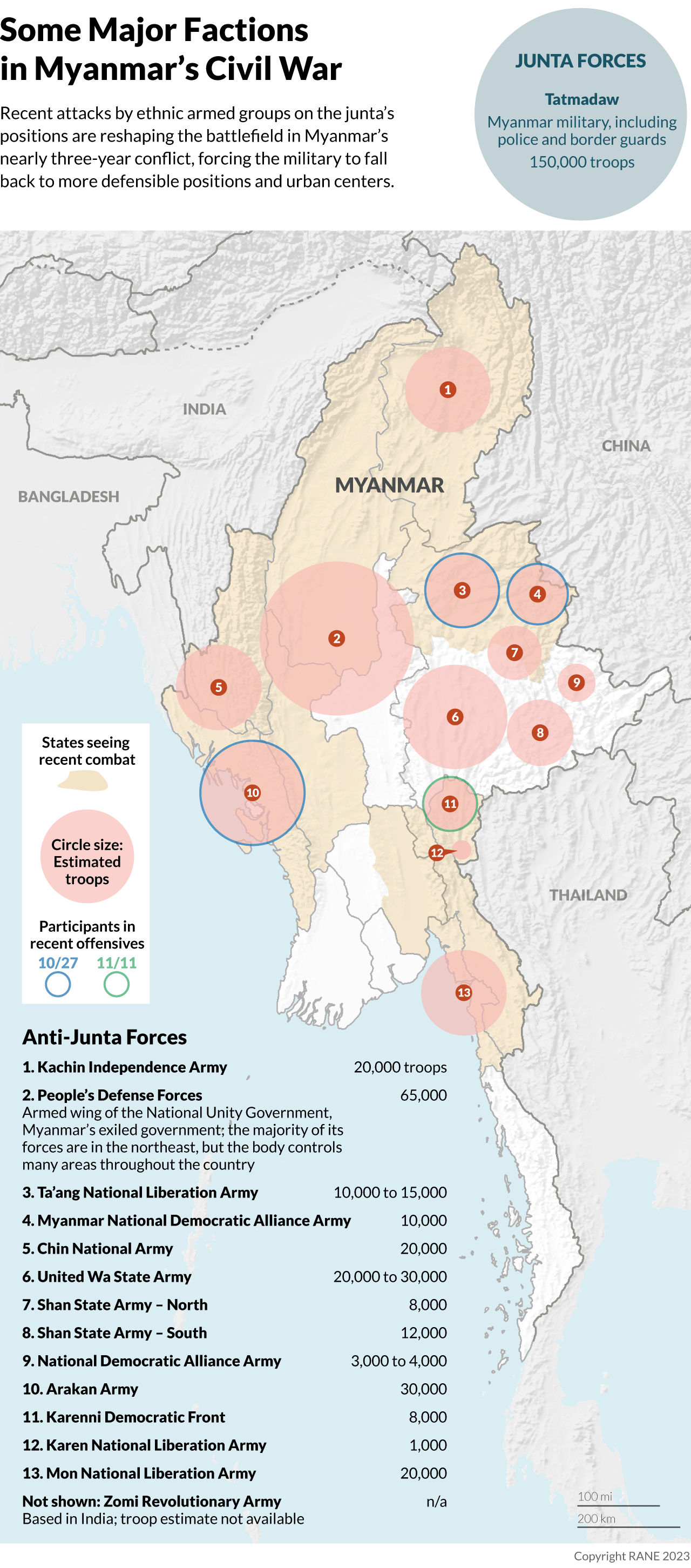
The rebels fighting against Myanmar's military junta have made vast territorial gains in recent weeks, with the apparent help of China's tacit support. But their constrained military coordination, inferior defenses and differing strategic priorities will likely challenge rebels' ability to take major cities, opening the door to a possible system of autonomous administrations in the coming years. Rebel advances began on Oct. 27 with the initiation of Operation 1027, an offensive led by the so-called Brotherhood Alliance, a group of approximately 20,000 fighters from three Shan ethnic armed organizations (EAOs) in Myanmar's northeastern Shan state that are supported by the National Unity Government (NUG), the elected rebel government-in-exile. In a matter of weeks, the Brotherhood Alliance rapidly captured dozens of military outposts, several towns and key border crossings and roads — which together comprise billions of dollars worth of infrastructure and handle most of China's overland trade into and out of the country. The junta, meanwhile, lost hundreds of soldiers in action in the rebel offensive, including its most senior officer of the war, a brigadier general, while junta soldiers have also reportedly been defecting to EAOs. In subsequent weeks, the success of Operation 1027 inspired fresh attacks by other anti-junta factions, such as the mostly Burman ethnic majority NUG-backed People's Defense Forces, leading to the capture of Kawlin, a district capital in northwestern Sagaing region, for the first time since Myanmar's civil war began in early 2021. On Nov. 11, Karenni militias launched Operation 1111, an assault on Loikaw, the capital of central Kayah state located just 140 miles (225 kilometers) east of Myanmar's national capital of Naypyidaw, where intense fighting has persisted throughout November and into December. Chin EAOs in Myanmar's far west launched additional attacks on Nov. 14, causing the junta to also lose control of its main border crossing with India. Government forces are also coming under fire from the Arakan Army in the country's southwestern Rakhine state.
- Myanmar's civil war began after the country's military, the Tatmadaw, staged a coup in February 2021, in which it overthrew the democratically elected government, claiming without evidence that the recent general elections had been rigged. This led to widespread protests and civil disobedience, to which the Tatmadaw responded with wanton violence, driving the opposition to take up armed resistance.
Rebel gains are slowly moving the conflict away from rural borderlands, toward the center of the country. Myanmar's military has never had full control over the country's border areas. However, what is fundamentally different now is that the core of the country — specifically areas dominated by the Burman ethnic majority and the country's major urban centers — appear increasingly under threat. In particular, the junta fears that urban centers, such as the capital Naypyidaw and commercial center Yangon are vulnerable. While they have not yet shown an intent to move south beyond the borders of Shan state, the components of the Brotherhood Alliance hope to expand the territory of their ethnic enclaves within Myanmar's borders — something that one of the group's EAOs, the Ta'ang National Liberation Army, has already accomplished within the borders of Shan state.
- The rapid loss of territory, trade infrastructure and personnel amid the Brotherhood Alliance's offensive prompted Myanmar's acting president, Myint Swe, to warn on Nov. 11 that the country risks disintegrating, particularly as the Brotherhood Alliance has severed key transportation links.
- Even before rebel forces launched Operations 1027 and 1111, government troops had been struggling to hold territory outside major urban centers and military facilities (like barracks) due to the dozens of rebel and ethnic groups targeting them. This caused the junta to increasingly rely on collective punishment, including indiscriminate air strikes and other scorched-earth tactics, to try to force the resistance into submission.
Meanwhile, China — the country with the most foreign influence in Myanmar — appears to be implicitly supporting the rebel offensive via its inaction. Operation 1027 may be accomplishing additional gains with the tacit endorsement of China, which sells weapons to all three Brotherhood Alliance militias. The provincial Chinese government in Yunnan also maintains close ties with Shan ethnic political and paramilitary groups, offering banking and other yuan-denominated services. Given that China backed negotiations between the junta and the Shan militias in late 2022 to maintain a cease-fire along the border, and combined with the scope of Operation 1027, it is unlikely that China did not grant at least tacit approval for the Brotherhood Alliance's offensive. In addition, there is notably no sign that China voiced its disapproval of Operation 1027, in contrast to Beijing's prior efforts to restrain EAOs in Myanmar, nor has China cut off the Shan militias from its markets and services, which Beijing could easily do if it wished. Together, these factors suggest that China is allowing the current rebel advance to develop, if not implicitly backing it. While Beijing's potential reasons for doing so are multifaceted, China is likely reacting to the junta's failure to shutter the many scam centers in Myanmar, which are typically run by Chinese organized crime fugitives wanted in China and have victimized thousands of Chinese citizens (as well as thousands of citizens from other countries). Indeed, the rebel offensive has so far forced several of these centers to shut down, freeing thousands of victims in the process. China may also be seeking to exercise leverage over the junta to extract more favorable concessions, such as greater Chinese control over Kyaukpyu, a planned deep sea port in Rakhine state that would provide China access to the Indian Ocean. Lastly, Beijing may be trying to preempt Western influence over the pro-democracy rebels led by the NUG, should they unexpectedly overthrow the junta and lead a potential new government. But even if the rebels don't eventually seize power in Myanmar, tacit support for their battlefield advances could still enable Beijing to have more productive relations with various rebel groups in their spheres of influence.
- Junta leader Min Aung Hlaing claimed on Nov. 8 that the Brotherhood Alliance was mainly using Chinese-made drones in Operation 1027.
- In late November, supporters of the governing junta staged protests in Naypyidaw and Yangon, including outside the Chinese embassy, to protest the perception that China was actively aiding the rebels in their offensive.
- China has rhetorically supported the junta since the February 2021 coup, initially downplaying the event as a ''cabinet reshuffle'' and backing its legitimacy in the international community.
Despite the opportunity to make further advances, lack of cohesion and differing priorities among the rebel factions will likely impede their ability to make significant gains. The EAOs and the NUG share the proximate goal of overthrowing the military junta. However, the Shan EAOs (as well as other groups) have historically sought to create independent homelands, while the NUG ultimately seeks to reconstitute Myanmar's federal system within its pre-war state borders. Though the EAOs also claim the goal of establishing a newly envisioned federal system in the context of the current conflict, these divergent long-term political goals mean that, despite current unity against the military junta, there is likely an upper limit to cooperation between the Brotherhood Alliance and NUG. There are also strategic limitations, as though the NUG and other EAOs are broadly supportive of Operation 1027 (as it has inspired other rebel attacks such as Operation 1111), it was not coordinated. In addition, the Brotherhood Alliance's offensive is notable in that Shan EAOs had mostly sat out the war before Oct. 27, in contrast to the other EAOs that have partnered with the NUG since 2021. This gave the Brotherhood Alliance's relatively well-armed fighters three years to arm, train, recruit, plan and ultimately surprise the junta, but it also means the rapid gains of Operation 1027 are unlikely to be replicated in other areas, as similar intense and time-consuming pre-planning has not taken place among other EAOs given perpetual conflict. Such strategic constraints, combined with different political goals, will thus make the EAOs and the NUG's temporary unity precarious, which will narrow their path to an eventual battlefield victory and unified post-war peace, particularly given the history of animosity, territorial disputes and clashes among the militias themselves. The NUG and the various EAOs may be able to continue their current momentum in taking some territory, especially if they can develop cohesiveness beyond occasional coordinated movements with higher levels of coordination and interoperability. However, they face significant constraints in mounting offensives against major cities, even if they can more frequently conduct bombings, assassinations and acts of sabotage in urban areas.
While it may never be able to retake all rebel-seized territory, the junta will likely maintain control of the capital Naypyidaw and most other major urban areas, opening the door for an eventual political compromise that leaves ethnic enclaves with greater autonomy and control of border crossings — an outcome that would de facto stabilize the country but is likely years away. The junta is experiencing challenges that have thus far been unprecedented in the nearly three-year civil war. In addition to rapid rebel gains, mass defections, sinking morale and a shortage of funds mean the junta may never be able to recapture all the territory now under rebel control. However, the junta maintains air superiority and other assets that the rebels lack, such as armored vehicles and warships. This military advantage means the junta will likely still be able to maintain and further secure its control of urban centers, with the capital Naypyidaw being particularly well fortified. Junta forces also appear to be adopting a strategy of effectively ceding some areas to the rebels and instead concentrating their defenses to protect major urban areas in the country's central core and the key lines of potential attack toward them. If the continued impasse does not see more enhanced coordination among rebel factions, the junta may be open to eventually creating a new federal system that provides greater autonomy for ethnic enclaves and significantly reduces the military's role in government affairs, even compared with its role in prior civilian governments. This situation could be palatable for the junta, given its desire to avoid losing more territory and prevent the country's dissolution. It would also be palatable for ethnic groups, which may find greater autonomy sufficient to avoid further conflict, especially if their unity falters amid contrasting views on governance. However, any final settlement is likely years down the road. A low-likelihood, high-impact scenario in which Myanmar dissolves could unfold if rebels fail to achieve greater cohesion, owing to EAOs' history of seeking independence and potentially divergent views on the country's future. China's friendly relationships with the various factions mean Beijing can live with whoever emerges the victor and will be active in stabilizing both its border, as well as its overland trade routes — possibly by brokering negotiations. But China will not support the formal fracturing of the country due to fears of further instability along its borders. In the intervening period, Myanmar will remain largely uninvestable, particularly given the likely uptick in attacks on urban centers in 2024. However, this will be tempered by the efficacy with which the junta protects its urban strongholds where the bulk of the country's economic activity takes place. Refugees will continue to stream into neighboring countries such as India, Bangladesh and Thailand, while narcotics sales that each side depends on for revenue — responsible for a large uptick in drug use and plummeting street prices throughout Southeast Asia — will continue to plague the region.
- Elections, as currently proposed, are highly unlikely as a means to resolve the conflict under the junta's auspices, given the Tatmadaw's lack of control of much of the country and the ongoing state of emergency, which has been renewed four times since hostilities began in February 2021 (under the constitution, elections cannot be held during a state of emergency). Even if the junta holds elections, they would be highly controlled and not lead to sanctions relief or an end to Myanmar's pariah status, resulting in continuing compliance, reputational and safety risks to business operations. The NUG formally rejected the possibility of participating in any junta-run election in April.
- Maintaining Myanmar's territorial integrity is a constitutional duty of the country's armed forces, and the constitution references a responsibility to uphold ''non-disintegration'' of the country 12 times in the document, implying this concern is the top institutional priority. Indeed, the basic imperative for Myanmar's government, no matter who rules the country, is to avert a situation in which it breaks apart given its many ethnic enclaves that seek independence or greater autonomy.
- China is already showing signs of reoccupying its mediator role. On Dec. 6, Myanmar agreed to step up law enforcement efforts against scam compounds. On Dec. 11, junta sources claimed that China had helped restart communication between the junta and Shan EAOs.
- In a report published on Dec. 12, the United Nations identified Myanmar as the world's biggest opium producer, surpassing Afghanistan.
