
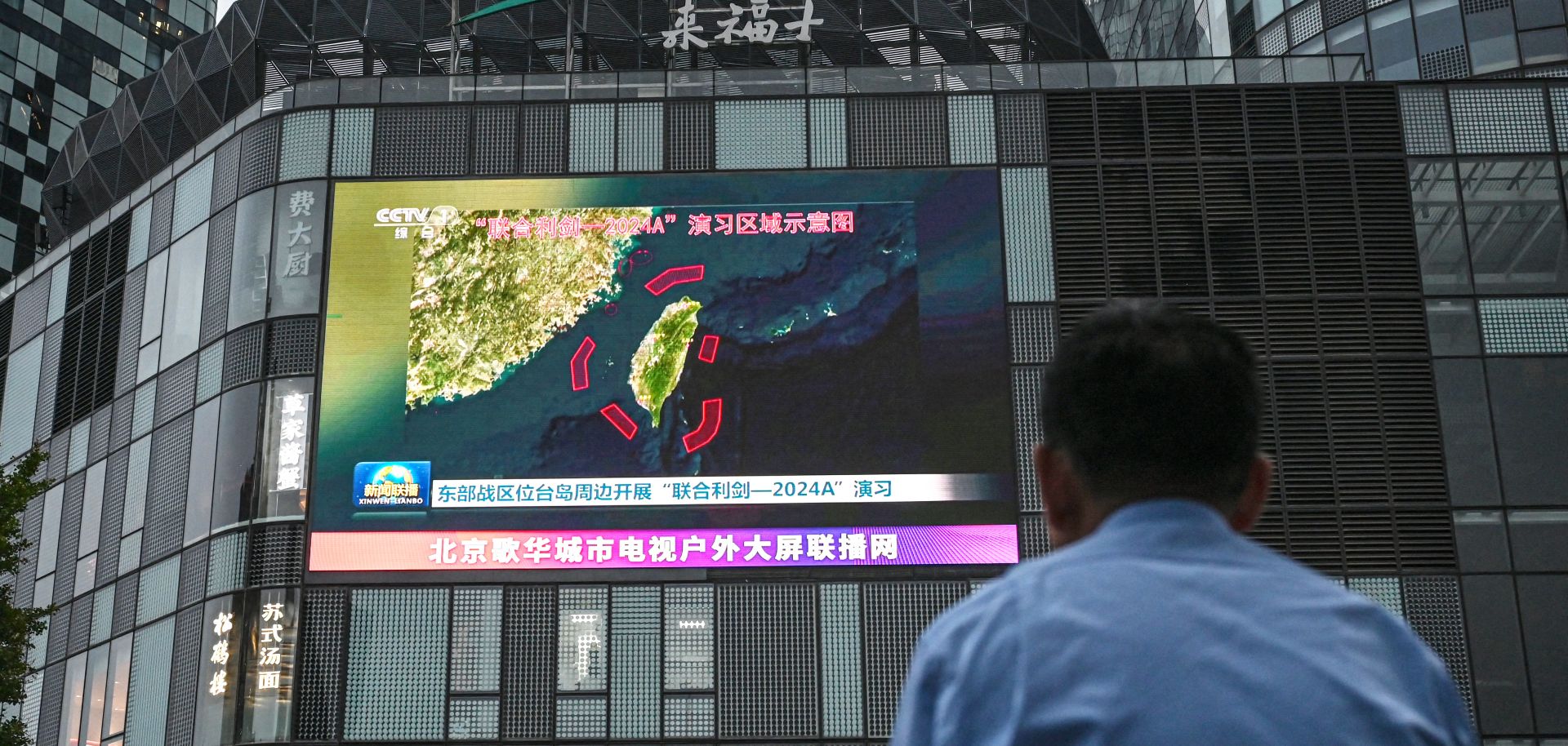
China's third round of large-scale military drills around Taiwan in two years will likely pose modest disruptions to regional shipping, especially if the drills are extended, and a low-level risk of military incidents, though wider conflict remains highly unlikely. The drills could also be followed by larger ones later this year in the likely event the United States steps up support for Taiwan. On May 23, the Chinese People's Liberation Army (PLA) began what it has labeled as the Joint Sword 2024A drills in waters on all sides of Taiwan. The drills, which are currently scheduled to last for two days, are the largest China has held around Taiwan since April 2023, when it conducted drills in response to then-Taiwanese President Tsai Ing-wen's visit to the United States, where she met with then-House Speaker Kevin McCarthy. The current drills are taking place in five maritime areas that are more than 12 nautical miles from the coast of the main island of Taiwan (outside of Taiwan's territorial waters), mainly near the key Ports of Kaohsiung and Keelung, but also in the Taiwan Strait and to the east of Taiwan. According to the PLA's Eastern Theater Command (ETC), the drills are focused on ''joint sea and air combat readiness patrols, joint seizure of battlefield comprehensive control, [and] joint precision attack on key targets'', and also involve exercises around Taiwan's outlying island groups of Kinmen, Matsu, Wuqiu and Dongyin, which are much closer to the Chinese coast than they are to Taiwan. The ETC noted that these drills are testing ''the actual combat capabilities of the theater troops in joint operations,'' and that they are ''punishment for the 'Taiwan independence' separatist forces'' and are meant to serve as ''a serious warning to external forces for interference and provocation.'' The drills also come a little over a week after China, on May 14, conducted its largest aerial incursion into Taiwan's air defense identification zone (ADIZ) so far this year, with 45 PLA aircraft and six PLA Navy vessels entering the ADIZ.
- The reference to ''separatist forces'' in the ETC statement is a veiled criticism of new Taiwanese President William Lai, who was inaugurated on May 20. In his inauguration speech, he at multiple points referred to Taiwan as the Republic of China or just Taiwan. He also referred to China by name, rather than ''the mainland,'' and he noted that neither China nor Taiwan were subordinate to one another.
- In August 2022, China conducted more extended drills around Taiwan in response to then-House Speaker Nancy Pelosi's visit to Taiwan. Those drills were originally slated for four days but were extended to 12 days.
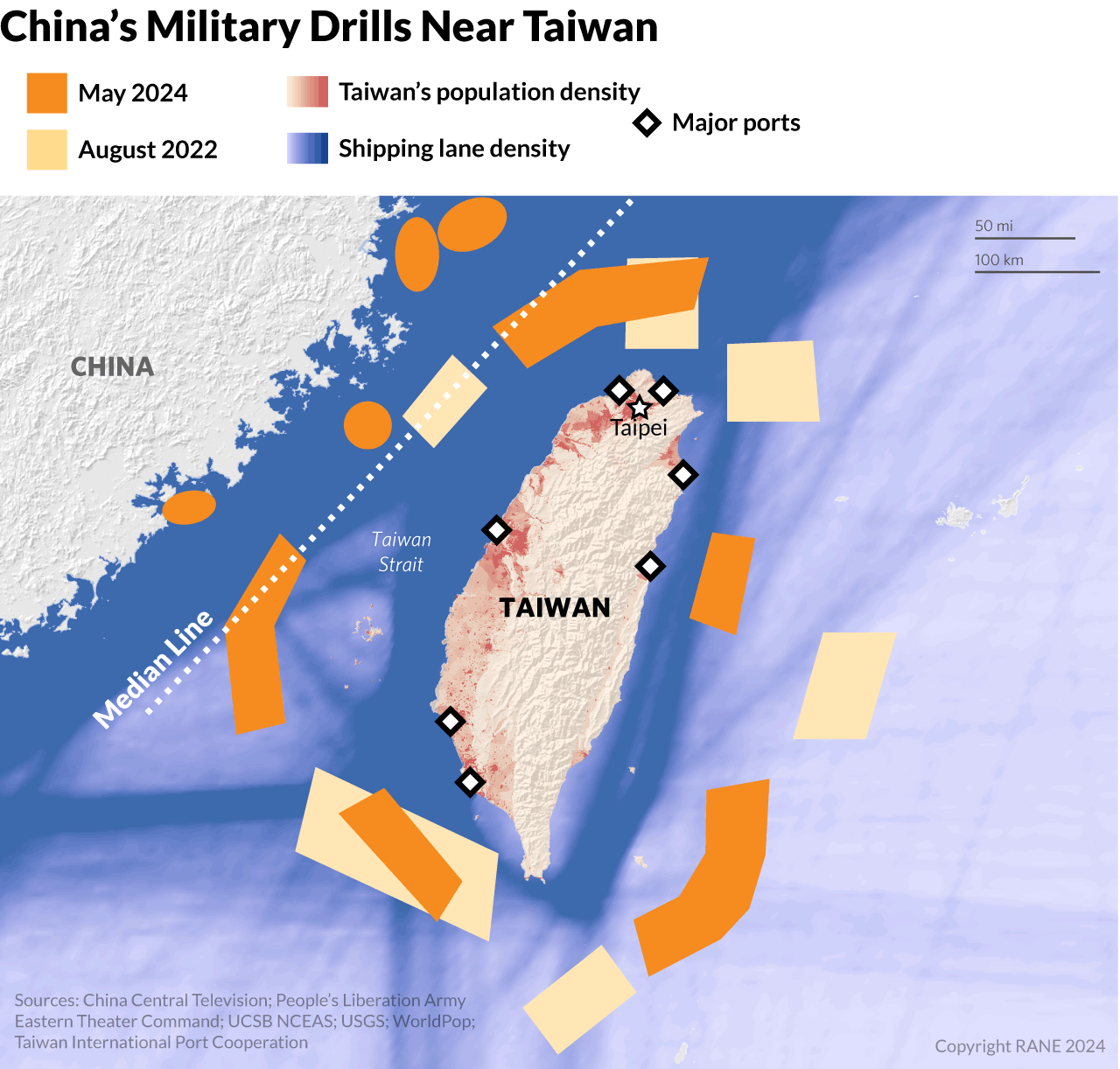
Compared with previous drills, these pose a likely greater, but still overall modest, threat of disrupting nearby shipping lanes, especially if drills are extended. On the off chance that Taiwanese President Lai takes a more active defensive stance against these drills than his predecessor, it would also raise the risk of a limited naval or coast guard clash, but a wider conflict remains highly unlikely. Compared with the previous drills China has conducted around Taiwan in recent years, these current drills are likely to be somewhat more disruptive to shipping going north-south through the Taiwan Strait, given that they are taking place in a more expansive geographic area. The military exercises also pose risks of delays to shipping reliant on the Ports of Kaohsiung, Taipei and Keelung, which are key for Taiwan's advanced electronics trade with the world. Such shipping disruptions could last for several days if China extends the length of the drills (as it did in August 2022); indeed, the naming convention of the drills, ''Joint Sword 2024A,'' obliquely suggests there could be follow-up exercises (e.g. under the name of Joint Sword 2024B, Joint Sword 2024C, etc.). Taiwan, for its part, appears to be focused on restraint and not inviting escalation based on public statements from its military leadership, which would track with its previous responses to China's April 2023 and August 2022 drills. However, with a new leader at the helm, there is a small chance that President Lai's administration will take a more hardened stance against these drills compared with the previous administration. In particular, Lai may order the Taiwanese military to closely tail or attempt to ward off Chinese forces during the ongoing drills, which could open the door to an incident at sea (e.g. collisions between Chinese and Taiwanese military assets, which have not been seen in prior drills) and a concomitant diplomatic crisis. But even if there are such incidents, or if China significantly extends the timeline of its drills, tensions remain highly unlikely to escalate to a greater conflict.
- The maritime trade disruptions caused by the current drills could delay shipments by several hours or a few days, as ships are forced to reroute to the east of Taiwan. This would be more disruptive to intra-China coastal trade than to international trade, as such hours- or days-long delays would have a greater impact on shipments transiting a multi-day intra-China route compared with a multi-week intercontinental route. The drills could also cause modest production delays for companies that rely on just-in-time supply chains for their factories in China or the factories of their supply chain partners in China, though global shipping routes that sail near Taiwan but don't involve China will be less impacted.
- Extending the length of these drills would enable China to practice for a de facto trade quarantine of Taiwan — an escalatory scenario that would likely begin with drills that gradually extend in geographical area and take place over a much longer timeframe, which could significantly disrupt Taiwan's vital chip trade with the world. However, this trade quarantine scenario remains highly unlikely during current drills, as it would invoke significant Western sanctions during an already vulnerable time for China's economy.
The drills suggest China will escalate military coercion toward Taiwan for the duration of Lai's term, and they could be followed by more extensive drills later this year — especially if the United States increases its military and diplomatic engagement with Taiwan in response to the Chinese provocations. By conducting these drills so soon after Lai's inauguration, Beijing is demonstrating that China remains ready to respond with military threats to what it views as ''separatist'' words or deeds by Taipei, even if Lai has so far pledged to play by previous President Tsai's playbook on steadily bolstering national defense capabilities without provoking China. This suggests that China's primary means of putting pressure on Taiwan will likely remain military coercion for the duration of Lai's four-year term. This will raise fears about a Chinese invasion, as well as the potential for long-term disruptions of the key shipping lanes that surround Taiwan and the global high-end semiconductor supply chains to which Taiwan is pivotal. However, such an invasion remains unlikely in the next few years given China's incomplete military modernization and vulnerability to Western sanctions. Nonetheless, the drills will add more impetus for the U.S. Congress to accelerate arms shipments to Taiwan and for House Speaker Mike Johnson to commit to meeting with Lai to show solidarity with Taipei, particularly if the drills are extended — developments that could prompt China to conduct even larger military exercises later this year.
- In Taiwan, the drills will also drive all political parties to show their commitment to Taiwan's sovereignty. This could see the opposition Kuomintang party attempt another visit to Taiwan's territorial holdings that are disputed with China, like Taiping Island, in an effort to show the inability of Lai and his Democratic Progressive Party to protect Taiwan's sovereignty. Such political plays would be unlikely to goad Lai into a more retaliatory or aggressive defense posture than he would otherwise have vis-a-vis China, but if they did, it would raise the risk of maritime incidents around disputed territories between China and Taiwan, as both sides attempt to stake their claims.
