
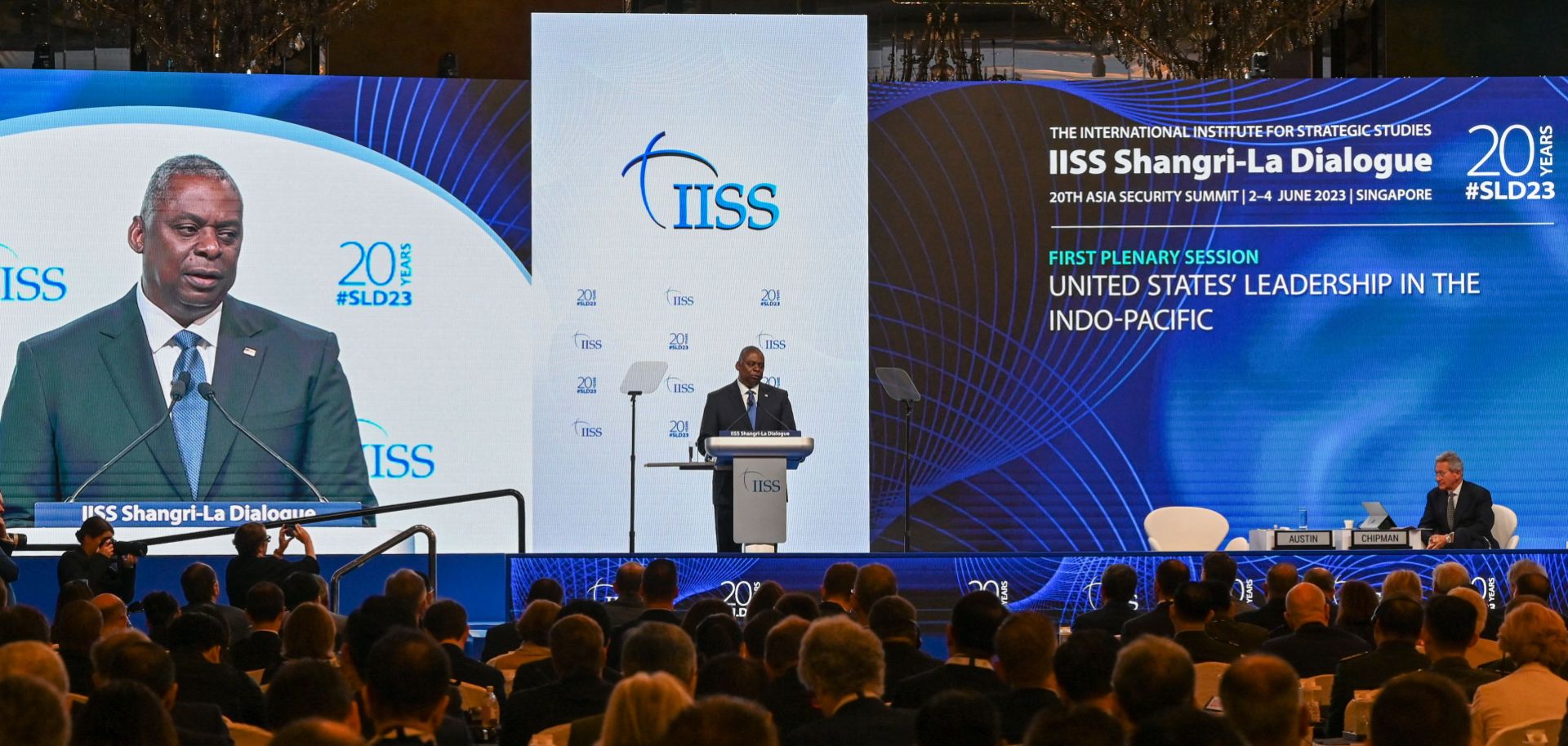
U.S. Secretary of Defense Lloyd Austin speaks during the 20th Shangri-La Dialogue summit in Singapore on June 3, 2023.
A tense U.S.-China naval encounter in the Taiwan Strait coinciding with the premier defense dialogue in Asia highlights the perils of reduced communication between Washington and Beijing, portending more such incidents and potential crises. On June 3, a U.S. guided-missile destroyer and a Canadian frigate in the Taiwan Strait had an ''unsafe interaction'' with a Chinese warship in which the latter directly cut across the path of the U.S. vessel twice, with one pass coming within 150 yards of the destroyer. The U.S. military said it and the Canadian navy were conducting a ''routine'' transit of the strait and called the incident ''unprofessional.'' China's foreign ministry responded that the Chinese military's actions were ''completely reasonable, legitimate, and professional and safe'' and that the United States had ''caused trouble and provocation first.''
- Canadian naval traversals through the Taiwan Strait are rare, with the last occurrence also in tandem with the U.S. Navy in September 2022.
- The U.S.-China naval encounter comes just a few days after a Chinese J-16 fighter jet flew directly in front of a U.S. reconnaissance plane over the South China Sea. The United States called the incident, which occurred on May 30, ''unnecessarily aggressive.''
The close encounter coincided with a regional security summit and took place amid a period of closed military-to-military communication channels between China and the United States. The June 3 naval incident occurred on the second day of the Shangri-La Dialogue in Singapore, Asia's premier annual security summit, which took place from June 2-4. The event drew more than 600 officials representing 49 countries with interests in the Indo-Pacific region, including the United States and China. As expected, U.S.-China bilateral tensions were the primary concern of the event, with regional countries aiming to avoid escalation and armed confrontation between the two powers. However, a hoped-for meeting between Chinese Defense Minister Li Shangfu and his U.S. counterpart, Defense Secretary Lloyd Austin, did not materialize, though the pair did exchange a cordial handshake. The Chinese and U.S. defense leaders' failure to meet disappointed many in attendance, as closed military-to-military dialogue channels are seen as a risk multiplier.
- Singapore has hosted the Shangri-La Dialogue each year since 2002. With the exception of the 2020 and 2021 COVID-19 forced cancellations, U.S. and China defense chiefs have regularly met on the sidelines of the event.
- China suspended military-to-military communications with the United States in August 2022 after former U.S. Speaker of the House of Representatives Nancy Pelosi visited Taiwan.
- Li has been under U.S. sanctions since 2018 for his involvement in procuring Russian Su-35 fighter jets and S-400 air defense missile systems for China's military. In recent weeks, Beijing has insisted that Washington remove the sanctions on Li before defense talks can resume.
The United States' attempts to shore up its Asian partnerships at the Shangri-La Dialogue showcases growing tensions in the region amid the ongoing break in communication between the U.S. and Chinese militaries. U.S. meetings with its regional allies during the Shangri-La Dialogue underscored the White House's effort to tighten its ''integrated deterrence'' defense strategy aimed at containing China's growing military power in the region. On June 3, the United States, Japan, Australia and the Philippines' defense chiefs held their first quadrilateral talks, which focused on the South China Sea and opened the door to conducting quadrilateral joint patrols in the contested waterway. On June 4, the defense ministers of U.S. allies Japan and South Korea also held their first talks in over three years on the sidelines of the event in Singapore, where they agreed to ''quickly resolve disputes over past military encounters that stand in the way of closer security cooperation,'' work closely against North Korean threats and, along with the United States, launch a trilateral real-time information sharing mechanism on North Korean missiles by the end of 2023. Meanwhile, NATO's push to establish its first Asian liaison office in Tokyo — potentially as soon as next year — has been gaining momentum as well, as have discussions around a trilateral Japan-Philippine-U.S. (JAPHUS) security grouping. These developments (which come despite the United States downplaying the possibility of new Quad-like mechanisms arising in the region earlier this year) are likely a direct response to China's two rounds of military drills around Taiwan in August 2022 and April 2023, the former of which led to the breakdown in military-to-military communication, as well as along other vectors.
- During his speech at the summit, Philippine defense chief Carlito Galvez, speaking on the South China Sea, noted that amicable relations depend upon neighbors having clear boundaries — demonstrating Manila's newfound confidence amid its deepening defense ties with the United States, Japan and Australia. A grouping between the Philippines, the United States, Japan and Australia could become more tightly focused, uniform and consequential than the latter three countries' existing Quad partnership with India. This is because compared with India, the Philippines has more convergent views on immediate military priorities in the region and on Russia (which is a long-time close partner of India). Manila is also more likely to hold joint military exercises with the United States, Japan and Australia.
- While diverging Indian interests have periodically undermined cooperation among Quad members, U.S.-India ties continue to deepen as well, as evidenced by Austin and his Indian counterpart also meeting on the sidelines of the Shangri-La Dialogue.
- During the U.S. defense chief's speech at the Shangri-La Dialogue, Austin expressed his ''deep concern'' about China's ''unwilling[ness] to engage more seriously on better mechanisms for crisis management'' and vowed that the United States would not tolerate ''coercion and bullying.'' His Chinese counterpart Li, meanwhile, warned against an emerging ''Cold War mentality'' and outside powers ''creating troubles and crisis'' during his address. On the sidelines of the summit, Li also met with top defense officials from Germany, Japan, the Philippines, Mongolia, New Zealand, Singapore and South Korea.
The risk of dangerous incidents that could trigger crises or even a greater U.S.-China confrontation will increase the longer the two countries' defense hotline remains suspended. The juxtaposition between Li's refusal to meet with his U.S. counterpart at the Shangri-La Dialogue and the simultaneous near-collision between U.S. and Chinese warships in the Taiwan Strait reflect the growing risk of a U.S.-China military escalation. While U.S. sanctions on Li do not preclude him from meeting Austin in certain venues, China is unlikely to quickly stand down on its demands that those sanctions first be lifted, as Beijing is hoping to strike a blow to Washington's foreign policy strategy that deploys what China sees as ''unilateral, unfair sanctions.'' With Beijing appearing unwilling to compromise at the moment, and with the political environment in the United States hostile to China, Washington likewise remains unlikely to break the impasse anytime soon by lifting its sanctions on Li. That said, the administration of U.S. President Joe Biden has recently made efforts to patch up ties with China, which could eventually see it lift sanctions on Li, but this may not materialize for months as Washington seeks alternatives to minimize loss of face. Alternatively, China could relinquish its demands for sanctions relief, potentially via a high-level U.S.-China defense meeting at a third-party venue. But it could be up to a year before such a meeting occurs. The break in military-to-military dialogue has affected other U.S.-China communication channels as well, but efforts to sustain these channels have proven more successful, particularly in trade, where dialogue remains ongoing. However, the growing multiplicity of actors in the territorially disputed Indo-Pacific — combined with the region's militarization and increased diplomatic focus on sovereignty — will still raise the likelihood of incidents like collisions, along with the attendant crises and diplomatic escalation, particularly as communications between the U.S. and Chinese militaries remain offline.
- U.S.-China engagement has stepped up in recent weeks, highlighting the Biden administration's push to establish robust dialogue mechanisms with Beijing across a variety of realms. In early May, U.S. National Security Advisor Jake Sullivan sat down with Chinese foreign policy chief Wang Yi in Vienna. On May 26, U.S. Trade Representative Katherine Tai then met with her Chinese counterpart Wang Wentao at the Asia-Pacific Economic Forum summit. On June 2, reports emerged that U.S. CIA Director William Burns secretly visited Beijing last month to meet with Chinese intelligence officials.
- In 2001, a U.S. EP-3 signals intelligence aircraft collided with a Chinese J-8II interceptor near China's Hainan Island, resulting in the Chinese pilot's assumed death and an international dispute between the two countries. A similar incident today would have much higher stakes given China's rapid military modernization since 2001 and Beijing's strengthened conviction that China is a rightful global leader and counterweight to U.S. power in the Pacific.
