
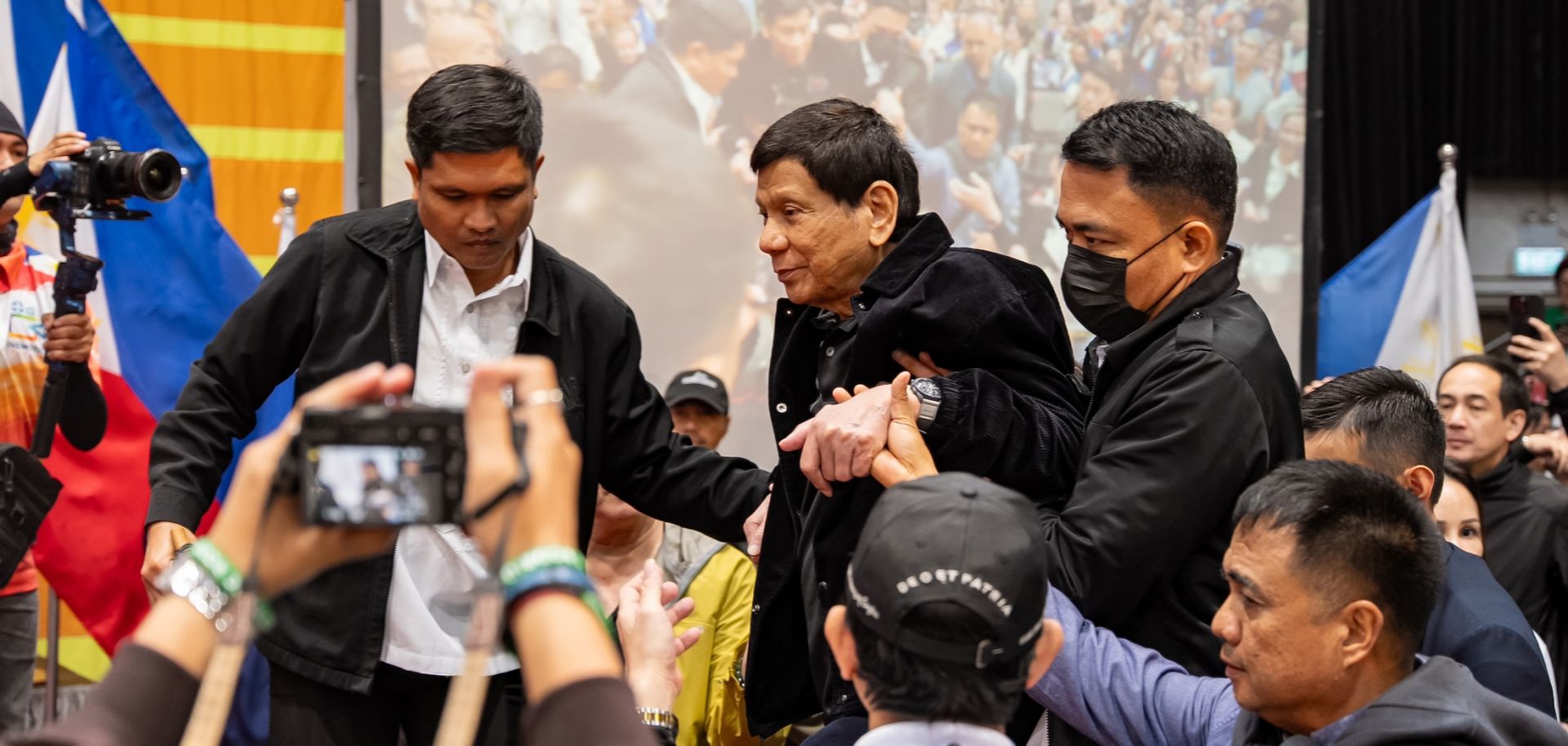
The high-profile arrest of former Philippine President Rodrigo Duterte risks factionalizing Philippine institutions and altering the landscape around the country's May midterm elections, which will help determine whether the current administration's defense and foreign policy agenda continues or stalls. On March 11, Duterte was arrested on an International Criminal Court (ICC) warrant accusing him of crimes against humanity related to the deadly anti-drug campaigns he oversaw as mayor of Davao City and later as president of the Philippines. He was apprehended at Manila's Ninoy Aquino International Airport after returning from Hong Kong, and was then extradited to The Hague in the Netherlands, where he is currently detained at the ICC detention center awaiting trial proceedings that could last several years and ultimately result in a prison sentence of up to 30 years. Duterte's anti-drug crackdowns, which began in 2016, officially led to approximately 6,000 fatalities, though some human rights groups have claimed the death toll could be as high as 30,000.
- Duterte served as president of the Philippines from 2016 to 2022. Prior, he served as mayor of Davao City, the Philippines' third largest city, for over 22 years across multiple non-consecutive terms, beginning with a 1988-1998 stint, after which he was in the House of Representatives from 1998-2001. He returned as mayor from 2001-2010 before serving as vice mayor from 2010-2013 (while his daughter, Sara Duterte, was mayor), then again was mayor from 2013-2016 when he began his anti-drug campaign at the local level before assuming the presidency, when he expanded it to a national endeavor. In January, Duterte announced he was running again for mayor of Davao City, though his arrest and extradition will likely prevent him from serving.
- On March 13, the Philippine Election Commission announced that Duterte will remain a mayoral candidate per the standard that he is innocent until proven guilty in his ICC trial. In practice, this means his son Sebastian Duterte, Davao City's current mayor and the vice mayoral candidate alongside his father in 2025, would step in as mayor should the elder Duterte win the election while being detained at The Hague.
- The Philippines withdrew from the ICC in 2019 on Duterte's direction, but the court maintains formal legal jurisdiction over crimes committed while the country was a signatory, serving as the legal justification for his arrest on Philippine soil despite the withdrawal.
Duterte's arrest reflects the culmination of an intensifying rift between his powerful family and that of his successor, President Ferdinand Marcos Jr. The Marcos and Duterte factions were allied when Marcos Jr. assumed office in 2022, with Sara Duterte, Rodrigo Duterte's daughter, as vice president. This was likely a key factor in Marcos's decision not to rejoin the ICC. However, in October 2024, Marcos stated his administration would cooperate with international legal institutions ''where necessary,'' signaling a new willingness to engage with the ICC. This shift followed Sara Duterte's announcement in June 2024 that she was resigning from the president's cabinet (though not as vice president) due to policy disagreements and fund mismanagement, marking a formal break between the Duterte and Marcos factions. The power struggle between the two elite families has since only intensified, with the House of Representatives voting to impeach Sara Duterte on Feb. 5 over various charges, including plotting to assassinate Marcos. Against this backdrop, it is likely that Marcos allowed international authorities to arrest his predecessor on March 11 as a calculated political maneuver to further weaken the rival Duterte faction ahead of midterm elections on May 12. This is further supported by the fact that Duterte's arrest will likely deny Rodrigo Duterte the opportunity to serve again as mayor of Davao City, the primary Duterte stronghold in the southern province of Mindanao. Additionally, the timing of Rodrigo's arrest shortly after his daughter's impeachment suggests that Marcos may be seeking to maximally and perhaps permanently weaken the Duterte faction before the 2028 presidential election.
- Marcos is the son of former Philippine dictator Ferdinand Marcos Sr., who ruled the Philippines from 1965-1986 until he was ousted in a popular revolt. The younger Marcos's 2022 presidential victory marked the full rehabilitation of the Marcos dynasty.
- In September 2024, Rodrigo Duterte called for Mindanao to secede from the rest of the Phillippines, prompting condemnation from the Marcos administration. This threat also likely motivated Marcos to cooperate with the ICC, as Duterte again serving as mayor of Davao City, Mindanao's capital, would raise the likelihood of further secession risks.
- In November 2024, Sara Duterte publicly and voluntarily revealed the existence of a plot to assassinate Marcos in the event she was assassinated first, sparking intense public backlash and demands for her removal. In February 2025, she then became the Phillippines' first sitting vice president to be impeached after an overwhelming majority of lawmakers in the House of Representatives voted to remove her from office over allegations of corruption, incitement to violence, abuse of power, involvement in the alleged extrajudicial killings brought on by her father's drug war, and plotting to assassinate Marcos. Her impeachment trial in the Senate is slated for July, after midterm elections.
- In December 2024, reports emerged that the Marcos administration had discreetly facilitated communications between the ICC and Philippine law enforcement, setting the stage for Duterte's eventual arrest.
- The Marcos administration would have faced little consequence in practice for refusing to cooperate with the ICC arrest warrant for Duterte, despite the court still having jurisdiction over crimes committed before the Philippines exited the ICC in 2019.
In addition to inciting protests from his supporters, Duterte's arrest most immediately risks factionalizing the Phillippines' government institutions, slowing policymaking and, if instability escalates, opening the door for armed groups and foreign states to exploit the resulting crisis in the coming months. The arrest of a former president on international charges is unprecedented in the Philippines and supporters of Duterte, particularly from his stronghold in Davao City and adjacent regions, view the arrest as a politically motivated act aimed at dismantling their influence. This sentiment has already sparked some localized protests in recent days, which could become more widespread in Mindanao and, to a lesser extent, the capital Manila. The Philippine National Police have already heightened alert levels in anticipation of such demonstrations. Moreover, Sara Duterte and her father's other influential allies have publicly condemned the arrest, accusing the Marcos administration of political persecution, further deepening the existing divide between the two factions. This polarization could strain institutional frameworks, as government bodies, law enforcement and the military — which each have pro- and anti-Duterte factions — risk becoming arenas for partisan conflict, undermining effective governance and policy implementation, particularly during a critical electoral period. While a coup is highly unlikely because pro-Marcos elements maintain the upper hand in most institutions, factionalization within security forces could potentially lead to the selective enforcement of laws, internal purges and refusals to suppress pro-Duterte demonstrations, exacerbating instability ahead of the midterms. If protests escalate, particularly in Mindanao, the government could resort to emergency measures, further polarizing the electorate and reinforcing Duterte loyalists' narrative of political persecution. The fragmentation of the Phillippines' security forces could invite domestic armed groups, such as communist and Islamist insurgent groups based in the south, and foreign states like China to exploit the crisis, which would test Marcos's ability to maintain national cohesion and strategic autonomy. China, in particular, could seize the opportunity to intensify its grey zone operations in and around South China Sea hotspots like Scarborough Shoal, to which the Philippine navy and coast guard would be less capable of responding.
- On March 11, hours after the arrest, a group of pro-Duterte lawmakers filed a petition seeking a temporary restraining order against ICC cooperation. While the Supreme Court denied the petition, pro-Duterte elements within the legislature will likely keep trying to further obstruct the Marcos administration's cooperation with the ICC.
The outcome of the midterm elections and Sara Duterte's impeachment case will be key in gauging whether Duterte's arrest signals the ultimate decline of his political faction or if his allies instead resurge to challenge Marcos. If Marcos-aligned candidates secure a decisive victory in the upcoming midterm elections, particularly in the Senate (which will oversee Sara Duterte's impeachment trial in July), it would further marginalize the Duterte faction, potentially reducing its influence in both legislative and local government contexts. Such an outcome would increase the likelihood that Sara Duterte is convicted in her impeachment trial. It would also further embolden the Marcos administration to pursue legal actions against Duterte allies, consolidating power and potentially reshaping the political landscape to diminish the prominence of the Duterte dynasty over the long term. This scenario would mark a significant shift in Philippine politics away from the populist strongman politics associated with Duterte's tenure. Alternatively, Duterte's arrest could galvanize his support base, potentially leading to a sympathy vote that propels Duterte-aligned candidates to victory in the midterms or splits one or both legislative chambers, each of which is currently dominated by pro-Marcos elements. Such a Duterte resurgence would enable the faction to maintain legislative influence, challenging the Marcos administration's policy agenda and preserving Duterte's political legacy. Moreover, a strong showing of Duterte allies in the Senate elections, in particular, would increase the likelihood of Sara Duterte remaining in office as vice president, which would also restore and likely enhance her position as an anticipated front-runner contender in the 2028 presidential election.
- Aside from the vice president, another presumed frontrunner for the 2028 presidential race is Speaker of the House Ferdinand Martin Romualdez, Marcos's cousin, whose position would be greatly enhanced in the absence of a Duterte challenger. President Marcos cannot run again due to the constitutional limitation of a single six-year term.
The elections will also influence the Philippines' foreign policy trajectory, including its approach to its maritime dispute with China. The midterm elections will determine whether Marcos's agenda of strengthening military ties with Western and Western-aligned partners continues with little institutional resistance or if a resurgent pro-Duterte faction pushes for a recalibration toward a more neutral or China-friendly stance — particularly in the South China Sea, where Duterte-aligned lawmakers have historically favored deescalation and direct bilateral negotiations with Beijing. The primary policy flashpoint between the Marcos and Duterte factions revolves around the Philippines' alignment in the great power competition. Duterte has consistently criticized Marcos's foreign and defense policies, both for his preference to negotiate with internal insurgent groups and his strong realignment with the United States and attendant assertive approach to China in the South China Sea, which, Duterte believes risks throwing the Philippines into armed conflict with China on behalf of supposed U.S. or other foreign interests. This also implies a more Duterte-aligned legislature would seek to, at least partially, reorient Philippine defense doctrine back to a focus on internal counterinsurgency and away from the heavy external focus on China that has emerged under Marcos. While less contentious, domestic policy disputes also exist, such as Marcos's relatively more lenient approach to law and order, his preference for market liberalization reforms (including easing restrictions on foreign investment), and his less prolific reliance on food and energy subsidies.
