
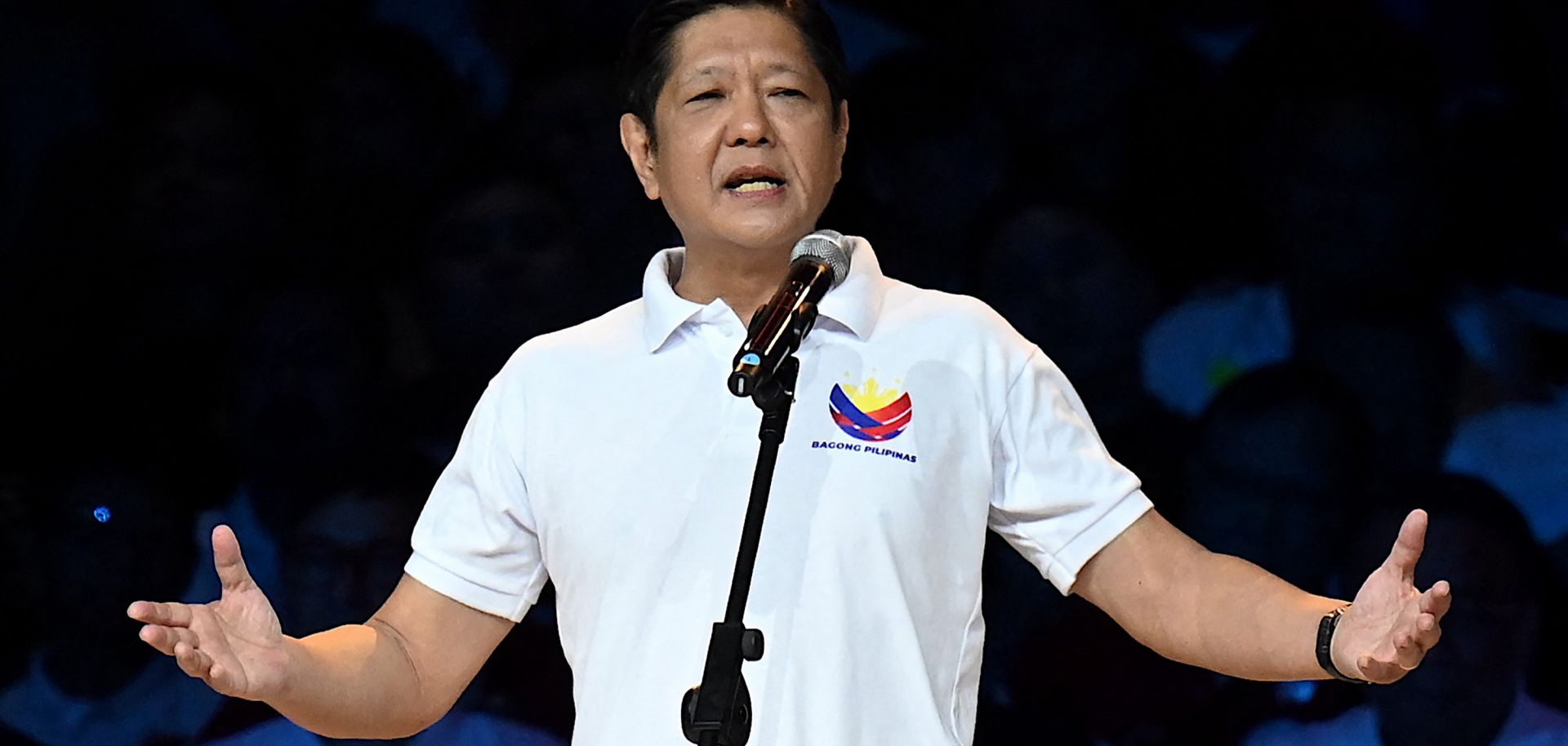
In the Philippines, a growing political dispute between President Ferdinand Marcos Jr. and former President Rodrigo Duterte could reignite secessionist sentiment on the Mindanao island and potentially derail government efforts to open the country to foreign investment and keep close ties with the United States. In early January, the Philippines House of Representatives began a nationwide signature campaign to initiate a People's Initiative to amend the 1987 constitution, distributed mostly through local mayoral offices but also through private activist efforts. Specifically, the petition asks voters whether they support amending the constitution to require both chambers of Congress to vote jointly on constitutional changes. Congress would then vote on lifting caps on foreign ownership of businesses and Filipino natural resources. The Senate, which totals 24 members to the House's 316, is against the initiative, given that it would effectively take away its voting power on such matters. Former President Duterte agrees with the Senate's position and on Jan. 30, threatened secession of his native Mindanao region in response. He also alleged current President Marcos, who backs the constitutional reform initiative, is intent on consolidating power and staying in office beyond his single six-year term (which the constitution forbids).
- The Marcos and Duterte families, both competing dynasties in Filipino politics, joined in 2022 to form the so-called Unity Team via Marcos as president and Rodrigo Duterte's daughter, Sara, as vice president. This resulted in a landslide victory for the Marcos-Duterte ticket (besting the nearest competition by over 30 points).
- Cracks may have emerged in the Marcos-Duterte alliance as early as 2022, when newly elected Marcos moved to substantially deepen defense cooperation with the United States shortly after taking office. Tensions then accelerated in May 2023 amid public disagreements over the International Criminal Court investigation into Duterte, Marcos's decision to engage in peace talks with communist rebels, and his denial of confidential funds for the education department, which Vice President Sara Duterte also heads.
- There is a pending investigation into the elder Duterte concerning whether his remarks broke the law, according to the Philippine Department of Justice.
- The People's Initiative, which requires the support of at least 12% of the total number of registered voters and 3% of registered voters in every legislative district, as well as a plebiscite for ratification, is one of three methods to amend the constitution, but it is likely the only realistic one. The other two methods, a Constituent Assembly and Constitutional Convention, both require at least supermajority votes in both chambers of Congress, and the Senate is unlikely to willingly participate in either.
- In November 2023, a former senator alleged that the elder Duterte was fomenting dissent within the ranks of the armed forces and plotting a coup, which he denied.
Marcos is seeking to amend the constitution to ease business and resource ownership requirements for foreign entities, though critics allege he is aiming to alter the political system in his favor. Filipino law places heavy constraints on foreign business ownership, such as a 40% cap on foreign ownership of a corporation's stock that owns land, and all-natural resources are owned by the state per the constitution. These rules limit the country's ability to draw foreign investment and undertake joint oil and gas exploration and exploitation in the resource-rich South China Sea with foreign countries. President Marcos's position is that the 1987 constitution, put in place after the overthrow of his dictator father and namesake, must be altered to accommodate a ''globalized world'' and attract more foreign investors. However, the Senate alleges that the charter change is an attempt to extend term limits and change the country's political system from a presidential republic to a unicameral parliamentary system, which would eliminate the Senate. This is because the first attempt to change the constitution under former President Fidel Ramos in 1997 called precisely for these measures, which was opposed at the time by the Senate for the same reasons. Marcos's critics allege that his cousin, Speaker of the House Martin Romualdez, has no chance to become president but would be able to become prime minister under such a system because Romualdez has the support of the House (which would hypothetically vote him in as prime minister once it became a parliament), but not the voters, with Marcos's son Ilocos Norte Representative Sandro Marcos next in line. The early forecasted matchup for the 2028 presidential election is Romualdez versus Vice President Sara Duterte, with the latter pegged as the favorite.
- On Jan. 23, all 24 members of the Senate signed a manifesto describing Marcos's constitutional amendment push as ''sinister and underhanded.''
- Both Marcos and Romualdez have denied that either this scheme or Marcos staying on beyond his six-year term is their intention.
Duterte's Mindanao secession threat has little chance of materializing, but the deepening rivalry between his camp and Marcos's camp could spark civil unrest and undermine peace talks with Mindanao separatist groups, which could result in an uptick in isolated attacks. Given the near-uniform opposition to Mindanao independence among Filipino leadership and the authorities' pledge to respond with force, it is highly unlikely that a real push for secession will materialize. The political fallout from the elder Duterte's rhetoric could still cause problems, however. Talk of secession could stir separatist sentiment and undermine peace negotiations with separatist groups on the restive southern island. For example, peace talks that Marcos restarted in November 2023 with the National Democratic Front (NDF), a communist separatist group active in Mindanao, have already been shaky, with the group stating in December that it remained committed to ''waging extensive and intensive guerrilla warfare'' and rebuilding the National People's Army, its armed wing, despite the negotiations. Moreover, the jihadist group Abu Sayyaf, which has pledged allegiance to the Islamic State, claimed responsibility for a Dec. 2 terrorist attack on a Catholic mass in Marawi, Mindanao, that killed three people. The deteriorating political situation could likewise inspire additional but isolated attacks.
- On Feb. 4, National Security Advisor Eduardo Ano said that any attempt to secede ''will be met by the government with resolute force.'' On Feb. 5, Defense Secretary Gilberto Teodoro vowed to ''strictly enforce'' Philippine sovereignty. The Department of Justice similarly released a statement ''vehemently oppos[ing]'' the remarks the same day. Mindanao's local authorities have also rejected the secession call.
- Duterte's Mindanao independence suggestion could be out of fear that Marcos will rejoin the International Criminal Court (ICC), which is investigating the former president's war on drugs that resulted in thousands of extrajudicial killings. Marcos ended cooperation with the ICC early in his term and has repeatedly stated that the investigation infringes on Filipino sovereignty, though the deepening rivalry with the Dutertes could motivate him to change his mind.
- Marcos and Duterte have spoken in front of competing rallies in recent weeks, riling up their supporters.
- The NDF has waged armed conflict against the government at varying degrees of intensity since 1969 (and is the world's longest-running communist insurgency). However, the NDF's ranks have shrunken substantially in recent decades, and the group now only has a few thousand fighters. On Dec. 25, the Philippines' anti-communist task force launched an assault on the NDF, killing nine of its fighters.
- The Moro Islamic Liberation Front is also active in Mindanao and staged an ambush in August 2023, killing a soldier and police officer, though it formally renounced independence as an organizational goal in 2012. According to a Philippine major, over a dozen militant groups continue to operate in Mindanao.
- Former Speaker of the House and Mindanao native Pantaleon Alvarez has advocated for the Christian-majority area of Mindanao to secede since 2005. He reiterated his support for this in response to Marcos's push to amend the constitution.
The deepening divide between the Filipino dynasts will likely drive shifting alliances in national politics, and if Marcos is outmaneuvered in Congress, his ambitions to harness energy resources and continue deepening military cooperation with the United States will be in jeopardy. If the Duterte camp gets its way and the constitution is not amended, restrictions on foreign businesses and ownership of resources will remain unaffected. Proposed joint exploration initiatives with China in the South China Sea would also remain unconstitutional, limiting the exploration and exploitation of energy resources in the contested waterway. China has conversely stymied most unilateral efforts to harness oil and gas in the South China Sea, as Beijing has a longstanding territorial dispute with the Philippines in the maritime space and thus actively and physically prevents Filipino exploration by force. Amending the Philippines constitution to allow joint exploration would very likely be met positively by China, as the two countries have often discussed easing tensions and mutually benefiting from such an arrangement, most recently in December 2023. However, such rapprochement efforts have made little progress due to constitutional constraints and ongoing geopolitical tensions. As the intensifying rivalry between the Marcos and Duterte camps continues to deepen political polarization in the Philippines, a significant enough dip in Marcos's approval rating could likewise drive a shift in policy preferences in Congress not directly related to constitutional reform. For example, Marcos's strong geopolitical pivot toward the United States could be stalled. Moreover, each camp will ramp up efforts to get preferred candidates elected in congressional elections in 2025. If the Dutertes manage to achieve majority congressional support next year, aspects of the U.S. alliance could even be reversed, such as the U.S. military's current access to nine sites in the Philippines under the two countries' Enhanced Defense Cooperation Agreement that was revitalized in November 2022.
- The Philippines is highly dependent on energy imports, making it vulnerable to global market shocks. Much of the energy-rich waters within its exclusive economic zone remain unexplored. The Philippines Department of Energy estimates that 6,203 million barrels of oil and 12.2 billion cubic feet of gas reserves lie untouched within its EEZ, which are massive amounts.
- Duterte had a strong preference for Beijing during his tenure as president, though began leaning back toward Washington near the end of his term.
- The Duterte camp argues that reinvigorating the alliance with the United States threatens the Philippines by putting it on the frontline of the U.S.-China competition. On Feb. 2, Sebastian Duterte, the former president's son and mayor of Davao City, similarly called on Marcos to resign over his ''flawed policies'' that ''endanger the lives of innocent Filipinos.''
- The Catholic Church, a major institution in the Philippines, has similarly come out against Marcos's push to amend the constitution, arguing it benefits only a small, self-interested group of politicians, and even alleging the Marcos government is bribing voters to support the initiative. The Church, however, cannot be said to be in the Duterte camp as it deeply opposed his war on drugs during his presidency.
