
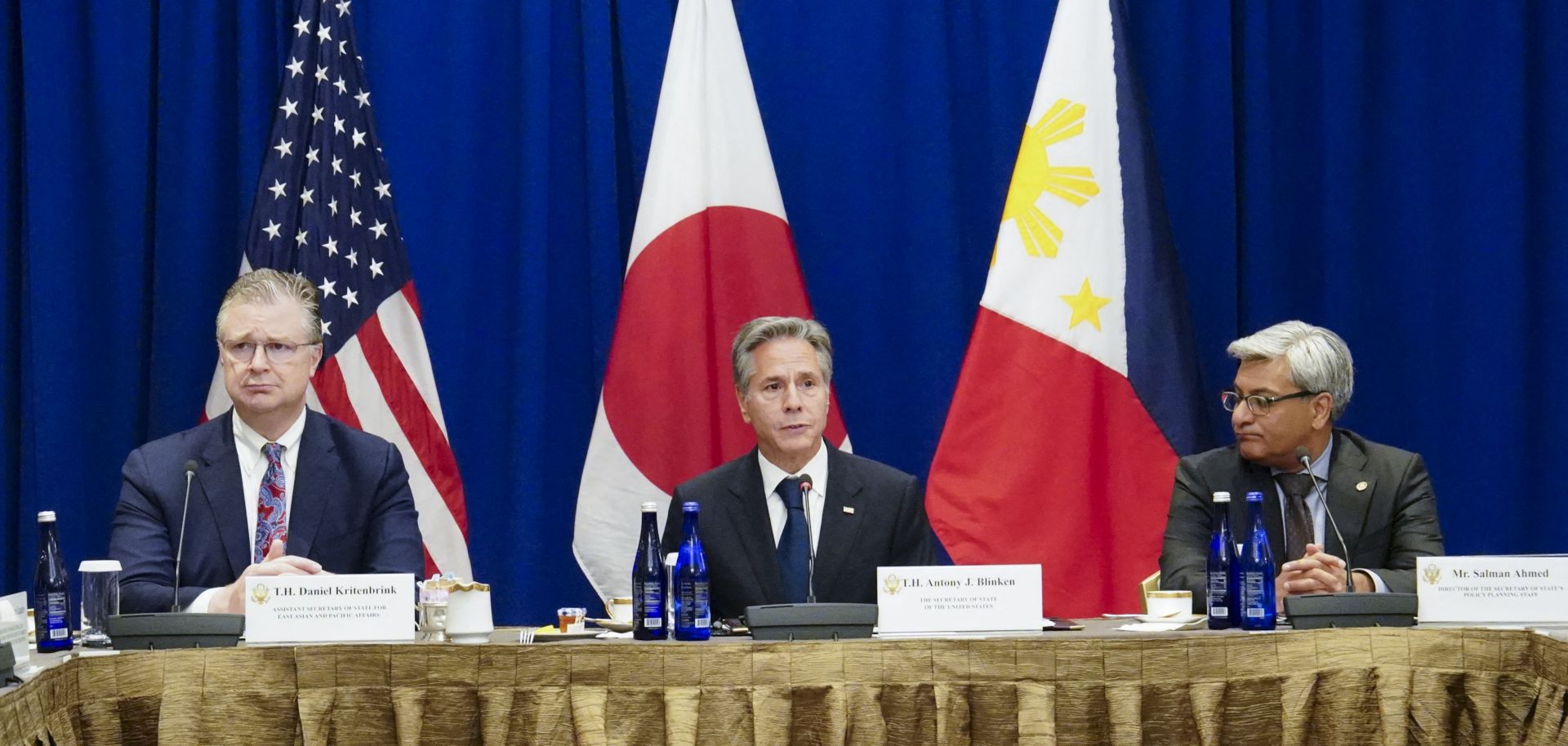
A trilateral partnership between the United States, Japan and the Philippines focusing on cyberdefense, joint maritime patrols and supply chain resilience will likely help improve freedom of navigation and economic security in the South China Sea, but it may also raise the risk of trade disputes and conflict with China. U.S. President Joe Biden will host Japanese Prime Minister Fumio Kishida for a state visit on April 10, followed by a trilateral summit on April 11 where Philippine President Ferdinand Marcos Jr. will also be present. The trilateral summit between the United States, the Philippines and Japan will be the first of its kind and will focus on three main areas: national security, economic security and mitigating climate change, with an eye toward institutionalizing cooperation via formal dialogue mechanisms in the medium-to-long term. The summit will likely conclude with the issuance of a joint vision statement laying out each country's roles and responsibilities in these areas. Specifically, talks will focus on maritime security and mutually strengthening supply chain resiliency in emerging technologies. The three sides will likely agree to establish joint patrols in the South China Sea and seek to address China's gray-zone tactics in the disputed maritime region. When it comes to economic relations, the countries will also likely reach agreements that aim to bolster supply chain resilience in semiconductor chips and critical minerals like nickel.
- The bilateral U.S.-Japan summit on April 10 will focus on integrating the two countries' defense industries, particularly in shipbuilding, and organizing a joint command structure.
- Prior to the April 11 trilateral summit between the United States, the Philippines and Japan, Kishida will deliver a speech to a joint sitting of the U.S. Congress, becoming the first Japanese prime minister to do so since the late Shinzo Abe in 2015.
- Both Japan and the Philippines are treaty allies of the United States.
The U.S.-Philippines-Japan summit comes amid uncertainty regarding future political and strategic directions in the United States and Japan. The April 11 meeting will be held at a time of domestic political uncertainty in all three countries. Philippine President Marcos, who took office in June 2022, is embroiled in a domestic political dispute at home regarding a controversial plan to amend the country's constitution, with powerful critics calling for his ouster. Meanwhile, in Japan, a slush fund scandal involving Kishida and his ruling Liberal Democratic Party (LDP) is raising doubts about whether he will win the LDP's September 2024 leadership elections and stay on as prime minister. In the United States, Biden could be unseated by former President Donald Trump in the November 2024 election. Barring an extreme turn of events in the Philippines, Marcos' position as president is unlikely to come under threat. Kishida and Biden's days, however, may very well be numbered, creating a sense of urgency to lock in these upgraded frameworks ahead of the potential leadership changes in the United States and Japan this year, which would create uncertainty in terms of policy continuity — especially U.S. strategy if Trump is re-elected.
The summit also comes amid deepening regional security worries. The main goal of the trilateral summit is upgrading the framework of the existing U.S.-led security architecture in the region by consolidating bifurcated partnerships into multilateral blocs to address common concerns, such as freedom of navigation, supply chain realignment, weapons systems interoperability and confronting the strategic threat posed by an increasingly assertive China. The U.S.-Japan alliance constitutes the center of gravity in this trend, first leading to trilateral cooperation in northeast Asia with South Korea, and now in Southeast Asia with the Philippines. In recent years, Japan and the Philippines have been ramping up their defense spending and modernizing their armed forces in response to what they see as growing security threats in the region, primarily from nearby China. The Philippines, in particular, has encountered more frequent and intense maritime standoffs with China in the South China Sea over the past 18 months. These incidents have seen Chinese forces use tools like water cannons to block Philippine resupply missions in what is known as ''gray zone tactics,'' or actions that do not cross the threshold of ''armed attacks'' that would prompt the United States to come to the Philippines' defense per the two countries' 1951 Mutual Defense Treaty. Altering the maritime balance of power in favor of the Philippines is intended to deter an escalation of Chinese behavior to more overt attacks that would trigger a U.S. military intervention.
- The upcoming U.S.-Philippines-Japan meeting follows other U.S.-involved multilateral initiatives in the region, such as the Quad partnership with the United Kingdom, India and Australia and the AUKUS agreement with the United Kingdom and Australia. The April 11 trilateral summit also mirrors the U.S.-Japan-South Korea summit that took place at Camp David in August 2023; Washington, Tokyo and Seoul will hold their second trilateral summit this year, most likely in May.
- Since taking office as Philippine president in June 2022, Marcos has undertaken a diplomatic push to secure a wider array of defense partnerships and to deepen existing ones, including with Australia. The Marcos administration has also employed a ''name and shame'' policy in the South China Sea wherein Manila has sought to expose alleged Chinese military coercion by highly publicizing incidents in the disputed waterway and allowing journalists to embed with its missions.
- The latest incident in the South China Sea between China and the Philippines occurred on March 26. The Chinese Coast Guard employed water cannons to hinder a Philippine vessel from carrying out a resupply mission to the Second Thomas Shoal, a submerged reef administered by the Philippines within its exclusive economic zone that houses a derelict World War II-era warship manned by a small detachment of Philippine marines. On March 28, Marcos declared that the Philippines would respond to the incident with ''deliberate countermeasures,'' the substance of which will likely be further discussed at the trilateral summit as well.
The summit will enhance cooperation between the United States, Japan and the Philippines in cyberdefense and maritime security, with direct involvement of Japanese forces in the South China Sea disputes for the first time, likely helping to increase freedom of navigation and supply chain security while also posing a risk of conflict. The United States and Japan already have a framework for ministry-level cyberdefense dialogue in place. At the summit, the two countries will likely expand this dialogue to incorporate the Philippines by unveiling a new trilateral framework. The impetus is the common cyber threats posed to each country by China, Russia and North Korea. Cyberattacks by suspected Chinese threat actors have increased in the Philippines amid the uptick in maritime tensions; cyberattacks against Japanese targets, such as on critical infrastructure, telecommunications systems and government agencies, have also increased since 2021. The other main defense aspect that the countries will discuss at the summit will be joint maritime patrols in the South China Sea, which, according to the Philippine ambassador to the United States, have already been agreed to in principle. Details left to iron out at the meeting include the patrols' start date, frequency and locations. With these patrolling missions, Japan will physically enter the South China Sea strategic space for the first time and become directly involved in the Philippines' territorial dispute with China. While an armed conflict remains unlikely, this will carry the risk of escalation with China by increasing the likelihood of accidents and miscalculations, such as real-time errors that see the forces of one country use live fire on another's assets. Moreover, as a result of Tokyo's decision to join patrols, Beijing could retaliate economically by, for example, placing trade restrictions on Japanese and/or Philippine goods in the automobile, electronics, agricultural, industrial machinery and other possible sectors. In this sense, the scope and locations of the patrols will matter, particularly in the context of adding Japanese forces to the mix, by determining to what extent the risk of clashes with Chinese maritime forces will ultimately increase. At the same time, carrying out the patrols in the South China Sea will reinforce the three countries' strategic imperative to secure freedom of navigation in the waterway amid China's sweeping territorial claims. However, absent direct U.S. and/or Japanese intervention in resupply missions, these arrangements are unlikely to alone compel China to modify its behavior.
- The United States has previously discussed establishing ministry-level cyberdefense dialogue with the Philippines, looking to build on new bilateral defense guidelines issued in May 2023 that include a cyberdefense component.
- In September 2023, the United States and Japan issued a joint cybersecurity advisory on Chinese cyber threat actors, which highlighted prioritizing intelligence sharing and coordinated responses.
- In August 2023, suspected Chinese hackers breached Japan's cybersecurity agency, potentially gaining access to sensitive information. In November, Japan disclosed that its aerospace exploration agency, JAXA, was also hacked, while major electronics manufacturer Aviation Electronics reported a cyber attack the same month.
- In February, cyberattacks originating from China attempted to infiltrate Philippine government websites and email networks, including those of President Marcos.
- On April 7, Australia, Japan, the Philippines and the United States undertook the four countries' first large-scale naval exercise in the South China Sea under the Multilateral Maritime Cooperative Activity framework.
In terms of economic cooperation, the summit will likely yield new frameworks to collaborate on green energy, critical minerals, semiconductors and telecommunications that seek to reduce supply chain risks, though implementation will prove challenging. The United States, Japan and the Philippines, like other countries, are seeking to develop global and regional supply chain networks that are less vulnerable to sudden disruptions amid an increasingly volatile geopolitical landscape by enhancing trade with like-minded countries, while minimizing supply chain exposure to rival countries (like China), particularly in strategic sectors (like semiconductors and critical minerals). For the United States and Japan, supply chain collaboration with the Philippines will also largely be aimed at increasing and securing their nickel supplies. The Philippines is the world's second-largest producer of nickel after Indonesia, accounting for around 10% of global supplies, though much of this remains untapped due to underdeveloped infrastructure and environmental concerns. The potential for more nickel, a key mineral for the energy transition, increases the Philippines' attractiveness for U.S. and Japanese investment in the sector, which would, in turn, facilitate additional, more effective and more environmentally sound mining operations. Tokyo and Washington may also agree to help build out 5G telecommunication networks in the Philippines (particularly as much of the existing 5G infrastructure in the Philippines is Chinese-owned, creating a vulnerability). In addition, the United States could assist in developing semiconductor assembly, testing and packaging facilities in the Philippines, with additional Japanese assistance in training Filipino semiconductor engineers. For the United States and Japan, such initiatives would be part of a broader effort to help wean the Philippines off of Chinese economic dependency by providing wanted infrastructure and a viable alternative for trade and investment. However, whether the two countries will be able to build out the necessary infrastructure in a timely manner remains uncertain due to structural constraints in the Philippines, such as limited funding, a lack of technical know-how, naturally occurring environmental hazards, corruption and bureaucratic red tape. Moreover, for Manila, economic cooperation with Beijing has proven cheaper, faster and more economically efficient in most cases, meaning providing a successful alternative to China will be a challenge for the United States and Japan. In the medium-to-long term, much will depend on efficiency and following through on promises. If these agreements are poorly implemented, the Philippines could lean back toward China in the coming years.
- China, which is typically among the world's most effective infrastructure builders, failed to follow through on several Belt and Road Initiative infrastructure projects in the Philippines in recent years. This bodes poorly for potential U.S. and Japanese infrastructure initiatives, which tend to operate more slowly than Chinese initiatives.
- Nickel is key to the production of electric vehicle batteries and other emerging technologies that countries are rushing to acquire.
- In March, the U.S. Presidential Trade and Investment Mission to the Philippines announced that U.S. companies had committed over $1 billion worth of investments in the country.
- Japan's interest in the South China Sea is to keep vital shipping lanes open. Around 90% of Japanese trade passes through the waterway, including energy supplies such as crude oil from Saudi Arabia and the United Arab Emirates. Japanese trade with Southeast Asia, as well as with Europe, also depends on free transit through the South China Sea. Moreover, around 94% of Japanese energy supplies are imported, rendering it almost entirely dependent on maritime trade.
