
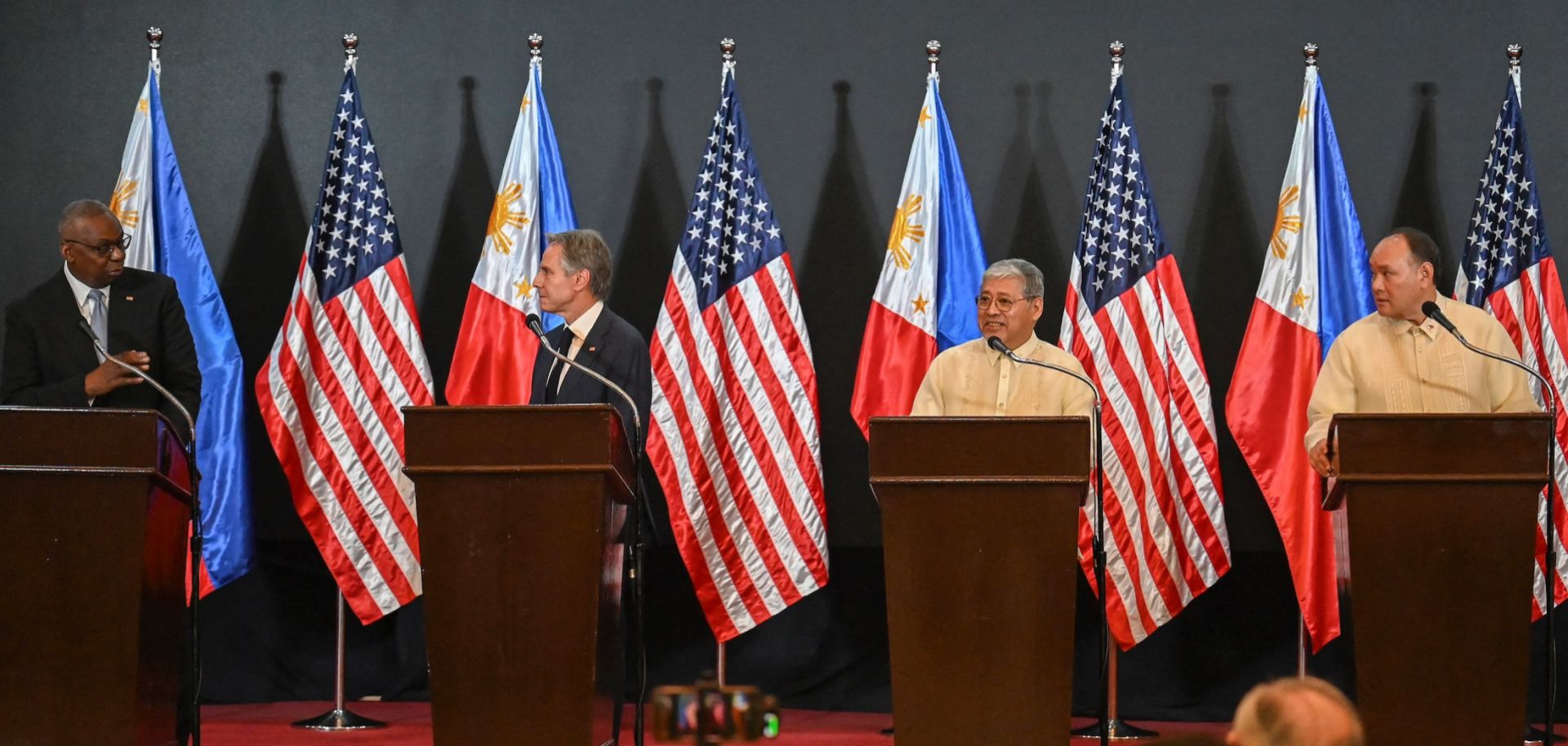
A recent slew of U.S.-Philippine agreements indicates an effort by both governments to rapidly expand defense cooperation and further institutionalize their alliance before Donald Trump returns to the White House in January. The United States and the Philippines significantly deepened their defense alliance between Nov. 18 and 21 in a series of high-profile developments. On Nov. 18, the two countries signed a General Security of Military Information Agreement, or GSOMIA, which enables a substantial expansion of mechanisms for the secure exchange of classified information between the two countries, as well as for advanced U.S. defense technology. On the same day, the two countries also inaugurated the Combined Coordination Center in Manila, which is designed to enable real-time operational coordination, intelligence sharing and joint mission planning between their militaries. On Nov. 19, the United States then announced it would provide the Philippine Navy with an undisclosed number of unmanned surface vessels, or USVs, to enhance its maritime surveillance and domain awareness, thereby enabling the Philippines to more effectively monitor its territorial waters amid ongoing Chinese assertiveness. Finally, the two sides announced the establishment of Task Force-Ayungin, a U.S. military task force that will assist the Philippines in intelligence, surveillance and reconnaissance in the disputed South China Sea. Together, these steps represent a transformative expansion of the U.S.-Philippine defense partnership, demonstrating a strengthened unified approach in the final months of U.S. President Joe Biden's term.
- The GSOMIA will grant the Philippine Armed Forces access to sophisticated and closely guarded U.S. weapons technology, opening the door to the future transfer of advanced weapons that use such technology, such as U.S. Patriot missiles, advanced multirole fighters, unmanned aerial systems like Reaper drones and advanced artillery like High Mobility Artillery Rocket Systems (HIMARS), as well as advanced surveillance technologies.
- The U.S.-led Task Force-Ayungin will focus on the Second Thomas Shoal hotspot in the South China Sea (called the Ayungin Shoal in the Philippines).
These developments come ahead of U.S. President-elect Donald Trump's inauguration in January and the Philippines' midterm elections in May, both of which could yield policy shifts that undermine U.S.-Philippine ties. The expansion of U.S.-Philippines defense cooperation is likely tied to post-election dynamics in the United States and the evolving security concerns of both nations. In his final months in office, Biden is seeking to solidify the gains his administration has made regarding the alliance with the Philippines, which plays an increasingly important strategic role in regionally containing China and staving off its encroachment into the disputed South China Sea. By fast-tracking agreements such as the GSOMIA and advancing military initiatives, the outgoing Biden administration is hoping to ensure the continuity of its Indo-Pacific strategy, regardless of potential shifts in domestic or foreign policy priorities under its successor. There is a sense of urgency from the Philippine perspective as well. For President Ferdinand Marcos Jr., China's escalating provocations in the South China Sea have added impetus to his push to strengthen the Philippines' military capabilities and external partnerships, including with the United States. But the Philippines' May 2025 midterm elections could disrupt Marcos' foreign policy, which the opposition argues heightens the risk of a war with China that could decimate the Philippines and thus advocates a change in tack. If opposition lawmakers secure a legislative majority in the elections, they could slow or even stall deepening defense cooperation with the United States, putting Marcos on a potential deadline as well, depending on the outcome.
- Since taking office in June 2022, Marcos has prioritized securing the country's maritime interests in light of increased Chinese assertiveness and use of gray zone tactics. There have been at least 15 high-profile confrontations between Chinese and Philippine maritime forces over his term.
- China's provocations in the South China Sea consistently escalate during Philippine resupply missions to contested outposts like the Second Thomas Shoal, fishing activities in traditional grounds (such as around Scarborough Shoal) and Philippine-U.S. military exercises and defense announcements. China regularly employs tactics like vessel blockades, laser targeting and harassment by maritime militia.
- Marcos' top critic is his predecessor, former President Rodrigo Duterte, with whom he is openly feuding. Politicians aligned with Duterte are far more likely to be skeptical of defense cooperation with the United States and wary of alienating China, including Vice President Sara Duterte, the former president's daughter.
In its final weeks in office, the Biden administration may reach additional agreements to bolster the Philippines' maritime capabilities. The recent acceleration of U.S.-Philippines defense initiatives signals a broader push by the Biden administration to solidify the alliance before the transition to a new administration. This suggests that additional high-impact initiatives could be fast-tracked in the coming weeks to further entrench the partnership. Such efforts would likely prioritize enhancing the Philippines' maritime capabilities, ensuring the sustainability of joint operational frameworks and institutionalizing mechanisms that future administrations (both U.S. and Philippine) would find cumbersome to reverse. The Biden administration could prioritize expanding the two countries' Enhanced Defense Cooperation Agreement, or EDCA, sites, for example by adding another site on Palawan in the South China Sea to host prepositioned U.S. defense equipment and support joint operations. Efforts to bolster the Philippines' naval and air capabilities could include expedited transfers of patrol boats, drones and surveillance aircraft, as well as fast-tracked training programs to enhance maritime domain awareness. Agreements on joint military exercises such as Balikatan could also be expanded to include more live-fire drills and maritime interdiction scenarios, potentially involving partners like Japan or Australia to build broader regional support. Diplomatic initiatives, such as an annual U.S.-Philippines defense dialogue or a regional maritime surveillance network, could see more thorough institutionalization as well. Meanwhile, U.S. economic projects under the Indo-Pacific Economic Framework could complement these efforts by investing in port and energy infrastructure, linking security goals with development priorities.
- The Nov. 18-21 agreements and any additional deals in the coming weeks will likely provoke a response from Beijing. China has long criticized the United States for interfering in regional disputes and will likely perceive these moves as a direct challenge. Possible Chinese responses could include increased deployments of maritime militia near contested features, more aggressive harassment of Philippine vessels or enhanced military exercises in disputed areas.
The incoming Trump administration is unlikely to scrap the existing U.S.-Philippine agreements, but it is also less likely to make similar deals in the future absent larger contributions from Manila. Against the backdrop of Washington's escalating competition with Beijing, Trump has recognized the Philippines as key to U.S. strategy vis-a-vis China, meaning his incoming administration is unlikely to exit these deals. However, given Trump's transactional approach to foreign policy, his administration is also unlikely to seek to deepen the U.S.-Philippine partnership without more substantial gives from Manila. Before agreeing to further arrangements, the Trump administration would likely ask for more in return, such as greater financial contributions from Manila (e.g., in maintaining EDCA sites), greater operational freedom for U.S. forces in the Philippines (which is currently limited to EDCA sites), or commitments to host forward deployed U.S. weapons systems. Through his more transactional approach, Trump could also seek concessions beyond the defense realm, such as through efforts to narrow the trade imbalance between the two countries.
- Marcos and Trump spoke by phone on Nov. 19 with both leaders expressing a general desire to deepen their countries' partnership.
- The Philippines had a $6.3 billion trade surplus with the United States in 2023.
