
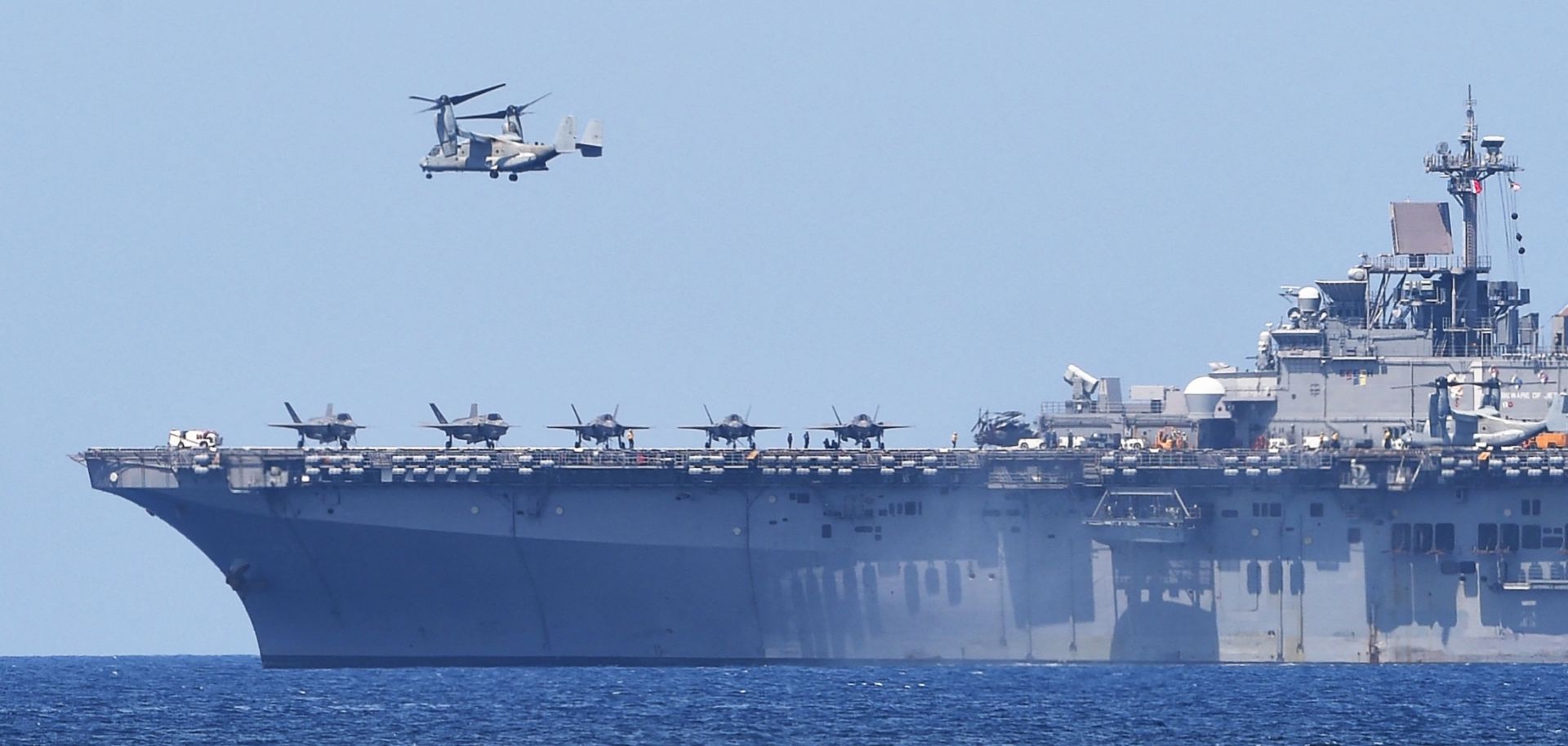
The outcome of the U.S. presidential election will impact Washington's defense partnership with the Philippines, with a Harris administration likely continuing the current multilateral, security-focused strategies, while a Trump administration would likely shift toward a transactional, bilateral approach that could strengthen or strain ties depending on Manila's response to increased U.S. demands. Despite its increasing relevance in the larger South China Sea territorial dispute, the United States' alliance with the Philippines alliance has not featured heavily in the U.S. presidential election campaign, with neither Democratic candidate Kamala Harris nor Republican candidate Donald Trump laying out clear policy preferences on the matter. Nonetheless, broader statements made by Harris regarding her stance on China and how she would approach U.S. diplomacy and military posture in the Indo-Pacific suggest her administration would maintain President Joe Biden's current multilateral approach to the Philippines, which has emphasized human rights and democratic values as part of defense and economic cooperation. Meanwhile, Trump's approach to U.S. allies during his previous term indicates he would likely place greater emphasis on bilateralism and more quickly attainable and tangible wins, which for the Philippines, would likely entail a tighter focus on military and economic ties with less pressure on governance and human rights standards — potentially allowing for more flexibility in defense agreements and strategic alignments, especially regarding China, though this will also likely require greater contributions from the Philippines. In the meantime, domestic developments in the Philippines (and most notably the 2025 midterm elections) will also shape Manila's views on both regional security and its relations with the White House.
- The U.S.-Philippines alliance — and, in particular, the larger South China Sea territorial dispute to which it has become increasingly relevant in recent years — is key to broader U.S. foreign policy in several contexts, including geopolitical competition with China, global shipping and trade (with $3.5 trillion of goods transiting the South China Sea each year) and greater regional stability (as growing tensions in the waterway risk sparking armed conflict). Indeed, the South China Sea's geography acts as a gateway between the Indian and Pacific Oceans and will thus remain crucial in U.S. military and strategic considerations for the foreseeable future.
The U.S.-Philippines alliance entered a new era in 2022 with the election of Philippine President Ferdinand Marcos Jr. When Marcos came into office in June 2022, the U.S.-Philippines relationship was at a crossroads. Marcos' predecessor, former President Rodrigo Duterte, spent much of his six-year term realigning Manila into China's orbit. However, Duterte's overtures to China did not substantially alter Beijing's behavior in the disputed waterway, with China continuing to build and militarize artificial islands while encroaching on the Philippines' exclusive economic zone, especially around the Spratly Islands and Scarborough Shoal. Beijing also failed to follow through on key infrastructure and investment promises. These two factors led to Duterte's disillusionment with China, prompting him to lean back toward the United States in 2021. Marcos has since intensified this trend, with his inauguration marking a firm commitment to strengthen ties with Washington. As a result, U.S.-Philippines defense cooperation has notably deepened under Marcos, best exemplified by the 2023 revival of the two countries' Enhanced Defense Cooperation Agreement, or EDCA, a de facto basing agreement for U.S. troops signed in 2014 that Duterte had delayed implementing. Meanwhile, bilateral economic ties, while more modest than military ties, are being bolstered through infrastructure investments and security-related cooperation in sectors like energy and telecommunications, which Philippine policymakers have highlighted as key economic needs that the country had previously relied on China to deliver.
- Duterte had sought closer economic ties with Beijing, downplaying the Philippines' territorial disputes with China in the South China Sea and making public statements minimizing the importance of the U.S.-Philippine alliance. For a time, Duterte even suspended joint military exercises with the United States and explored nullifying the two countries' Visiting Forces Agreement.
- Shortly after Marcos took office, he reaffirmed the 1951 U.S.-Philippines Mutual Defense Treaty, stating that the Philippines' relationship with the United States remains a ''pillar'' of Philippine foreign policy. This treaty remains at the core of U.S.-Philippine military relations, as it obliges both nations to come to each other's defense in the event of an armed attack.
- The original EDCA signed in 2014 allowed the United States to rotate troops and store defense equipment at five Philippine bases. Under the expanded EDCA reached in 2023, the United States gained access to four additional military bases, bringing the total to nine locations across the Philippines.
- The annual Balikatan military exercises, co-hosted by the United States and the Philippines, saw its largest-ever iteration in April 2023, involving over 17,600 troops from both nations, including participation from additional regional partners like Australia.
If Harris is elected, the Philippines would likely remain a key U.S. strategic partner and central to the United States' efforts to counter China's regional influence. A Harris administration would likely strongly back the Philippines' territorial claims in international fora, while seeking to deter China via continued freedom of navigation operations that see the U.S. Navy regularly sail through the disputed waterway. Under Harris, Washington would also continue the focus on improving Manila's maritime defense, including by offering more military hardware like coast guard vessels, radar systems and drones to optimize surveillance and intelligence gathering capacity. However, U.S. defense commitments toward the Philippines have also been marked by a certain ambiguity around the phrasing of the Mutual Defense Treaty, specifically the term ''armed attack'' and how that relates to provocations in the South China Sea. Philippine maritime forces in the disputed waterway have routinely come under physical threat from their Chinese counterparts in the form of boat rammings, water canons and military-grade lasers being used to blind sailors. However, none of these incidents reach the threshold of an ''armed attack'' per the U.S. interpretation of the term, and Washington has never clarified what precisely would. This ambiguity would most likely continue under a Harris administration, barring an unlikely and highly escalatory incident (like one that involves live fire) that forces her administration to provide more clarity. This also means China would likely maintain its current strategy of staying within the so-called ''gray zone'' of warfare by pressuring the Philippines via assertive action but staying below the ''armed attack'' threshold that would trigger U.S. intervention. More broadly, a Harris administration would continue Biden's multilateralism push in the Indo-Pacific region, encouraging deepening partnerships between the Philippines and Washington's other regional allies, particularly Australia and Japan, as well as, to a lesser extent, South Korea.
- During a 2021 visit to Southeast Asia, Harris reaffirmed the U.S. commitment to supporting its allies and partners in the region, particularly regarding the South China Sea. In a speech delivered in Singapore in August 2021, she emphasized Wasington's opposition to China's ''unlawful'' claims in the South China Sea, stating that the United States will ''stand with our allies and partners in the face of threats.'' She reiterated the U.S. commitment to freedom of navigation and upholding international rules and norms, explicitly referencing the United Nations Convention on the Law of the Sea, which underpins the Philippines' legal victory against China in a 2016 arbitration ruling.
- Harris would also deepen U.S. involvement with the Association of Southeast Asian Nations, or ASEAN, of which the Philippines is a member. This is evidenced by public statements she made in 2021 and 2023 endorsing ASEAN centrality (the bloc's core doctrine) and promoting U.S.-ASEAN initiatives on sustainable infrastructure, climate change and the digital economy.
By contrast, Trump's transactional approach to diplomacy could either strengthen or deteriorate the U.S.-Philippine relationship depending on what he asks of Manila and if those asks are answered. Trump's return to the White House would inject more uncertainty into the U.S.-Philippines relationship, and could bring commitments made by the Biden administration into question. Still, Washington remains highly unlikely to abandon Manila. Instead, a second Trump administration would more likely seek to intensify bilateral security ties with the Philippines, given that Trump's foreign policy in the region would be focused through a China lens, with the Philippines likely to be seen as an indispensable link in regional security architecture designed to contain China within the first island chain. This bilateral approach could result in more robust defense ties, such as through another expansion of the EDCA. But it could also inhibit the Philippines' engagement with regional organizations like ASEAN, within which the Philippines already feels increasingly isolated as the only member state to take an openly confrontational stance toward China despite not being the only member state embroiled in a territorial dispute with Beijing. Trump's transactional approach to foreign policy also carries risks, as seen during his first term when he demanded U.S. allies provide greater financial contributions to shared security arrangements. If such a transaction (or set of transactions) is concluded, it would likely bolster the Philippines' defense capabilities and make the Trump administration more amenable to providing sought-after military hardware and fast-track trade and investment agreements. At the same time, Trump may make demands that are unpalatable to the Philippines, such as pre-positioning or forward deploying military assets in a way Manila deems overly antagonistic to China. Manila would likely also bristle at any U.S. demands to access Philippine shipbuilding and repair facilities, such as at Subic Bay, which would largely be seen as limiting Philippine sovereignty. If Washington makes such demands and Manila refuses to heed them, the two countries' defense partnership would weaken. Without careful management, and if such fracturing endured for a period of years, a more extreme scenario in which the Philippines no longer feels assured by U.S. commitments could drive Manila to again rebalance toward China.
- Trump's stance toward ASEAN during his 2017–2021 term reflected his broader approach to foreign policy, which emphasized bilateralism over multilateral engagement. While Trump maintained diplomatic ties with ASEAN, his administration was less engaged with the regional bloc than prior U.S. administrations.
Beyond the U.S. presidential election, the outcome of the Philippines' upcoming midterm elections could impact the alliance as well, if it enables former President Duterte to regain political influence. While Marcos has intensely pursued closer ties with the United States, midterm elections in May 2025 could impact his ability to maintain this trajectory if they shift the balance of power in Congress in favor of his predecessor. In these midterm elections, former President Duterte is running for mayor of Davao City (the Philippines' second most important political center after the capital Manila), while two of his sons are running for seats in the Senate (the upper house of the Philippines' legislature, which plays a crucial role in approving treaties and defense agreements). If Duterte and his family gain greater control of Davao City and the Mindanao region it represents (his traditional power base) and the Senate, they could push for a recalibration of foreign policy, possibly advocating for a stance they deem less antagonistic to China that likewise reduces reliance on U.S. military support, which, per their calculus, would mitigate the risk of an armed conflict erupting with China. This would likely also result in greater legislative pushback against Marcos' efforts to further deepen U.S.-Philippine military cooperation, especially in the South China Sea, as a Duterte-aligned Senate would probably advocate for a more balanced, non-aligned or even multi-aligned foreign policy.
- Duterte's daughter, Vice President Sara Duterte, is also eyeing a 2028 presidential run.
- The Marcos and Duterte families teamed up for the 2022 election, but the families have since publicly fallen out and feuded.
