
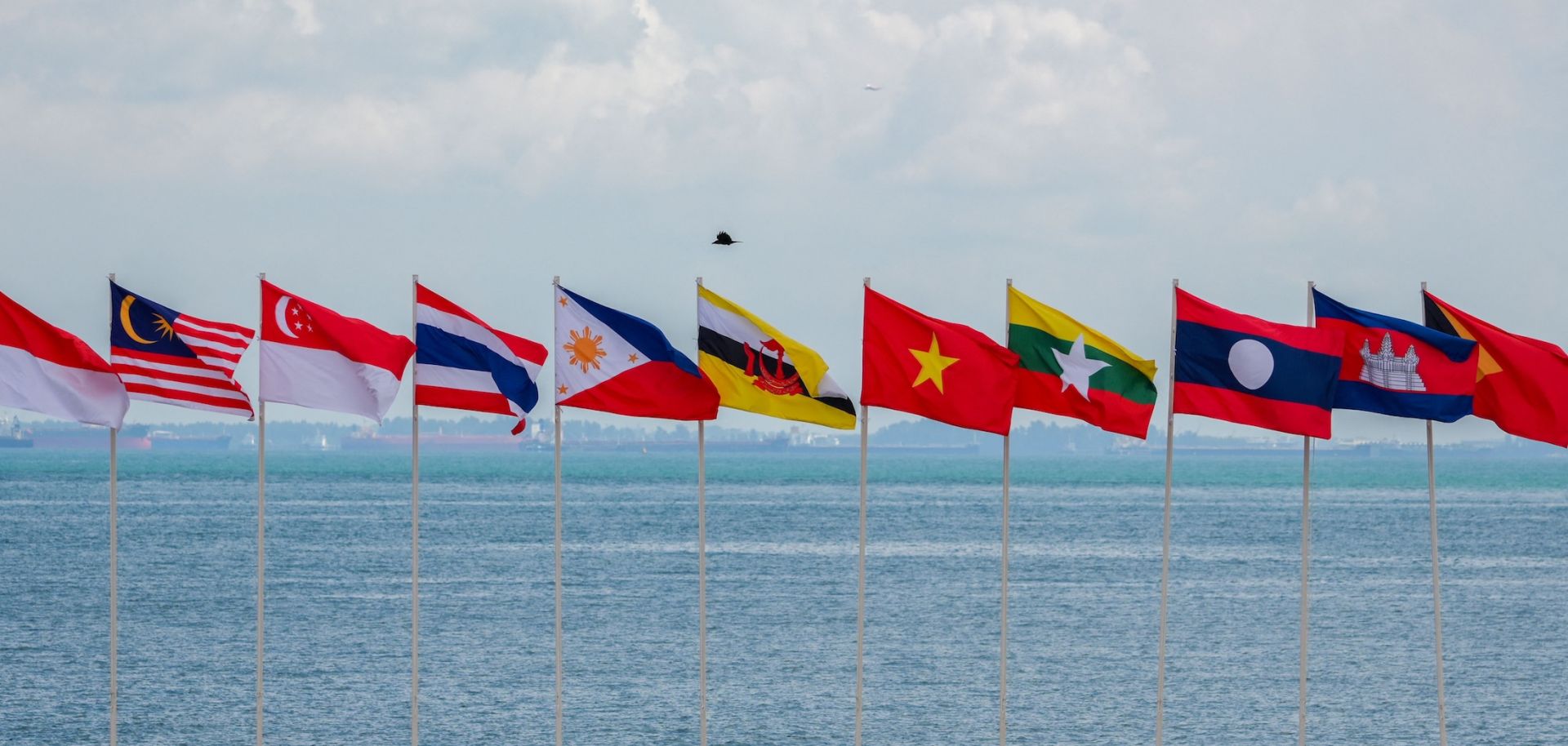
ASEAN members' economic and geopolitical diversity will hinder any significant progress toward deeper economic integration, despite their stated intention to collaborate more closely amid an emerging multipolar world order. The Association of Southeast Asian Nations, or ASEAN, is an economic and political grouping of 10 Southeast Asian countries. ASEAN's members vary significantly in terms of demography, economic development and political regimes, ranging from democracies like the Philippines and Indonesia to military-controlled regimes in Myanmar, as well as from liberal, laissez-faire economies like Singapore to "non-market" economies like Vietnam. Geopolitically, some countries are semi-aligned with China, while others are treaty allies of the United States. Compared with the most successful example of economic and political integration, the European Union, the region is economically far more heterogeneous, less aligned regarding security interests and lacking important intra-regional leadership to drive integration.
- ASEAN has 10 members: Brunei, Cambodia, Indonesia, Laos, Malaysia, Myanmar, the Philippines, Singapore, Thailand and Vietnam. The bloc was founded in 1967, and its charter commits members to accelerate economic growth, social progress and cultural development, as well as promote regional peace and stability.
- The population of ASEAN countries is almost 700 million. ASEAN economies account for around 7% of the global economy in terms of purchasing power parity. However, ASEAN economies account for a far smaller share of global economic output at market exchange rates, roughly equivalent to Japan or Germany.
- Several ASEAN countries are among the fastest-growing economies in the world, and economic growth in ASEAN is far higher than in Latin America, Eastern Europe and the Middle East. The International Monetary Fund projects that Cambodia and Indonesia will grow more than 5% in 2024-29 and that the Philippines and Vietnam will grow more than 6% during that period. The ASEAN laggards, Brunei, Myanmar and Thailand, will see average real gross domestic product growth of 2%-3%. The unweighted average real GDP growth (excluding Singapore) in ASEAN is projected to be 4.4% from 2024 to 2029.
ASEAN boasts its own free trade area, along with many external free trade agreements, or FTAs, with regional countries, but deeper integration remains elusive. All ASEAN members are part of the bloc's Free Trade Area, or AFTA, and ASEAN also has FTAs with other countries — including Australia, China, India, Japan, South Korea and New Zealand — as well as with other blocs like the Regional Comprehensive Economic Partnership, or RCEP. Most ASEAN members are also members of China's Belt and Road Initiative, and some ASEAN members are parties to other, separate FTAs. However, despite the abundance of FTAs between and beyond ASEAN members, these agreements are largely limited to tariff-free market access for goods and continue to lack deeper integration in terms of trade in services, the free flow of capital and the free flow of labor, limiting the overall degree of economic integration. ASEAN has tried to facilitate deeper integration by launching many ambitious economic goals over the years, but most of them remain unmet. For instance, ASEAN in 1995 adopted a Framework Agreement on Trade in Services and Mutual Recognition Agreements to liberalize trade in services, but progress has been limited, leading to the liberalization and mutual recognition of only a small number of selected professions. Additionally, ASEAN member states in 2007 signed a declaration pledging to establish an "EU-style community," which has yet to be realized. Likewise, ASEAN launched the ASEAN Economic Community in 2015 to create a common market, including further trade liberalization, regulatory harmonization, and the free movement of goods, services, capital and labor, but these goals remain largely unmet. ASEAN also aimed to progressively align its members' currency and macroeconomic policies and push for greater banking and capital market integration to support the single market, but progress toward greater monetary cooperation has progressed little since the Asian financial crisis in 1997. Similarly, ASEAN has pushed back its goal of establishing a common market to 2025, and it now looks highly unlikely that the bloc will achieve this objective next year.
- In 1992, AFTA established a common effective preferential tariff of 0%-0.5% among ASEAN members, which means ASEAN members largely trade goods duty-free among each other. However, Vietnam, Laos, Myanmar and Cambodia have yet to implement the internal preferential tariffs fully.
- In 2020, ASEAN joined RCEP, which aims to liberalize 90% of tariffs among members over the next two decades. RCEP is the world's largest trade bloc and includes all countries with which ASEAN has bilateral FTAs, except India. While RCEP primarily focuses on tariff reduction, it falls short of addressing increasingly important non-tariff barriers and other trade-related issues. Therefore, RCEP's economic benefits will be limited, except for facilitating greater supply chain integration across the region.
- Brunei, Malaysia, Singapore and Vietnam are members of the Comprehensive and Progressive Agreement for Trans-Pacific Partnership, which goes far beyond the removal of tariff barriers and compromises 11 Asian and Latin American economies.
Despite ASEAN's professed commitment to achieving deeper integration, further progress on intra-regional economic and financial cooperation will remain limited given the high degree of economic and geopolitical diversity between its members. A major reason ASEAN has struggled to meet its goals is its members' high degree of economic diversity, including their level of financial development. For instance, per capita income in terms of purchasing power parity varies widely, from $132,000 in Singapore to $5,200 in Myanmar. This makes economic integration more difficult, particularly the free movement of labor given the large-scale migration of labor flows from low- to high-income countries this would trigger. Vastly different approaches to financial development will also make it more difficult for ASEAN members to integrate their financial services. For instance, Singapore has a highly sophisticated, internationally oriented financial services sector, while Vietnam retains extensive controls over its capital account and financial system. De facto regional trade integration also remains limited due to ASEAN's economic size and the fact that ASEAN members trade far more with countries from outside the region. Meanwhile, geopolitical divergences will further constrain ASEAN members' economic integration amid U.S.-China strategic competition; ASEAN members remain split over which side — if any — to take, with Cambodia and Laos leaning toward China, while the Philippines and Thailand trend toward the United States. Amid these diverging interests, ASEAN lacks clear leadership to guide its members toward unified goals, leaving the bloc split into conflicting fragments. As a result, ASEAN's intra-regional trade (not just in goods, but also in terms of services and non-tariff barriers), capital flows, flows of people and exchange rate stability will remain limited. These limitations will reduce multinational corporations' interest in using ASEAN members for supply chain diversification, weakening the bloc's ability to take full advantage of U.S.-China de-risking and diversification policies.
- Not a single ASEAN member has more than one other ASEAN member as its top export market. Instead, the United States, the European Union, China, Japan and Hong Kong dominate the ranking of ASEAN members' top-five export markets.
- ASEAN is formally committed to upholding the status quo in the South China Sea and objects to China's nine-dash line that claims most of the maritime territory. However, ASEAN members' degree of security tension with China in the South China Sea and their willingness to take action vary. For instance, China's disputes with the Philippines and Vietnam are far more intense than those with Malaysia and Brunei.
