
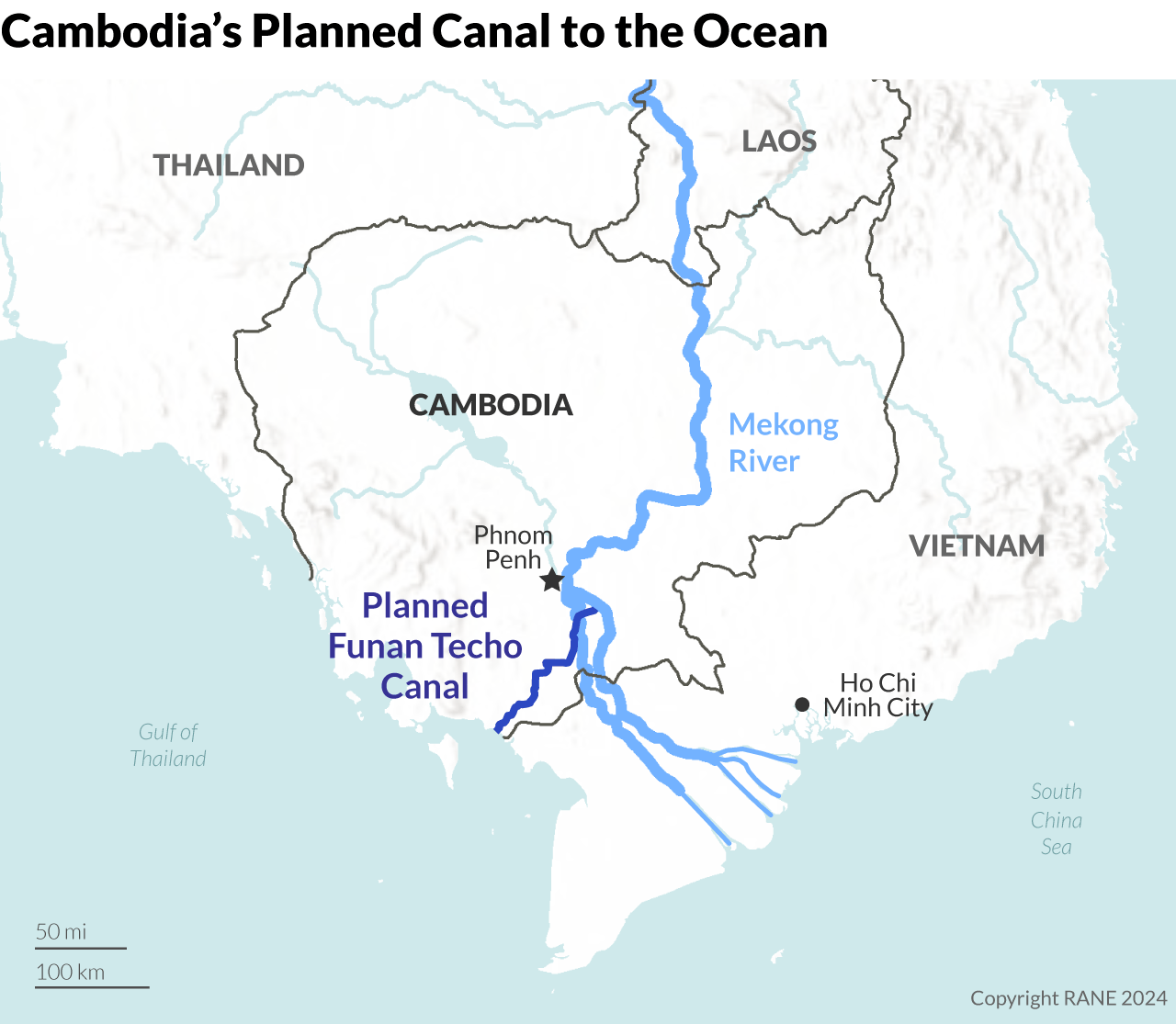
Cambodia's new canal project will encourage economic development and connectivity in the country while substantially reducing its dependence on Vietnam, which will stoke national security concerns in Hanoi, while contributing to China's broader geopolitical goal of constructing a global network of friendly ports. On May 7, Cambodian Deputy Prime Minister Sun Chantol confirmed that construction of the country's Funan Techo canal will begin sometime in 2024, with a target completion date of 2028. The planned canal will span 18 kilometers (around 11 miles), connecting the Phnom Penh Autonomous Port, a river port in the capital, to Kep province on the Gulf of Thailand. Envisioned to be 100 meters wide and up to 5.4 meters deep, it will accommodate vessels weighing up to 3,000 deadweight tons. A Chinese state-owned company, China Road and Bridge Corp., will oversee the development, administration and operation of the $1.7 billion project under Beijing's Belt and Road Initiative, assuming full financial responsibility for its construction and maintenance under a build-operate-transfer model. China Road and Bridge Corp. will then return the canal to Cambodia in 40-50 years once the company has recouped its expenses.
- Specifically, the canal will connect the small Mekong River tributary of Prek Teo with Prek Ta Ek and Prek Ta Hing, tributaries of the Bassac River that is itself a major tributary of the Mekong River. The canal will flow through four Cambodian provinces: Kandal, Takeo, Kampot and Kep. The potential environmental impacts of the project remain largely unknown.
- Prime Minister Hun Manet announced the initiative at a cabinet meeting in August 2023, his first major infrastructure initiative since taking office earlier that month.
The canal will help develop the industry in Cambodia's interior regions while enabling the country to circumvent Vietnam for trade and gain direct access to global markets, which will encourage foreign investment. The shipping channel will enable cargo vessels to travel directly from the sea into the interior regions of Cambodia, likely driving growth in inland transportation and industrial development for the Southeast Asian country, which remains a developing economy. The project aims to connect various regions within Cambodia, streamlining costs and time for the transportation of goods, services and people throughout the country. This will also improve Cambodia's transportation networks at large as extra infrastructure, such as roads, bridges and dams, will be constructed along with the canal. The Mekong River, along with its vast network of tributaries, is a major highway network for Cambodian goods and services, and the canal will increase and enhance boat traffic between the coast and the region surrounding the capital Phnom Penh in the country's interior. Moreover, approximately one-third of Cambodia's total imports and exports currently pass through Vietnam as they traverse the Mekong River. This has enabled Hanoi to employ various mechanisms, such as fees and licensing requirements, to collect revenues and maintain substantial influence over the flow of goods in and out of Cambodia. According to the plan, however, the Funan Techo canal is projected to reduce the amount of Cambodian cargo that must pass through Vietnam by 90%. The project will also combine with the Japan-funded Sihanoukville Autonomous Port, a deep-sea container port expected to begin operations in 2026, to allow Cambodia a greater ability to bypass foreign ports and trade directly with markets such as North America and Europe. Overall, the canal will encourage foreign direct investment in Cambodia, a policy priority of the government, by improving both domestic and international connectivity.
- The infrastructure blueprint for the canal includes three waterway dams, 11 bridges and over 200 kilometers of sidewalks to accommodate secure navigation and connectivity.
- In 1956, South Vietnam restricted access to the Port of Saigon to pressure Cambodian neutrality vis-a-vis North Vietnam. In 1994, Vietnam similarly blocked Cambodian trade along the water route for several months amid territorial tensions over Phu Quoc island. These examples demonstrate Vietnam's powerful leverage over Cambodian trade and, indirectly, over policy.
- Cambodia's top imports include pearls and semi-precious or precious stones; mineral fuels and knitted fabrics; mechanical appliances and parts thereof; electrical machinery and parts thereof; and plastics and aluminum. Its top exports include textiles and clothing, both knitted and unknitted; electrical machinery (such as sound recorders and televisions); handbags and other leather products; and footwear, furniture and rubber. The country is also growing as an exporter of solar panels.
Vietnam opposes the project as the canal would inevitably and significantly reduce its leverage over Cambodia, which would result in a loss of revenue and influence for Hanoi, while stoking national security fears of Chinese encirclement and greater Cambodian assertiveness. While Vietnam has raised alarms that the canal could accommodate Chinese warships, the canal's small dimensions render that highly unlikely. Nonetheless, the canal will accommodate barges, with its 100-meter width sufficient for two-way traffic. This means that small Chinese armed patrol vessels could fit within the waterway. While not posing an outsized national security threat per se, this fuels broader encirclement fears in Vietnam: China to the north, the Chinese-dominated South China Sea to the east, and increasingly Chinese-aligned Laos and Cambodia to the West. However, there are key constraints on China deploying military assets to Cambodia. Hosting foreign troops is forbidden under the Cambodian constitution, and doing so would likely trigger social unrest. It would also reduce the popularity of Cambodia's new prime minister, Hun Manet, as he looks to establish himself after taking over for his father Hun Sen in 2023, who served as prime minister for 38 years. Additionally, Vietnam is worried that Cambodia's diminished trade dependence on Vietnam will make Cambodia increasingly assertive over time, which could threaten to reinvigorate old territorial disputes between the two countries around the Mekong Delta and Phu Quoc island in future decades. Besides national security concerns, Vietnam's opposition to the project also comes from the loss of trade revenues and potential environmental and social impacts, such as the displacement of populations, loss of agricultural land, reduction of wetlands needed for irrigation (thus perpetuating water shortages), and increased salinization of the Mekong Delta.
- Vietnam has traditionally regarded Laos and Cambodia within its sphere of influence. The Vietnamese Communist Party historically empowered the two countries' governments in 1975 and 1989, respectively, enabling hegemony over the Indochinese Peninsula until Chinese influence eclipsed its own starting in the 2010s, mostly thanks to economic initiatives, aid, loans and the Belt and Road Initiative that Vietnam cannot match.
- China holds over 40% of Cambodia's approximate $10 billion of foreign debt.
- Cambodia has not had direct access from the Mekong River to the sea since the early 19th century when Vietnam completed its conquest of the southeasternmost tip of the Mekong Delta. This region, referred to as Kampuchea Krom from the Cambodian perspective, remains a point of contention among Cambodian nationalists who want it back. Indeed, recapturing Kampuchea Krom was the main military objective of Pol Pot and his Khmer Rouge's 1978 invasion of Vietnam, and such sentiments could be reinvigorated among the over one million ethnic Khmers living in the so-called Kampuchea Krom region of Vietnam. The region is moreover Vietnam's rice basket and primary source of food, rendering it highly strategically valuable.
- Regardless of China's potential military access to the canal, development around the project could also become a strategic threat to Vietnam. Such developments include the potential to link Cambodia to Laos' Chinese-constructed north-south speed rail, which would allow China to more readily access mainland Southeast Asia from its interior in Yunnan province as opposed to almost exclusively relying on its eastern seaboard. Vietnam is likely raising the alarm about Chinese warships despite the dimensions being too small to host them as a diplomatic play to get Washington's attention.
- From an environmental point of view, the Mekong Delta is already under extreme stress due to largely unchecked economic development, such as hydroelectric damming upstream, as well as the ongoing impacts of El Nino.
For China, the project could create infrastructure, manufacturing, real estate and tourism investment opportunities, while somewhat contributing to an expanding global network of ports and infrastructure designed to minimize the criticality of the Malacca Strait. The project will offer economic benefits to China, as a Chinese state-owned company will operate the canal for the next 40-50 years. This will allow China to earn revenues once the canal is completed while also creating greater investment opportunities in Cambodia's interior for Chinese companies — particularly in infrastructure, manufacturing, real estate and tourism — by improving connectivity. It will likewise enhance connectivity with, for example, Cambodia's Sihanoukville Special Economic Zone, a major beneficiary of Chinese Belt and Road Initiative funding. From a broader geopolitical perspective, the canal pairs with other Chinese-funded projects that could create a string of ports from the South China Sea to the Persian Gulf and the Red Sea. These include the Ream Naval Base in Cambodia, the proposed Kra landbridge in Thailand, the Kyaukphyu deep sea port in Myanmar, the Hambantota Port in Sri Lanka, the Gwadar Port in Pakistan, and potentially the Khalifa Port in the United Arab Emirates, onto China's only existing foreign naval base at the Port of Doraleh in Djibouti in the Horn of Africa, among others. These are in addition to the hundreds of ports worldwide where China has a controlling stake or substantial investments. For Beijing, this network serves the main strategic purpose of reducing the importance of the Malacca Strait, a critical chokepoint that an adversarial navy could easily blockade in the event of conflict and thus cripple Chinese imports of energy products and foodstuffs, while militarily encircling India. Successfully circumventing the Malacca Strait or minimizing its importance would contribute to securing China's strategic position by eliminating a major vulnerability, which would, in turn, increase the likelihood of future Chinese military action against Taiwan or the Philippines.
- The name of the canal, Funan Techo, is itself a reference to ancient ties between China and Cambodia as Funan was the name given to the country by a third-century Chinese explorer.
- The Kra landbridge is a new take on an old idea to cut Thailand's Kra Peninsula in half and thus circumvent the Malacca Strait, as well as Singaporean and Malaysian ports. The Thai government is seeking Chinese investment for the project, but China has yet to show official interest in funding it.
- Kyaukphyu is a Chinese-funded deep-sea port in Myanmar that may eventually be able to host Chinese warships, similar to Cambodia's Ream Naval Base, but both governments have denied this as a possibility. Construction on the project has yet to break ground.
- Hambantota is a deep water port in Sri Lanka where China secured a 99-year lease in 2017.
- The Gwadar Port in Pakistan is a key link in China's Belt and Road Initiative and became operational in 2016.
- China is also constructing the Khalifa Port in the United Arab Emirates that is suspected to potentially be designed to accommodate Chinese warships as well.
- The Port of Doraleh in Djibouti is China's only official overseas military base, which opened in 2017.
- According to U.S. intelligence, China now maintains six to eight warships in the Indian Ocean after having no military presence there just two decades ago.
