
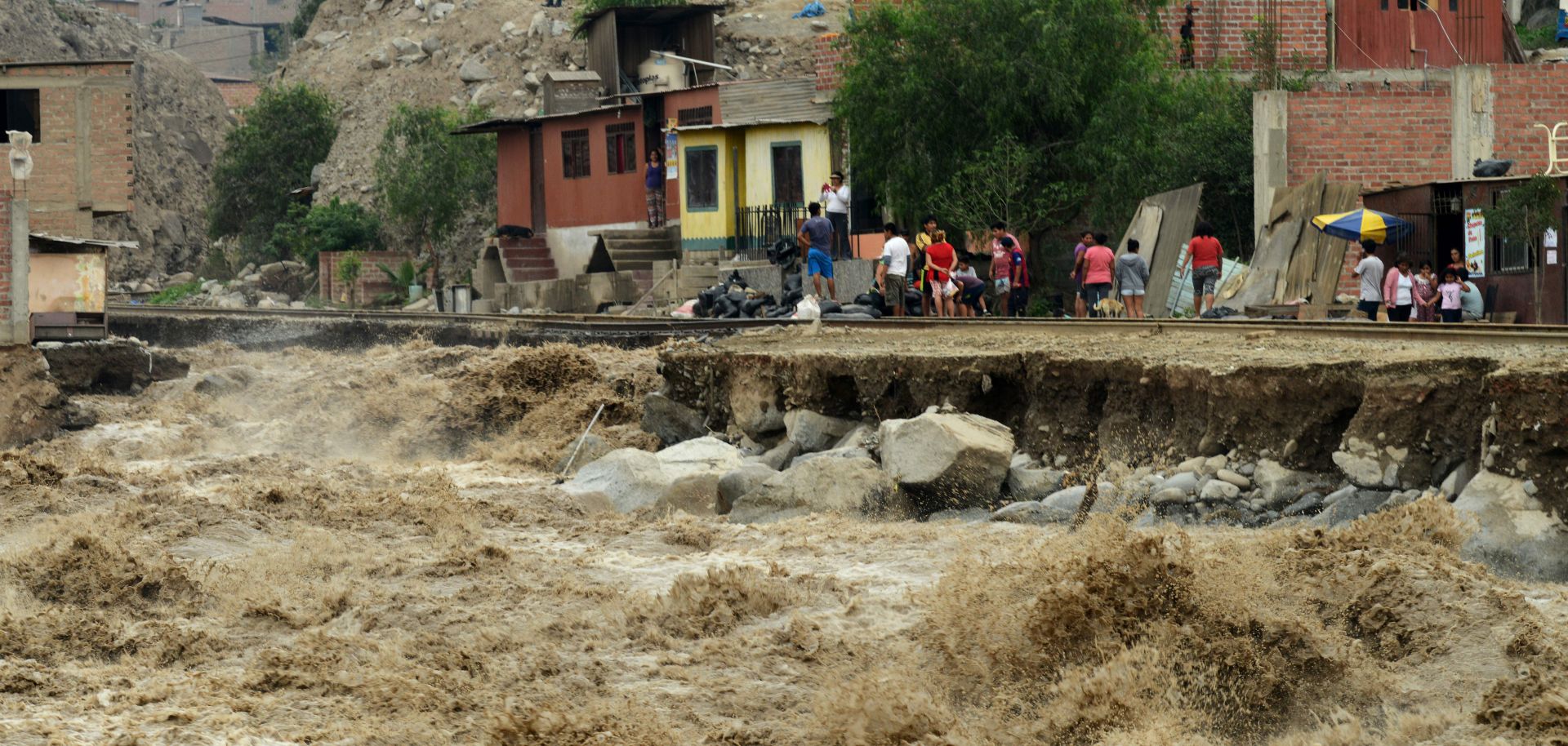
The effects of the El Nino-Southern Oscillation weather phenomenon that contributed to floods, crop failure, heat waves and drought across Latin America in 2023 will persist until the second quarter of 2024. ENSO, more commonly referred to as El Nino, is a naturally occurring weather phenomenon that takes place roughly every two to seven years that drives an increase in sea surface temperatures in the Equatorial Pacific Ocean, altering atmospheric circulation patterns and in turn creating a variety of weather patterns across the globe. In December 2023, the National Oceanic and Atmospheric Administration assigned a 54% probability that the current ENSO system will be "historically strong" — ranking in the top five in terms of the "temperature anomaly," or distance from a 30-year average — but that weather conditions associated with the phenomenon should gradually weaken between March and May. Nearly every government in the region was pressed to respond to El Nino's effects in 2023.
- El Nino led to or intensified flooding in Peru, heat waves in Brazil and abnormally low water levels in the Panama Canal.
- Heavier rainfall led to standing water; combined with the warmth, this created optimal mosquito breeding conditions. The Pan American Health Organization reported 4.2 million cases of dengue fever across the region in 2023, surpassing the previous record set in 2019 by more than 35%. Brazil, Peru and Mexico were among the most affected, with 2.9 million, 271,000 and 244,000 cases, respectively. According to the organization, 2,050 people died from the disease in the region in 2023.
Going forward, cold fronts in Northern Mexico and the southern United States through March may impair cross-border delivery of natural gas to Mexico, while below-average rainfall in central and Southern Mexico will exacerbate the water crisis and diminish crop yields. Mexico's National Meteorological Service projects more cold fronts through March in the north of the country, specifically in Chihuahua, Durango, Nayarit and Sonora states. If winter storms in the southern United States prove particularly strong, then cross-border delivery of natural gas to Mexico could slow or be cut off completely, which could throttle production in industrial hubs in Mexico's northern border region, as Mexico imports 70% of its natural gas from the United States. Meanwhile, a series of dams called the Cutzamala System that normally supplies water to Mexico City stood at 39% of normal capacity as of Jan. 29. Mexico's National Water Commission has instituted water cuts throughout much of the capital since Oct. 17, resulting in small-scale protests. El Nino-fueled drought has also hampered agricultural production. Cotton production in the state of Chihuahua, for example, decreased 25% year on year while yellow corn production there fell by 30%. With Mexico's environment ministry predicting a possible 24% reduction in overall rainfall in February and a 25% decline in March due to abnormally dry conditions in the Yucatan Peninsula and western states like Jalisco, Nayarit and Sinaloa as well as states in central Mexican states such as Hidalgo, Queretaro and San Luis Potosi, the winter corn harvest will likely see similar shortfalls, potentially driving food inflation.
- In mid-February 2021, an eight-day winter storm crippled power grids in Texas and led Gov. Greg Abbott to ban out-of-state natural gas shipments of liquefied natural gas; the shutdown of exports caused blackouts in Northern Mexico, costing manufacturing plants an estimated $2.7 billion.
- As of Jan. 15, more than 80% of Mexico suffered from "abnormally dry" conditions, with 28% of the country "extremely" affected and 9% "exceptionally" affected, according to National Water Commission's Mexico Drought Monitor.
Reduced rainfall tied to El Nino will likely exacerbate food insecurity in Central America, drive food inflation and continue to hamper international shipping through the Panama Canal. In El Salvador, the Chamber of Small and Medium Agricultural Producers Association (known by its Spanish abbreviation, CAMPO) reported that drought conditions in 2023 caused many smallholder farmers to abandon planting altogether for the 2024 season due to high input costs and uncertainty regarding harvests. With such large production deficits, CAMPO warns that domestic grain production will only last until June 2024 before the government will have to rely entirely on imports to satisfy local food demand, likely driving food inflation higher. Forecasts by the Famine Early Warning Systems Network, an organization established by the U.S. Agency for International Development, warn that Nicaragua will face accentuated food insecurity from March to May, with Honduras reaching "crisis" levels over the same period. The Panama Canal garnered international headlines in 2023 when a historic drought lowered water levels in Gatun Lake, hampering canal operations. Responding to the driest October in 73 years, the Panama Canal Authority slashed the number of vessels that could transit the waterway to 25 ships per day and then to 22 ships per day in December 2023 compared to 36 under normal conditions. The Panama Canal Authority originally projected only 18 slots per day in February, but has since increased that slightly to 24. Roughly 6% of global trade — including 40% of U.S. trade — goes through the Panama Canal. Drought in the Central American country has resulted in higher surcharges levied by canal operators, elevated insurance rates, and supply-chain disruptions and delays. The waterway will likely face increased stress until the dry season ends in June, which a Panama Canal Administrator warned could strip the Panama Canal of up to $700 million in operational revenue in 2024.
- El Salvador's Ministry of Environment reported a 7.7% rainfall deficit in 2023 compared to the 30-year rainfall average.
- In August 2023, the Panama Canal faced a backlog of 154 commercial ships waiting an average of 21 days to transit the waterway, CNBC reported.
The coastal Andean region will be at higher risk of floods and landslides, damaging infrastructure and creating safety risks, while drought conditions in Colombia will fuel wildfires and stress electrical grids reliant on hydropower. The northern coastal regions of Peru, including Piura, Tumbes and La Libertad, will likely see elevated levels of rainfall until March as El Nino strengthens the country's rainy season. Increased incidence of extreme weather events, like flooding and landslides, could result in extensive infrastructure damage and supply chain disruptions. As vital industries, such as fishing, agriculture and construction were impacted by weather events, the Peruvian central bank estimated El Nino reduced economic growth by fully 1.1% of GDP throughout 2023 and the government spent more than $1 billion to cope. Ecuador will similarly face elevated risk of floods, landslides and infrastructure damage in the coming months, particularly in the coastal provinces of Manabi, Esmeraldas and the slightly inland province of Los Rios, according to the Secretariat of Risk Management. Meanwhile, exceptionally dry conditions forced Colombia to place 747 municipalities under alert due to the threat of wildfires, and President Gustavo Petro declared a disaster Jan. 25, calling for international assistance to extinguish at least 25 uncontrolled wildfires. Colombia is heavily dependent on hydropower, so drought conditions and less rainfall will hamper hydroelectricity production, likely elevating energy costs and potentially driving social unrest.
- After warming sea-surface temperatures attributed to El Nino drove adult anchovy populations to deeper waters, Peru's Ministry of Production canceled the anchovy season in June 2023 to preserve the marine resource, costing the industry an estimated $1 billion.
- According to the U.N. Office for the Coordination of Humanitarian Affairs, by March 2023, heavy rains destroyed at least 144 bridges across Peru and damaged more than 54,000 homes.
- Roughly 80% of Colombia's electrical generation capacity is produced by hydropower and an El Nino-induced drought in the first half of 2023 caused electricity prices to rise 90%.
In the Southern Cone of Latin America, a heat wave associated with El Nino may dampen Brazil's agricultural production, but optimal rains in Argentina should provide a boon to soy production. Accounting for roughly one-third of Brazil's exports, agricultural products provide an important source of foreign currency for the government. Decreased rainfall registered in late 2023 in the central-western Brazilian state of Mato Grosso, an agricultural hub bordering Bolivia, has delayed planting for some farmers and has forced others to replant large plots. This led Brazil's National Supply Company to slightly mark down its previous forecasts for both soybean and corn production for the 2023-24 season. The supply company, however, still predicts a record year for soy production, with a 3% increase from the 2022-23 harvest season but a 10% decline in corn production from the 2023 harvest. In late November, southeastern Brazil experienced a strong heat wave, creating health risks and stressing electrical grids. Dry conditions will likely continue through Brazil's summer season, which lasts from December to March, heightening the risks of wildfires and potentially raising electricity prices as reservoirs that power hydroelectric resources face stress. By contrast, El Nino rains may prove a boon for Argentina. After a multiyear drought depressed agricultural production in Argentina, the Rosario Board of Trade expects this year's soy harvest to reach 52 million metric tons on the back of above-average rainfall in the agricultural Pampas region, a 160% increase from last year. With a similarly rosy outlook for corn production, the Argentine government is set to benefit from a boost in agricultural exports, providing much-needed hard foreign currency to government coffers and strengthening President Javier Milei's negotiating position with the opposition-controlled Congress as his austerity reforms work their way through the legislature.
- Temperatures reached 112.6 degrees Fahrenheit in the southeastern Brazilian state of Minas Gerais in November 2023, the highest temperature ever recorded there.
- In October 2023, the Santo Antonio hydroelectric power plant, one of the largest in Brazil, was temporarily closed after water levels in the Madeira River dropped to 50% of their historical average. Hydropower accounts for roughly 68% of Brazil's total electricity generation capacity.
