
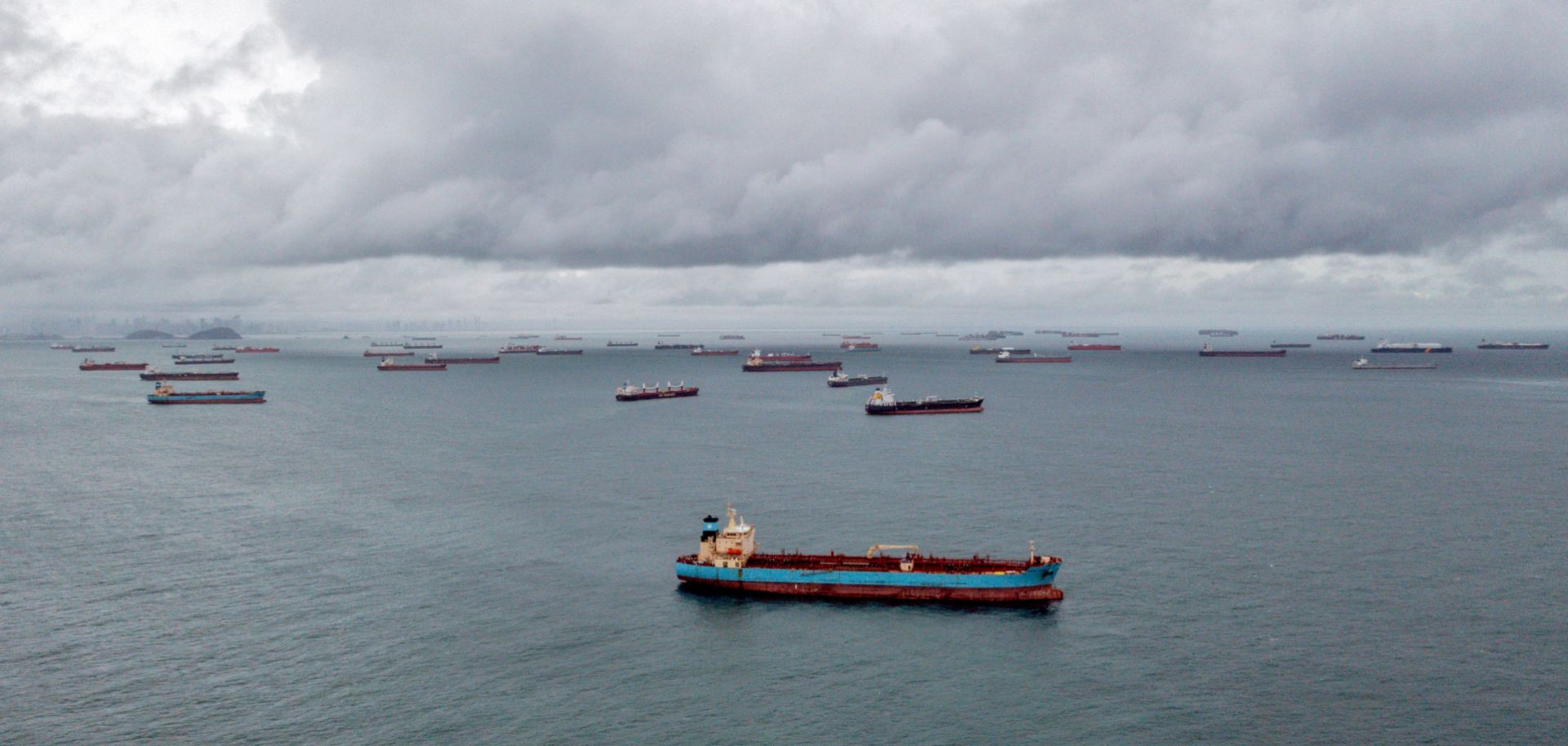
Ongoing restrictions at the Panama Canal due to historic drought conditions will cause a slight increase in container shipping costs and supply chain delays, but the impact will be modest as long as the restrictions are short-lived. Since July 30, the Panama Canal Authority (PCA) has restricted the total number of ships passing through the canal per day to a maximum of 32, down from the normal daily average of 36 crossings, in an effort to conserve water amid record-low rainfall. Since April, the authority has also maintained a decreased depth limit on ships of 44 feet (down from 49.9 feet), which has forced some vessels to carry less cargo and some to transport some of their cargo to the other side of the canal by road or rail. Amid the restrictions, over a hundred ships are now reportedly waiting off the coast to pass through the canal. According to shipping intelligence firm Clarkson Research Services Ltd., the average wait time for deep-sea cargo vessels reached 79.8 hours on Aug. 19, though some ships have waited over 17 days to go through the canal. On Aug. 16, the PCA extended the restrictions through Sept. 2.
- Roughly 29% of all container traffic in the Pacific, and roughly 40% of all container traffic heading from Asia to Europe, pass through the Panama Canal. The Central American waterway is particularly crucial for transporting goods from Northeast Asia to the Eastern United States, which has become an increasingly popular shipping route in recent years amid several high-profile port disruptions on the U.S. West Coast and the widening of the Panama Canal in 2016.
- During a less severe drought in 2020, the PCA decreased daily crossings to 27 per day.
Because of the ongoing El Nino weather phenomenon, weather conditions in Panama are unlikely to ease in the coming months, which means that the canal authority could implement further restrictions on water usage. In June, Panama City declared the country had entered the El Nino weather phenomena, with rains expected to significantly decrease until May 2024. As a result, Panama's rainy season — which traditionally goes from May to December — is expected to be stunted, which means the drought could persist over the coming months. If drought conditions worsen significantly, the Panamanian government will need to balance water needs for the Panama Canal with water needs for the population of Panama City or the agricultural lands surrounding the canal. Such a scenario could see the PCA further lower the depth limit and/or allow even fewer ships to pass through the waterway each day. The authority may also halt the number of slots available for registration to allow the backlog of ships that have been waiting offshore to pass through the canal.
- On Aug. 16, a total of 131 vessels were lined up to pass through the Panama Canal, leading the PCA to temporarily halt new sign-ups for passage slots in an effort to ease the existing bottleneck.
- In June, the PCA considered lowering the depth limit by 6 inches (about 15 centimeters), but after a brief period of rain, it decided to maintain its current depth limit of 44 feet (about 13 meters) for the time being.
- The 164-square-mile Lake Gatun and the 20-square-mile Lake Madden supply water to both the Panama Canal, as well as local farming communities and parts of Panama City.
- Rainfall measurements around the canal have been 30-50% below normal levels for 2023.
The restrictions will likely cause a slight increase in container shipping costs and some delays to goods ahead of the holiday shopping season in the United States, as containerships ride out the disruptions or divert flows to other destinations. However, the overall macroeconomic impact will likely be modest. Unsurprisingly, container rates along the routes connecting Northeast Asia to Europe and the U.S. East Coast have risen this summer amid the PCA's restrictions and the consequent increase in wait times at the Panama Canal. Between June and August, container rates from mainland China to the U.S. East Coast rose from $2,300 per forty-foot equivalent unit (FEU) to around $3,000 per FEU, and from about $1,266 per FEU to $1,800 per FEU for the route to Europe, according to Freightos. However, this is a far cry from the shipping crisis in 2021 and 2022, which saw rates for the China-U.S. and China-Europe routes peak at nearly $23,000 and $16,000 per FEU, respectively. And despite the build-up in delays at the Panama Canal, in recent earnings calls, many U.S. retail firms like Home Depot and Target have said the supply chain costs that were a major problem in 2021 and 2022 have largely been eliminated. There's also been significant overcapacity in the shipping industry that has contributed to lower container rates: in the first seven months of 2023, new containerships added a record 1.2 million FEU in global shipping capacity. So while shipping costs may slightly increase along some routes due to the PCA's restrictions and drought conditions in Panama, the current situation is unlikely to emerge as a major inflation driver in the same way that shipping costs rose across supply chains from 2020-2022. Moreover, if the restrictions become permanent, container ships could use alternative routes that avoid the Panama Canal altogether by, for example, going around the Cape of Good Hope in South Africa, or transiting through Egypt's Suez Canal. Cargo deliveries could also be rerouted through ports along the U.S. West Coast, where labor unions are soon expected to formally approve a new contract that would reduce the short-term risk of labor distribution, and be sent eastward via rail and road.
- For individual companies, delays can certainly affect their bottom line, especially if they are reliant on a high degree of just-in-time deliveries for their supply chains. For shoppers, inventories of some goods may be limited during the holiday season, though neither of these will likely have a major macroeconomic impact on the United States or the European Union.
A more pronounced drought that causes indefinite restrictions may have a more pronounced impact on bulk and tanker shipping from the Americas to Northeast Asia, but even then, alternatives still exist. Bulk carriers (such as grain carriers) and tankers have seen some of the longest delays as a result of this summer's restrictions at the Panama Canal. But agricultural and energy exports transiting from the Americas to Northeast Asia could face among the most significant disruptions in the coming months, as seasonal demand for both of these commodities is about to pick up. The United States will enter its harvest season in September and October, with U.S. exports of soybeans and other grains to China and Asia typically passing through the Panama Canal. The same will be true for energy exports in the winter, as colder weather increases demand for liquified natural gas (LNG). The shipping disruptions at the Panama Canal could cause small spikes or delays in Chinese or Japanese import prices for energy and agricultural goods. But even then, ships can often use alternative routes by going through the Suez Canal or around the Cape of Good Hope. Such reroutes add to shipping costs (i.e., more marine fuel) and time, but are often economical. Typically travel times from the U.S. Gulf Coast to Asia take an extra 9-14 days for LNG tankers. But ships may decide that this added travel time is worth it, because if they cannot secure a reserved passage through the Panama Canal, they risk facing even longer delays. Nevertheless, the escalating impacts of climate change portend more drought- and flood-related supply chain disruptions at not only the Panama Canal but at all critical nodes in the global shipping industry; low water levels in Germany's Rhine River, for example, have also caused shipping disruptions in recent years. If the Panama Canal's problems become more frequent, there will be a significant shift in shipping lines, as more vessels opt for longer maritime routes — or, in the case of the U.S. West Coast, more land-based transportation — to avoid the canal.
