
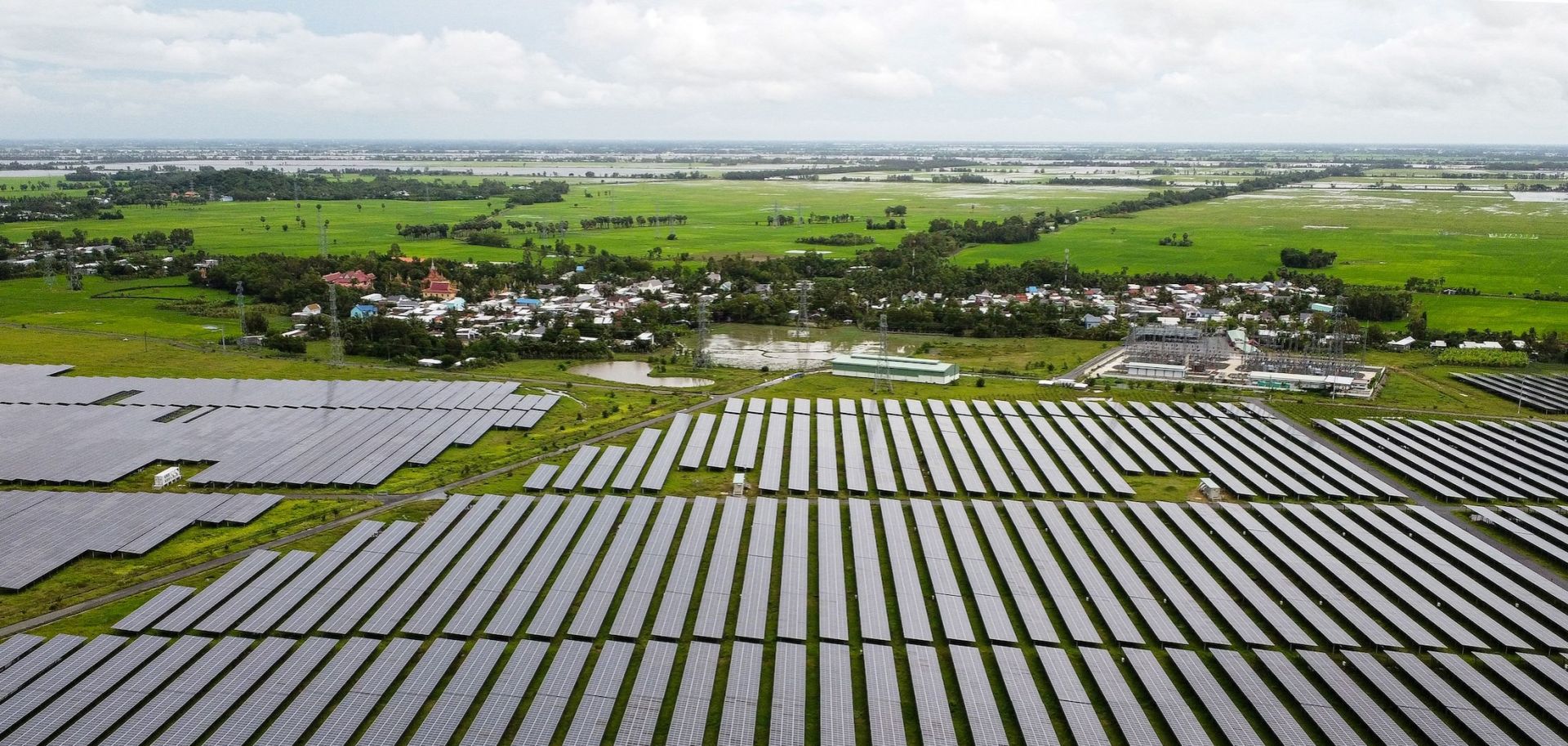
Several Southeast Asian countries are on track to develop substantial renewable power capacities in the short term, but technical, political and financial constraints, coupled with incentives to continue burning fossil fuels, mean long-term energy transition goals appear unlikely. Like much of the world, all Southeast Asian countries have ambitious plans to significantly phase out fossil fuels and, in most cases, reach net zero carbon emissions in the coming decades. For example, Brunei, Cambodia, Laos, Malaysia, Singapore and Vietnam all have targets to achieve net zero carbon emissions by 2050, while Indonesia has the same goal by 2060. Even wartorn Myanmar maintains the official goal of achieving net zero carbon emissions by 2040 in certain land-use-intensive sectors, a tall order for a country with an outsized agricultural sector. The Philippines is the only Association of Southeast Asian Nations (ASEAN) member state that has not yet set an official net zero target, though the country aims to cut 75% of its carbon emissions within a 2020-2030 timeframe. ASEAN has also set the goal for the entire bloc to become carbon neutral by 2060. ASEAN countries are thus pursuing various means to accomplish these goals, particularly by increasing their consumption of renewable energy like wind and solar power.
While these countries enshrine bold carbon emission reduction plans into law and policy, economic development goals suggest a gap in medium-to-long-term planning. Every country in ASEAN, aside from Singapore, is a developing economy. This means that demand for energy in these countries will only grow in the coming years as they aim to reorient power sourcing away from fossil fuels and toward renewable technologies. ASEAN countries will thus need to balance carbon neutrality commitments with ambitious economic growth targets. For example, Indonesia and Vietnam intend to become high-income economies by 2045 (with the latter looking to achieve upper middle-income status by 2030). To reach these targets, both countries will need to achieve around 6-7% GDP growth per year — a pace of economic growth that Indonesia has not seen since the 1990s, though for Vietnam, this is more realistic given the country's pre-pandemic growth rates were consistently in that range. In Indonesia's case, the stakes are arguably higher in that it intends to become the world's fifth-largest economy by 2050. Generally speaking, ASEAN countries are all looking to achieve similar levels of annual GDP growth to accomplish their economic development goals, which will require a concurrent increase in energy consumption that renewables are unlikely to be able to fill without significant supplemental fossil fuel sources.
- The International Energy Agency forecasts that ASEAN countries' energy demand will increase by an annual average of 3% until 2030.
- Southeast Asian governments are cautious about increasing debt burdens, particularly given the substantial borrowing almost all of them undertook during the COVID-19 pandemic. But the private sector alone will not be able to undertake enough significant investments in renewable energy for these countries to hit their net-zero carbon targets — especially given the unpredictable regulatory landscapes prevalent across many parts of the region, and the fact that coal remains a more profitable industry.
ASEAN will come close to fulfilling shorter-term renewable targets, but substantial contributions toward this goal will come from a limited number of member states. According to a January report from Global Energy Monitor, solar and wind capacity in ASEAN has reached 28 gigawatts in 2024, accounting for 9% of the bloc's energy consumption. This is a sizable step toward the bloc's goal of reaching 35% total renewable energy by the end of 2025. According to the report, ASEAN countries only need to construct an extra 17 gigawatts of utility-scale solar and wind installations over the next two years — specifically, those directly linked to the electricity grid — to meet that target. The report also states that the bloc is already on track to add a further 23 gigawatts via currently scheduled renewable energy infrastructure projects. The Philippines and Vietnam alone represent 80% of the region's total solar and wind potential, with anticipated solar and wind energy capacities of 99 and 86 gigawatts, respectively. The two countries have so far contributed 19 and 3 gigawatts, respectively, to the collective total for ASEAN, with Thailand likewise contributing 3 gigawatts of wind and solar energy. Indonesia is likewise set to hit its emission reduction goals, according to the United Nations' 2023 Emissions Gap Report. Even Laos, despite the small size of its economy, boasts over 3 gigawatts in prospective solar and wind capacity. This means that in most cases, short-term, ASEAN-wide emission reduction targets will likely be achieved. That said, Laos, Brunei and incoming ASEAN member Timor-Leste currently have no operational utility-scale solar or wind projects. There are also no ongoing construction activities for such projects in Indonesia, Cambodia or Brunei, suggesting that even if some countries like Vietnam make outsized contributions that allow ASEAN to reach its collective goal, several countries will struggle to make worthwhile short-term gains in renewable energy.
- The Philippines and Vietnam currently rank the eighth- and ninth-largest in the world in terms of anticipated solar and wind capacity.
While several countries in the region have expressed an interest in nuclear energy, this will not be a short- or medium-term solution to decarbonization due to technical shortcomings, geographical constraints and public skepticism. ASEAN countries are also betting on nuclear power as a way to reduce their consumption of fossil fuels. This, however, will require overcoming public skepticism for nuclear power owing to the historical memory of the Chernobyl and Fukushima disasters that still loom large in society. Singapore, Indonesia, Thailand and the Philippines are the furthest along in developing plans for nuclear power, though none is close to deploying it. In Singapore, the country's Energy Market Authority announced on March 22 that nuclear power could be harnessed to account for around 10% of the city state's energy mix by 2050. Despite this policy shift on nuclear power, Singapore is not planning to build conventional nuclear power plants, but rather small modular reactors (SMRs) or advanced reactors relying on fission technology, neither of which is close to being deployed on a commercial scale. Indonesia, for its part, is moving away from nuclear power as a ''last resort'' per the country's 2014 energy plan and plans to have its first nuclear power plant by 2045. Thailand, meanwhile, is finalizing a new power development plan that is set to be unveiled in September, which may incorporate plans to build out SMRs with a combined 70 megawatts of capacity. The Philippines is likewise working in tandem with the United States to develop its nuclear power sector, signing an agreement in November 2023 allowing the transfer of nuclear material and technology. The Philippines envisions adding nuclear power to its energy grid as early as 2032.
- Indonesia is building out an experimental nuclear power reactor near the capital Jakarta, with assistance from Russian technicians who completed the technical design. In March 2023, the island nation also signed an agreement with the United States to assess the technical and economic viability of a proposed nuclear plant utilizing SMR technology.
- Like Indonesia, Thailand would rely on U.S. know-how to build out SMR capacity, as underscored by an agreement the two countries reached in 2022.
- The Philippines also has an intact nuclear facility, the Bataan Nuclear Power Plant completed in 1984, that the country mothballed in 1986 following the Chernobyl nuclear meltdown. In addition to deploying SMRs with U.S. assistance, the government is currently exploring the prospect of reviving the Bataan Nuclear Power Plant, which a feasibility study deemed would be viable for commercial use on a five-year time horizon despite the Philippines' geographic positioning in the Pacific Ring of Fire, though this environmental hazard is sure to cause public pushback to the plan.
- Vietnam and Malaysia's nuclear energy plans are less developed. Vietnam shelved plans to build out a nuclear power sector in 2016 with two commercial plants, which would have been the first in Southeast Asia, and has yet to revisit this proposal. Malaysia has long disregarded nuclear power as an option, though its current government is rethinking that strategy; nonetheless, building public consensus for nuclear power in Malaysia would alone take several years.
Future energy demand on the back of economic growth means substantial investments in renewable energy technologies are needed for ASEAN countries to reach their goals, but foreign aid is unlikely to fill all gaps. Fossil fuels will maintain a central role in ASEAN countries' energy mix for the foreseeable future despite bloc-wide and national plans to phase them out by mid-century, as the region will continue to rely on hydrocarbon technologies to power economic growth. Constraints such as high costs, limited financing and fewer profitable opportunities for private investment — along with incomplete and at times contradictory energy policy reforms — will also slow the rollout of renewable energy and nuclear power. Several initiatives to help the region's transition away from fossil fuels are underway, such as the Energy Transition Mechanism (ETM) and Just Energy and the Transition Partnership (JETP), which connect developing countries with the Asian Development Bank and G-7 financiers, respectively. Indonesia and Vietnam signed on to the ETM in late 2022 to receive billions of dollars worth of financing to phase out coal and invest in emerging technologies. However, roadblocks have so far inhibited progress. For example, the particulars of whether financing will be provided in loans or grants remain a sticking point, and incentives for private investors have proven lacking, particularly given that more established industries like coal continue to provide safer, more profitable investments. Against this backdrop, most ASEAN countries are projected to increase their coal consumption in 2024 in contravention of the goals of the ETM, JETP and domestic policies, highlighting how such policies are not yet working as intended. Moreover, despite all the commitments and incentives to decarbonize, neither Vietnam nor Indonesia has demonstrated an ability to build out new high-end industries like semiconductors and electric vehicle battery manufacturing without adding more coal to the mix. It is thus unlikely that either country will be able to meet ETM and JETP targets as they pursue growth-oriented policies, which could jeopardize their access to funding if international financiers do not lower their standards.
- Global costs for renewable technology products have dropped considerably in recent years. But despite this, the capital investment needed for utility-scale solar and wind projects remains substantially higher in Indonesia, for example, compared with China.
- Financing risks typically center on power sector sustainability, project viability, funding accessibility, capital expenses and the degree to which countries have embraced comprehensive policy frameworks to bolster the expansion of renewable energy. This is partially attributable to uncertainties surrounding cash flow projections, as well as to foreign exchange risks (e.g., power purchase agreements denominated in local currencies while equipment costs are priced in international currencies).
- Despite its commitments, Vietnam has burned more coal than ever so far in 2024. Vietnam's coal-fired power plants released 11 million metric tons of carbon dioxide in January alone, a new record. This is largely in response to a series of power outages in 2023 that hurt investor sentiment in the country's emerging high-end manufacturing and semiconductor sectors, thus showcasing the contradiction between ASEAN countries' emissions reduction and economic development goals.
- Despite its JETP commitments, Indonesia is similarly utilizing more coal and planning to build at least three new coal-fired power plants, largely in an effort to expand its electric vehicle battery sector — the power sourcing for which exceeds Indonesia's current hydro and renewable capacities.
