
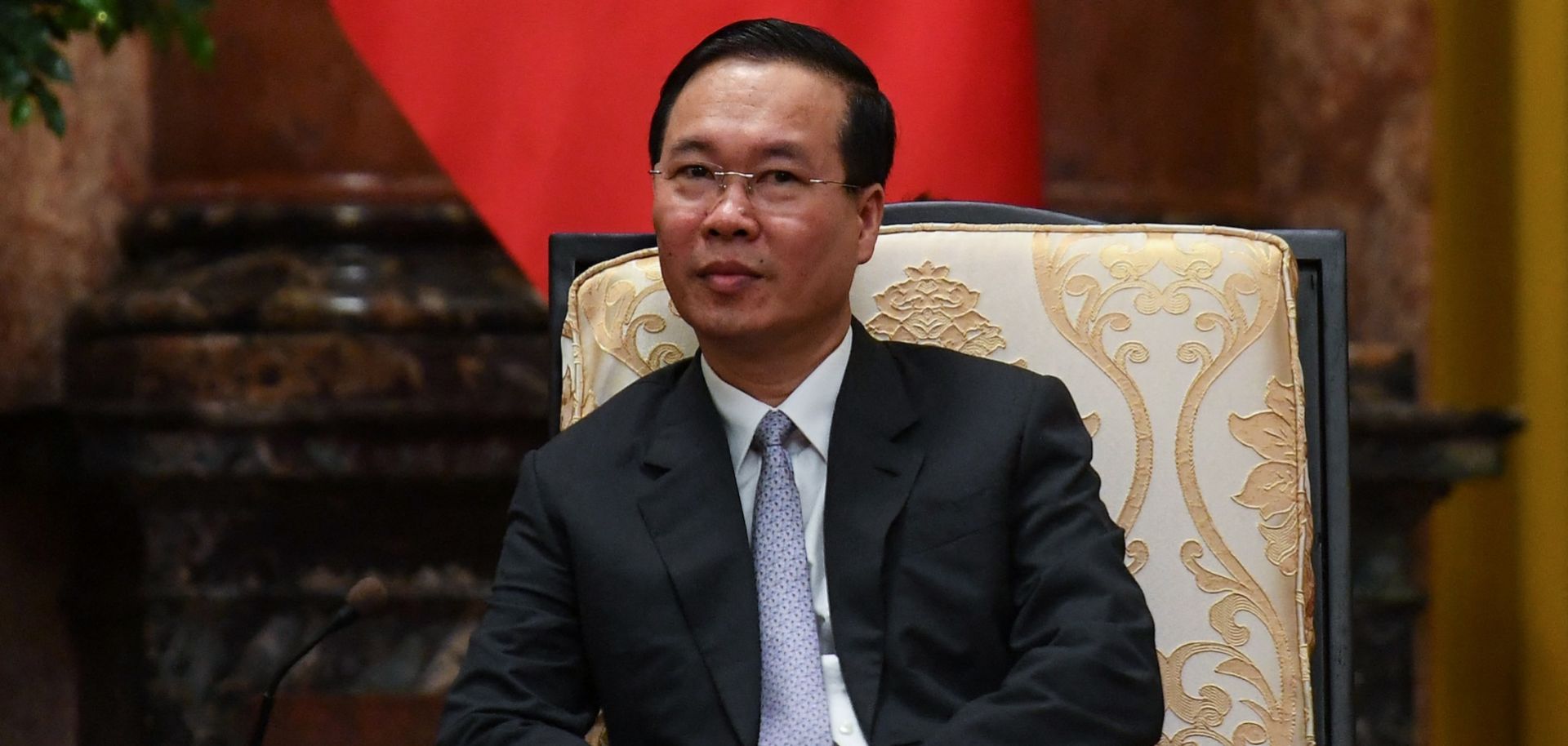
The resignation of Vietnam's president will likely further empower the country's national security apparatus, which in the longer term could harm the country's business climate. On March 20, the Central Committee of the Vietnamese Communist Party, or VCP, accepted the resignation of President Vo Van Thuong for breaking unspecified party rules. According to the VCP, Thuong violated ''regulations on what party members cannot do,'' but the authorities did not elaborate on what exactly those rules were. He was also relieved of his membership in the Politburo (where he had been ranked the second-most powerful member, behind only VCP General Secretary Nguyen Phu Trong), the 13th Party Central Committee and the National Assembly, as well as his role as head of Vietnam's defense and security council. The VCP's statement said Thuong filed a request to resign from these positions, which was granted, and that he will retire from politics.
- Thuong is Vietnam's second president to resign since January 2023, when his predecessor Nguyen Xuan Phuc stepped down.
- Thuong was appointed in March 2023 directly from the VCP apparatus, and not a government ministry, replacing the more business-minded Phuc.
- Vice President Vo Thi Anh Xuan has since taken over as acting president, the same role she held for two months in 2023 between Phuc's removal and Thuong's appointment.
- The Vietnamese president's constitutional powers include high-level appointments, like the vice president, cabinet ministers, and chief justice. The president is also charged with making military appointments and taking command of the armed forces to announce national emergencies and order mobilizations. Importantly, as head of state, the Vietnamese president typically plays the most prominent role among the top four leadership positions in terms of interfacing with foreign political and business leaders. Nonetheless, the role atop the government is subservient to that of the general secretary position, which leads the VCP.
The rationale for Thuong's resignation remains unclear, but it is highly likely related to the ongoing anti-corruption campaign. Thuong's ouster came just days after the Central Committee called for a special session of the National Assembly to discuss ''personnel matters.'' Though the reasoning for his abrupt dismissal was not provided, early reporting suggests that Thuong was punished for infractions committed over a decade ago during his tenure as Party Secretary of Quang Ngai province from 2011-2014 — namely, his failure to properly oversee his subordinates, the same justification the committee used to remove Phuc from power in 2023. On March 8, five high-ranking Quang Ngai provincial officials were arrested for taking bribes during Thuong's tenure. Other unconfirmed reports state that a member of Thuong's family received a $2.4 million bribe from local real estate developer Phuc Son Group during his tenure as provincial VCP secretary. If true, it would demonstrate the ever-expanding remit of Vietnam's anti-corruption campaign, highlighting that there is no statute of limitations for violations. If Thuong's ouster is indeed connected to the uncovering of such bribe schemes, it would also serve as the latest reminder that Vietnam's leaders up and down the hierarchy are vulnerable to immediate and sudden reprimand, up to and including imprisonment and execution, whenever new information comes to light. This would leave open the possibility that Thuong's forced resignation is politically motivated as well, given that the VCP has used the anti-corruption campaign in the past to remove problematic party members (while sparing others).
- Former chairman of Vietnam's state-run energy conglomerate PetroVietnam Nguyen Xuan Son was sentenced to death for a $69 million corruption scandal in 2017.
Though Thuong's resignation will not lead to significant policy changes in the immediate term, the rapid leadership turnover will harm business sentiment, and the development could be a harbinger of deepening political instability in the coming years. As with Phuc's early departure, Thuong's exit will not lead to substantial changes in either domestic or foreign policy before 2026 because Vietnam's rule by consensus model among its top-four leadership positions has already established the broad policy contours for the remaining term. Nonetheless, the development creates a degree of government instability that could undermine the country's image as a politically predictable country with a stable business environment (something that Vietnam has used as an advantage in its competition with its Southeast Asian neighbors in attracting foreign investment). The sudden leadership change and lack of information around it also highlight the opacity of Vietnam's system, which could further spook businesses. Indeed, the rapid turnover of various political figures — and increasingly business actors — as part of the VCP's anti-corruption campaign heightens risk perceptions and could affect investors' long-term planning — particularly in industries with long time horizons such as infrastructure, energy and manufacturing, areas identified by Vietnam as critical to long-term development goals. Moreover, the development has major implications for Vietnam's next leadership turnover in 2026 because Thuong, a close ally of top leader General Secretary Nguyen Phu Trong, had been on the shortlist for likely candidates to replace the aging 79-year-old leader, who is in poor health and intends to retire at the end of the term. The upending of this expected succession plan further suggests that infighting and factionalism could mark the next two years of Vietnamese politics, which would further concern business stakeholders in the country by ushering in an era of political turbulence that could harm investor confidence and weigh on the country's economic performance.
- In the broader context of the anti-corruption campaign, foreign business organizations, such as the American Chamber of Commerce in Vietnam, have complained about overbearing red tape and personnel turnovers that inhibit business efficiency.
If a member of Vietnam's national security apparatus is chosen to replace Thuong, it would further portend a less friendly business environment in the years ahead. Under VCP regulations, a full term in the 15-seat Politburo is a prerequisite for the presidency. This means only five individuals are eligible for the job, including Trong, Prime Minister Pham Minh Chinh, National Assembly Chair Vuong Dinh Hue, VCP Secretariat Truong Thi Mai and Minister of Public Security To Lam. The first three are unlikely to fill the position, given their existing roles in top-four spots (plus Trong's health would likely prohibit him from doing so). This leaves Mai and Lam as the most likely candidates to succeed Thuong, with the former representing the VCP apparatus (the organizational structure that holds ultimate decision-making power that is formally separate, and above, the government), and the latter representing Vietnam's national security establishment (governmental entities responsible for the day-to-day protection of the nation, with a heavy emphasis on internal security). For both Mai and To Lam, an ascent to the presidency would position them to jockey for the general secretary role in 2026. As each is 66 years old, the presidency would strengthen their respective cases in seeking an age exemption for the top spot (the age limit for general secretary is currently 65) — a privilege previously granted to senior leaders like Trong. In his capacity as minister of public security, Lam has personally overseen the government's anti-corruption campaign, enabling him to amass substantial institutional power, which overshadows Mai's. A Lam presidency would be a negative sign for foreign investors, as Lam and his public security ministry are known to harbor anti-foreign sentiments, or at the very least regard foreign investment as a trade-off to ensure VCP stability and Vietnam's national security. If he becomes president, Lam would likely lean toward the latter, meaning tighter scrutiny of foreign businesses to guard against perceptions of political and cultural influence — especially if he leverages the position to accrue more political power and eventually ascend to general secretary in 2026. If, on the other hand, Mai is selected to replace Thuong, her presidency would likely share many of the same dynamics as her predecessor, given her veteran status as a party operator and the fact that she replaced Thuong in his prior position as VCP Secretariat — meaning little individual power base and a clear subordination to the other three leadership positions (i.e. VCP general secretary, prime minister and National Assembly chair). However, her status as a woman could alone preclude her from being considered for the top job. There is also the issue of top leader Trong's health and the implication that his succession plan has been dashed with Thuong's ouster. The aging general secretary was hospitalized for several weeks in January. As the likelihood of political infighting rises, contenders may feel a sense of urgency to lay their plans should Trong suddenly retire, become incapacitated again, or pass away.
- Vietnam has a rule-by-consensus governing model that splits decision-making and political power among the VCP general secretary, the prime minister, the president and the National Assembly chair. These four positions are considered the most powerful leadership roles in the country.
- On March 1, a report from Vietnamese dissident and activist publication Project 88 leaked a Vietnamese Politburo document dubbed Directive 24, which frames foreign investment as a threat to national security. The directive calls to ''end foreign interference in policymaking; prevent the degradation of morality, lifestyle, and culture; and stop foreign powers, as well as groups within Vietnam, from using increased international cooperation as a means to promote an independent civil society and domestic political opposition groups.'' The plan also calls for more intensive monitoring and scrutiny of foreign enterprises in the country. Given Lam's national security role and status as a Politburo member, he likely played a major role in crafting the document's language. While the authenticity of the leaked document has not been confirmed, Vietnam's foreign ministry commented on the news to reaffirm its commitments to international trade and human rights, but did not offer a denial, which suggests the document is likely genuine.
- The VCP could conceivably bend its rules to allow other officials to be considered for the presidency, such as Ho Chi Minh City Party Secretary Nguyen Van Nen or Defense Minister Phan Van Giang, who — like Mai and To Lam — respectively represent the VCP apparatus and national security establishment.
- Phuc's 2023 forced resignation represented a purge of government ministry (as opposed to Party apparatus) technocrats from Vietnam's elite levels of leadership, meaning cadres from the likes of the foreign and health ministries have little chance of advancement for now.
