
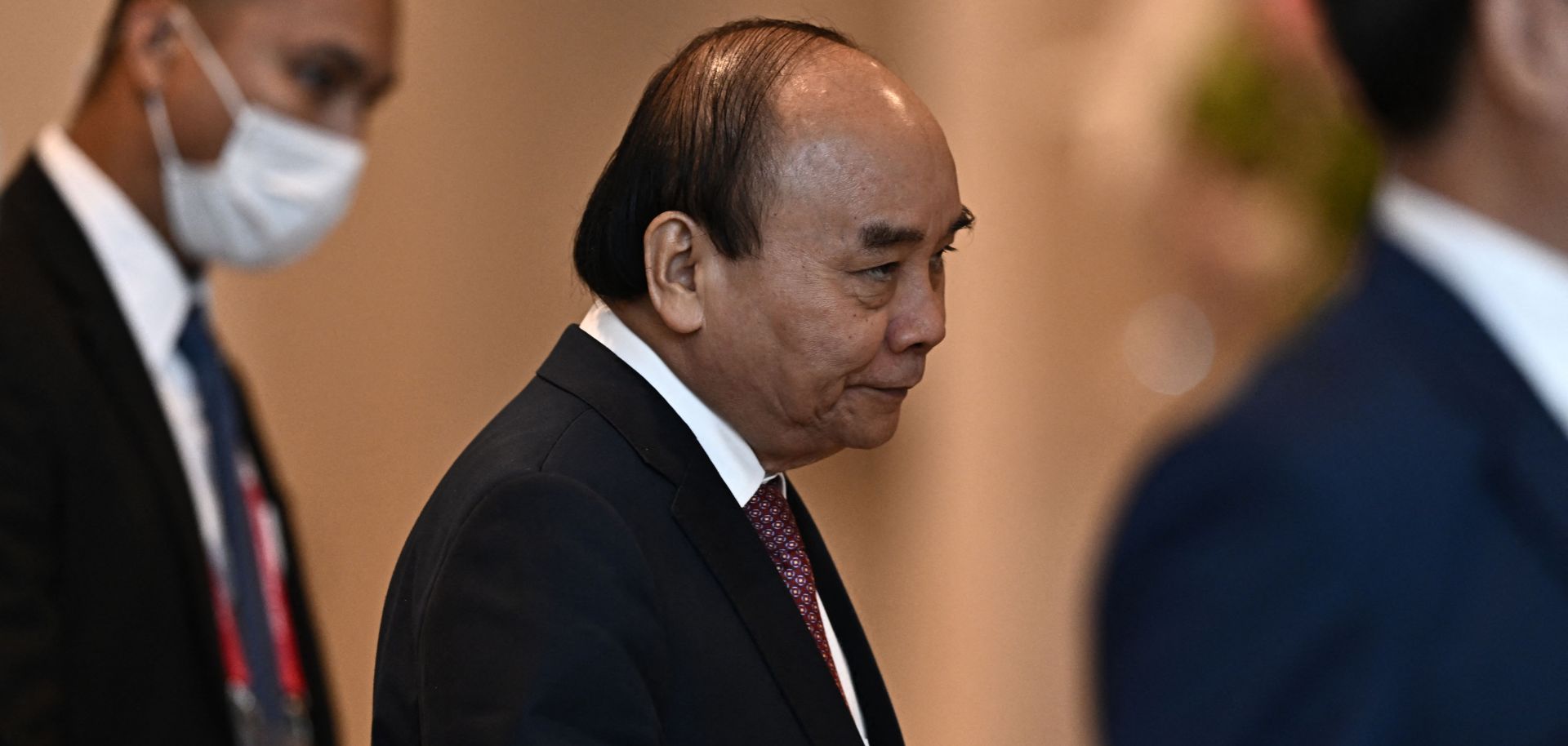
Then-Vietnamese President Nguyen Xuan Phuc arrives at the Asia-Pacific Economic Cooperation (APEC) summit in Bangkok, Thailand, on Nov. 18, 2022.
The forced resignation of Vietnam's president marks the highest-ranking official targeted by the ruling Communist Party's sweeping anti-corruption campaign and portends the strengthening of national security elites, but the country's long-term outlook remains relatively unchanged. Vietnamese President Nguyen Xuan Phuc resigned on Jan. 17 after the Communist Party's Central Committee found him responsible for ''violations and wrongdoing'' related to the corruption of officials under his purview when Phuc was prime minister from 2016-2021. Phuc is the first Vietnamese president to be effectively ousted from office. He is also the highest-ranking government official to be implicated in General Secretary Nguyen Phu Trong's growing ''blazing furnace'' anti-graft campaign, which saw the removal of two deputy prime ministers earlier this month. Phuc resigned from leadership positions in the politburo, Central Party Committee, and National Defence and Security Council as well. Vietnam's National Assembly is expected to elect a new president in May; Vice President Vo Thi Anh Xuan will serve as acting president in the interim.
- The Central Committee decided to relieve Phuc in light of ongoing fallout from several high-profile corruption scandals, including the Viet A COVID-19 test price gouging scheme and a Foreign Ministry-led repatriation flight extortion racket. The two aforementioned deputy prime ministers were also forced out on Jan. 5 due to their involvement in the schemes. Members of Phuc's wife's family have allegedly been implicated in the COVID-19 test kit scandal as well.
- During the Jan. 17 extraordinary session, the committee also offered high praise for Phuc's contributions after agreeing to remove him from office, which contrasts with previous disciplinary action and signals a perceived need to protect the Vietnamese Communist Party's prestige.
Targeting the president, who is also the second-ranking politburo member, marks a significant escalation of Trong's anti-graft campaign. The campaign was initiated in 2016 as the general secretary's signature initiative intended to weed out endemic corruption. It has so far netted thousands of cadres, leading to party expulsions, prosecutions and, in a few notable cases, death sentences. Foreign Minister Bui Thanh Son was ''severely reprimanded'' on Dec. 27 after several high-ranking Foreign Ministry officials were expelled from the party and charged with crimes, and two deputy prime ministers who served under Phuc when he was prime minister similarly resigned under pressure — leading to speculation that Phuc could be next. Altogether, this represents Vietnam's most significant leadership shakeup in the post-war era. Prime Minister Pham Minh Chinh may also face discipline owing to his association with another scandal-laden character, Nguyen Thi Thanh Nhan (who was sentenced in absentia and is now on the run).
- According to the Communist Party, 539 party officials were disciplined in 2022 alone under Trong's anti-graft campaign, including ministers, diplomats and businesspeople.
Phuc's exit opens the door for national security elites to take on a more outsized political role and lends momentum to the broader consolidation of power under the Communist Party apparatus at the expense of government bureaucrats. The president's removal alters the balance of power in Vietnam's government, most immediately by concentrating authority in Trong's hands. Trong temporarily served as president after the 2018 death of then-President Tran Dai Quang, and could do so again following Phuc's ousting. But a loyal subordinate is more likely to be elevated to the post. According to early reports, Public Security Minister To Lam is currently the top candidate to replace Phuc, followed by Defense Minister Phan Van Giang. The appointment of either would give national security alumni two of the four most powerful positions in Vietnam (in addition to Trong) since Prime Minister Chinh previously served as Deputy Minister of Public Security after starting his career as an intelligence officer. In addition, recent removals have opened up two of the 18 seats on the powerful politburo, where five members already hail from the national security apparatus. Greater control over the politburo and/or control of the presidency would elevate the country's national security establishment to new heights and continue an ongoing trend in Vietnamese politics that has seen ostensible business-minded technocrats phased out in favor of national security elites. Domestically, the further concentration of power under security officials would portend an intensification of the Vietnamese government's ongoing crackdown on dissent as Vietnam becomes more integrated with an international system largely insistent on democratic norms, the sentiments of which are perceived as a threat to the Communist Party's political monopoly. It could also remove potential barriers in carrying out a more streamlined campaign against endemic corruption, which Trong and his allies recognize as the largest existential threat to their regime. More high-profile cases are thus likely forthcoming, which may enhance accountability and clean governance, but will come at the risk of disrupting patronage networks and undermining unity.
- To Lam is a trusted lieutenant of Trong in the anti-corruption fight; his term as public security minister is set to expire in April. Acting President Xuan is another potential candidate who could be elected president as a compromise choice.
- A To protege, Tran Luu Quang, was recently elevated to deputy prime minister to fill one of the vacancies.
- Vietnam's Communist Party, ever fearful for its survival, has increasingly relied on national security policy and personnel to preempt what it deems ''self-transformation,'' or derivation from party control through the expression of imported culture and ideology.
But while significant, the leadership shakeup does not portend long-term political instability, nor does it indicate economic changes or a new foreign policy. The presidency is the least impactful of Vietnam's four leadership pillars, where the general secretary has the most influence. This mitigates the greater impact of Phuc's resignation and should ensure policy continuity, given that Secretary General Trong remains firmly in power. The leadership turnover may still spook investors since Phuc was a high-profile outward-facing advocate for free trade. But it will likely have a minimal impact on Vietnam's overall economy, as Hanoi's economic policy is unlikely to fundamentally change under Trong's continued leadership. Indeed, the party's sweeping anti-corruption drive has yet to disrupt Vietnam's rapid economic growth, which saw the country's GDP expand by 8% in 2022. Vietnamese foreign policy will also persist under Trong's ''bamboo diplomacy'' model that seeks to hedge against great power capture by collaborating with all involved parties. That said, Phuc was instrumental in deepening security cooperation with the United States during his tenure as prime minister. His removal from power may thus lessen the probability that Hanoi and Washington will elevate relations to the top-level ''comprehensive strategic partnership'' in the short term, as U.S. security leaders had anticipated. Nonetheless, shared security concerns in the South China Sea will continue to foster U.S.-Vietnam cooperation despite the leadership shakeup.
- Vietnam is governed under a four-pillar consensus governing model that distributes power between the party apparatus and the government as represented by the General Secretary of the Communist Party, the prime minister, the National Assembly Chair and the president.
- Vietnam’s single-party politics is often characterized as a power struggle between the more ideologically inclined Communist Party apparatus that favors party control and the technocratic state faction that favors government preeminence in policymaking. Phuc's removal is a win for the party apparatus and will lead to a broader reshuffling of allegiances that will set the stage for the next party congress in 2026, when 78-year-old Trong is set to step down. But other ostensible state faction players will also find themselves in favorable positions in the wake of the president's exit. National Assembly Chairperson Vuong Dinh Hue, for example, may emerge as the only viable option to replace the aging General Secretary Trong (who leads the party faction) in 2026.
