
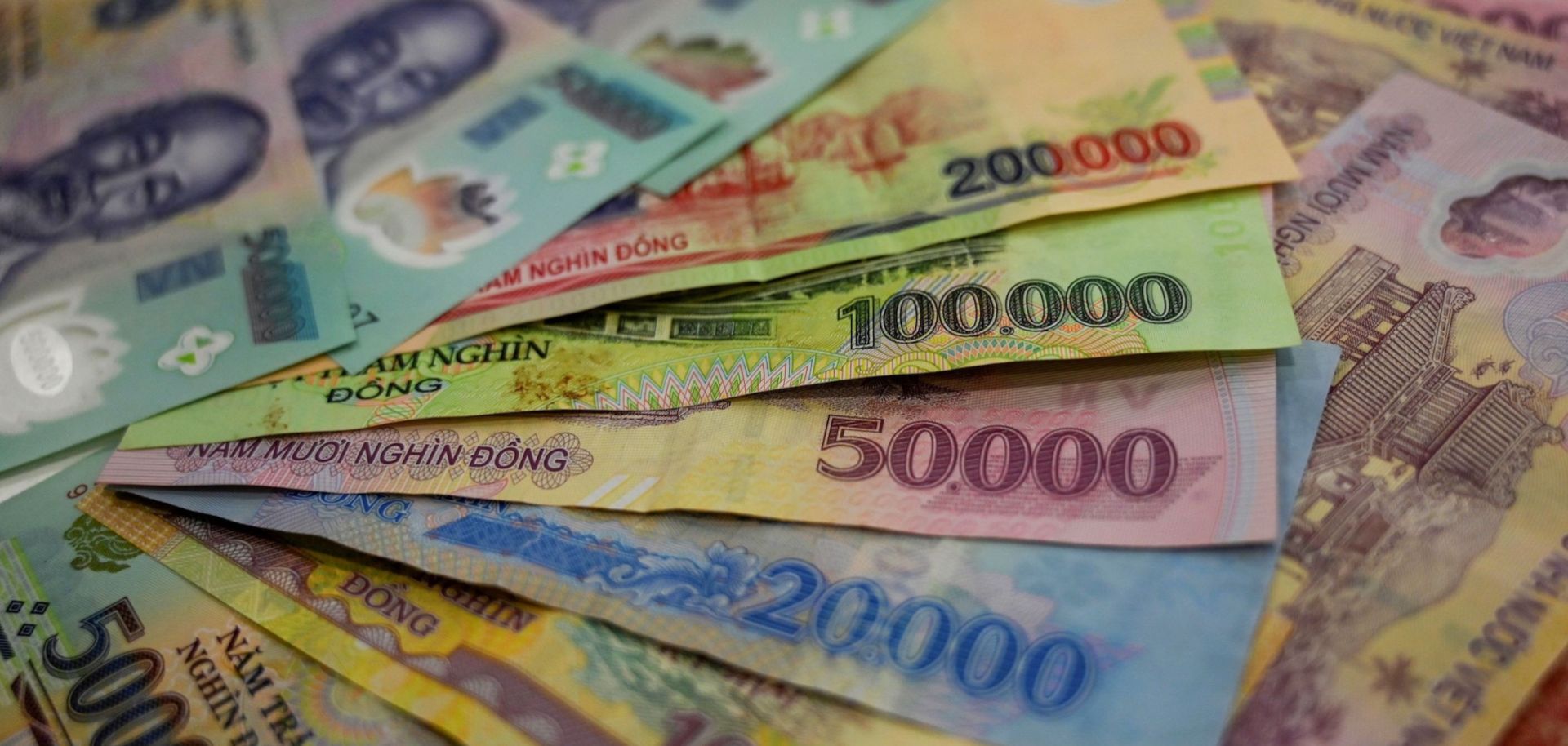
A photo illustration shows banknotes of the Vietnamese dong.
An agreement with the United States on Vietnam’s exchange rate management removes a potential bilateral irritant, returns the United States to a traditional view of foreign currencies and global trade, and sets Vietnam up for a return to export-driven high growth in 2021. On July 19, the State Bank of Vietnam (SBV) and the U.S. Treasury Department announced a joint agreement on exchange rate policy according to which Vietnam will not engage in competitive devaluations of its currency. In the long-term, by not imposing retaliatory tariffs on imports from Vietnam, the United States will make it easier for companies to begin to shift their supply chains away from China, while also giving Vietnam clarity on the external environment as Hanoi begins to plan economic development for the next five years.
- The U.S. Treasury Department designated Vietnam a “currency manipulator” in December 2020, but the administration of U.S. President Joe Biden reversed that decision in April.
- As a part of the July 19 agreement, Vietnam will provide the Treasury Department with data needed to analyze its economic fundamentals and determine if the exchange rate is appropriate. SBV Governor Nguyen Thi Hong acknowledged that the focus of monetary policy is to promote macroeconomic stability and control inflation.
The agreement reinstates the U.S. government’s conventional view of bilateral trade deficits as not alone being enough evidence to prove unfair trading practices by trade partners. The U.S. position is that economic policies can distort exchange rates from underlying fundamentals and enforcement action may be necessary, but that comparative advantage and macroeconomic factors are principal in assessing international trade on a global basis and bilateral trade deficits should be viewed in the broader context.
- The agreement puts in abeyance potential U.S. tariffs on imports from Vietnam under Section 301 of the Trade Act of 1974, which would have severely disadvantaged the competitiveness of Vietnam’s exports.
- U.S. Trade Representative Katherine Tai said her office “will monitor Vietnam’s implementation of its commitments and work with Vietnam to ensure that it addresses the acts, policies and practices related to the valuation of its currency that were found actionable in the Section 301 investigation.”
- According to the Congressional Research Service, Section 301 is “one of the principal statutory means by which the United States enforces U.S. rights under trade agreements and addresses ‘unfair’ foreign barriers to U.S. exports.”
The deal removes a significant source of uncertainty for Vietnam, a small open economy that is heavily reliant on trade. While Vietnam’s currency should somewhat appreciate against the U.S. dollar, the agreement will help maintain the country's external competitiveness and contribute to its attractiveness as an alternative investment destination, with businesses redirecting supply chain links away from China. Vietnam’s dependency on trade makes it vulnerable to trade tensions, especially with large partners such as the United States.
- According to World Bank data, Vietnam’s exports of goods and services as a percentage of GDP were equivalent to 106.8% in 2020, while its imports of goods and services were equal to 103.6% — making net exports at 3.2% of GDP a significant contributor to economic growth.
- The United States is Vietnam’s largest export market, accounting for 25-30% of export receipts. The country is the sixth-largest source of U.S. imports, including shipments of furniture, seafood, computers, electronics, apparel and footwear.
- In 2019, the International Monetary Fund (IMF) assessed Vietnam’s external position to be “substantially stronger than warranted by fundamentals and desirable policy setting,” suggesting the exchange rate was undervalued by slightly less than 7%. In March 2021, the IMF advised that “enhancing [Vietnam’s] exchange rate flexibility would facilitate external adjustment and management of domestic liquidity,” which the recent U.S. agreement is consistent with.
The exchange rate agreement will enable Vietnam to segue to a fresh start for what are likely to be ambitious industrial production targets for the next five years. Vietnam’s 15th National Assembly will set the country’s economic goals for the next five-year period during its first session from July 20-31. The Vietnamese economy was one of the only economies worldwide that grew in 2020, which at 2.9% was still well below its long-term trend of 6-7%. Vietnam should return to high growth this year if it can control its current COVID-19 outbreak, with the IMF projecting a 6.5% increase in GDP in 2021. New economic targets, however, hinge on Vietnam leveraging its export-led growth model with the United States as its number one export destination. Meeting those targets depends on Vietnam continuing to attract manufacturing from developed neighbors like China as well, while also moving up the manufacturing value chain and nurturing domestic high-tech champions in digital services.
- Taiwanese firm Foxconn, which assembles Apple’s iPad tablets and MacBook laptops, announced in late 2020 it was building assembly plants in Vietnam that are expected to come online this year.
- Samsung already has manufacturing facilities in Vietnam and in 2020 announced it was investing $3 billion in addition to its existing $2 billion in manufacturing facilities.
- Vietnam was the world’s 12th-largest electronics exporter in 2019 and the second-largest exporter of mobile phones behind China.
