
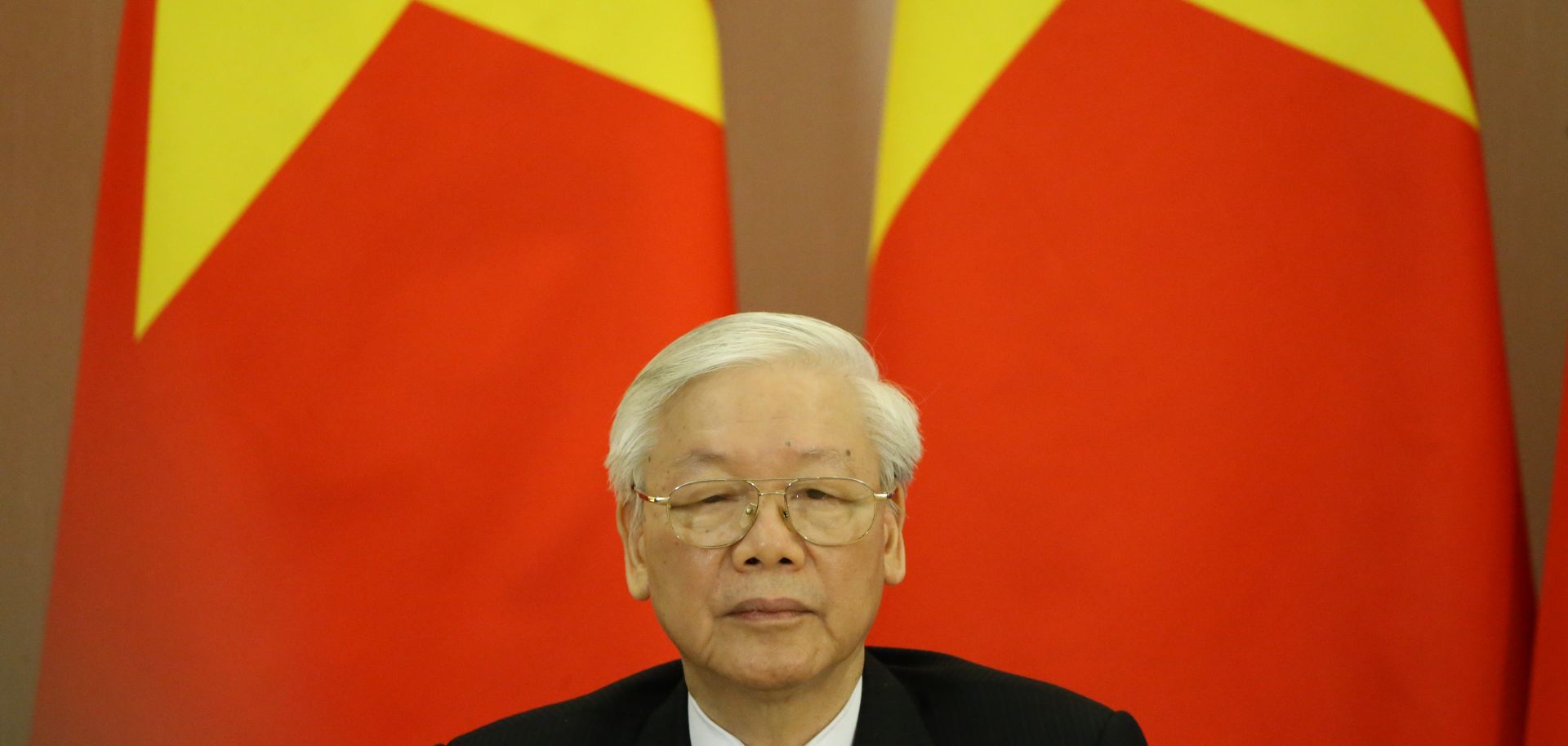
Nguyen Phu Trong, Vietnam’s president and chief of the ruling Communist Party, attends a meeting in September 2018.
Vietnamese leader Nguyen Phu Trong’s anti-corruption and anti-dissident (ACAD) campaigns will fuel political infighting and further empower the Vietnamese Communist Party (VCP) over the technocrats, increasing regulatory and reputational risks for foreign businesses looking to take advantage of Vietnam’s economic boom. Trong has greatly intensified the VCP’s ACAD campaigns since 2016 when he fended off a challenge from former Prime Minister Nguyen Tan Dung. Now, having achieved a third term as general secretary (a move unprecedented since 1976) and facing declining health at 77 years old, Trong will continue ACAD activities as a means of consolidating his foothold and ensuring his chosen successor takes power, all while assisted by newly installed allies such as Prime Minister Pham Minh Chinh.
- With the appointment of a new president on April 5, Vietnam has restored its “four pillars” model of collective leadership following a three-year period in which Trong held both the state presidency and general secretary position, confirming that Vietnam’s is not yet a system ruled by a single leader, as seen in China. Still, despite the VCP’s “four pillars” ideal, Trong has managed to fend off rivals to his post and see the appointment of more friendly faces to two other leadership positions, while temporarily sidelining a rival for general secretary to the ceremonial presidency.
- Trong appears to have successfully installed an ally as Prime Minister, Vietnam’s chief administrator. Prime Minister Chinh served as head of the Central Organization Commission from 2016-2021, the body responsible for appointing senior VCP officials. He then served as Deputy Minister of Public Security, where he led “stability maintenance” over citizens, from 2010-2011, capping a 25-year career with the ministry. He also sat on the Central Steering Committee on Anti-Corruption, chaired by Trong. Given this experience, Chinh will be instrumental in managing citizen dissent and refilling key VCP roles after Trong’s anti-corruption purges.
- Trong seems to have also sidelined his rival and 2021 competitor for the general secretary role, former Prime Minister Nguyen Xuan Phuc, by “promoting” him to president. As Prime Minister, Nguyen was credited for guiding Vietnam’s rapid economic growth from 2016-2021 and managing Vietnam’s response to the COVID-19 pandemic. Though the presidency is a largely ceremonial role and keeps him out of policymaking, Nguyen’s new role keeps him in the running for general secretary in 2026.
- Chairman of the National Assembly Vuong Dinh Hue leads Vietnam’s rubber-stamp congress. Vuong was previously the VCP head of Hanoi after his predecessor Nguyen Duc Chung was sentenced to five years in prison in 2020 as part of Trong’s anti-corruption campaign. Though a skilled technocrat and economist, Vuong’s new position leaves him with little influence over the VCP or Vietnam’s economic policy.
The VCP is facing a potential leadership crisis as the aging Trong attempts to find a successor and stokes party infighting with his anti-corruption campaign. At age 77 and in poor health following a stroke in April 2019, Trong is not expected to stay on for a fourth term in 2026 and may resign far before the end of his term. Trong intends to choose his own successor, though he was unable to do so at the January 2021 National Party Congress. In the meantime, he will continue using the anti-corruption campaign to target political rivals and cement party control over the state, further sidelining comparatively apolitical technocrats.
- Prime Minister Chinh will be instrumental in staffing the Vietnamese government to align with Trong’s VCP, given his personnel expertise from the Organization Commission. Amid ongoing internal strife in the VCP, Trong and his conservative faction will continue to be sensitive about citizen dissent, lest it’s used by rivals to undermine his legitimacy.
Trong accelerated the VCP’s ACAD efforts following Dung’s leadership challenge in 2016, and his still-tenuous hold over VCP leadership suggests he will continue to do so during his third term. Despite being confirmed for a rare third term as general secretary in January, Trong must still work to consolidate his power through the anti-corruption campaign, which has been used by leaders in Vietnam (as well as China) as a means of striking key figures from rival factions. His choice for successor, former anti-corruption leader Tran Quoc Vuong, was passed over for general secretary in January 2021. And though Trong has Prime Minister Chinh to strengthen ACAD efforts and restaff the government toward Trong’s conservative faction, bureaucratic leaders President Nguyen and Chairman Vuong still balance the “four pillars,” despite them both having limited policy influence.
- At the beginning of his second term in 2017, Trong intensified his anti-corruption campaign — originally launched in 2011 — after a long-time rival and then Prime Minister Nguyen Tan Dung challenged Trong’s candidacy for general secretary at the January 2016 Congress.
- Between 2017 and 2020, Trong’s anti-corruption campaign targeted 110 senior officials and 23 military generals, as well as the VCP leaders of Hanoi and Ho Chi Minh City (Vietnam’s two largest cities) and three members of the Politburo (the 18-member elite VCP council that answers to Trong). The campaign also prosecuted a number of senior officials, including a former Politburo member. After being nominated for a third term in January, Trong vowed to continue the anti-corruption campaign, regardless of VCP procedural norms, stating “the fight against corruption will neither stop nor rest, no matter who it involves.” Trong also broke the VCP tradition of prosecutorial immunity for Politburo members when he wielded the anti-corruption campaign in 2017 to sentence former Politburo member and party head of Ho Chi Minh City, Dinh La Thang, to 30 years in prison.
- In addition to the anti-corruption campaign within the VCP, Trong led the VCP’s crackdown on citizen dissent after Dung’s 2016 challenge and as part of efforts to ensure tight party control of the country. In the five years before the January 2016 Congress, Vietnam convicted 58 citizens of “anti-state activities” and made approximately 15 peaceful political arrests per year. And in the five years after the 2016 Congress, Vietnam convicted 260 citizens of “anti-state activities” and made more than 50 peaceful political arrests per year. Vietnam also contained 170 prisoners of conscience in 2020 (70 of which were targeted for online activities) — more than any other year, with the next closest being 2018 at 97. This banner year for detentions was partly due to sensitivity prior to the January 2021 Congress amid VCP factional fighting.
Trong’s continuing anti-corruption campaign will increase business risks in Vietnam, as the high turnover of senior VCP members hinders policy continuity and deters officials from experimenting with innovative economic policies for fear of jeopardizing their standing in the party. The government’s broadening crackdown on dissent could also harm Vietnam’s international reputation. Trong, like all VCP leaders, sees Vietnam’s future prospects in economic opening and continued global trade. But his sidelining of senior technocrats and skilled economists, as well as his emphasis on putting VCP leadership above all aspects of governance, will skew Vietnam’s economic policymaking toward policies that protect the VCP, which in some cases will conflict with the best policies for Vietnam’s growth and attracting foreign business. The significant rise in political arrests and prisoners of conscience in the past five years could also begin to hit the global conscience, like forced labor in Xinjiang did in 2020. This would increase reputational risks for businesses operating in Vietnam.
- The VCP’s control over communications in Vietnam portends a continued crackdown on online speech, especially as Hanoi moves up the value chain and internet services become incorporated into more industries. This risk is particularly potent for foreign companies employing Vietnamese citizens, who are less diplomatically protected than foreigners.
- To move up the value chain and avoid the middle-income trap, Vietnam must attract digital investment, improve the efficiency of some state-owned enterprises and privatize others, handle bottlenecks in the manufacturing industry (like infrastructure), and improve energy security through renewables and plant construction. These policies require skilled technocrats and sober-minded economists in the seats of power. But Trong’s focus on VCP primacy and his use of ACAD campaigns, if unchecked, will see loyal party members replace effective policymakers.
- A conservative successor to Trong could further strengthen the VCP’s tight control over economic and overall state policy, allowing it to shape the pace and scope of reform in Vietnam.
