

As part of an effort to reform the economy, the Vietnamese government has launched an anti-corruption campaign that has taken down hundreds of officials and business leaders, including Ha Van Tham (R), the former chairman of Ocean Bank.
Restructuring Vietnam's state economy has been a recurring theme over the past three decades. Yet despite the country's many impressive economic achievements, reform is still largely a work in progress. Time and again, efforts to make state-owned enterprises more competitive, to strengthen Vietnam's fragile financial systems and to improve the state's ability to allocate capital efficiently have run up against the Communist leadership's political ideology. A bureaucracy based on cronyism and corporate interest, along with the government's desire to retain its dominance over Vietnam's political economy, also have hindered progress. As a result, the near-continuous pledges from central authorities to introduce a more sustainable economic model have fallen flat as public debt and budget deficits have steadily grown and prominent state-owned firms have collapsed.
Still, the government hasn't given up. Vietnam has revived its reform agenda this year under the Communist Party's new leadership following a period of relative reversion as the Trans-Pacific Partnership deteriorated after the National Party Congress in early 2016. Measures to overhaul the country's underperforming, corruption-laden state-owned enterprises and weak banking system have gained momentum as the state works to maintain its commitment to high regulatory and labor standards. At the same time, the government has launched a string of corruption probes against members of Vietnam's ruling elite, state-owned firms and financial conglomerates that have brought down hundreds of officials so far. Staying the course with these initiatives will be no less difficult for the government today than it has been for the past 30 years, and the reforms themselves are not a panacea for the country's economic ills. Nevertheless, the Communist Party is forging ahead with the measures, knowing that without them, Vietnam would never overcome the structural flaws in its economy to realize its ambitions.
The Dark Side of Success
Though Vietnam has made a name for itself as an economic success story, the country's worsening structural problems have tarnished its reputation. Vietnam's budget deficit is among the highest in Asia: It has exceeded 6 percent of the country's gross domestic product in each of the past five years. This year, in fact, it rose to nearly 6.5 percent of GDP, thanks to ballooning expenditures, plummeting oil export revenue and surging debt service obligations. The protracted imbalance stands to undermine Hanoi's many social, economic and strategic objectives unless the government finds a viable way to boost revenue in the short term, beyond raising taxes. Adding to Vietnam's fiscal challenges, its public debt is now estimated to exceed 63 percent of GDP — and it's expected to grow as the government increases borrowing to cover the budget and fuel economic growth. The country's state-owned enterprises, meanwhile, have buckled under the weight of their own inefficiency, and the government has fallen short in its efforts to strengthen the banking sector.
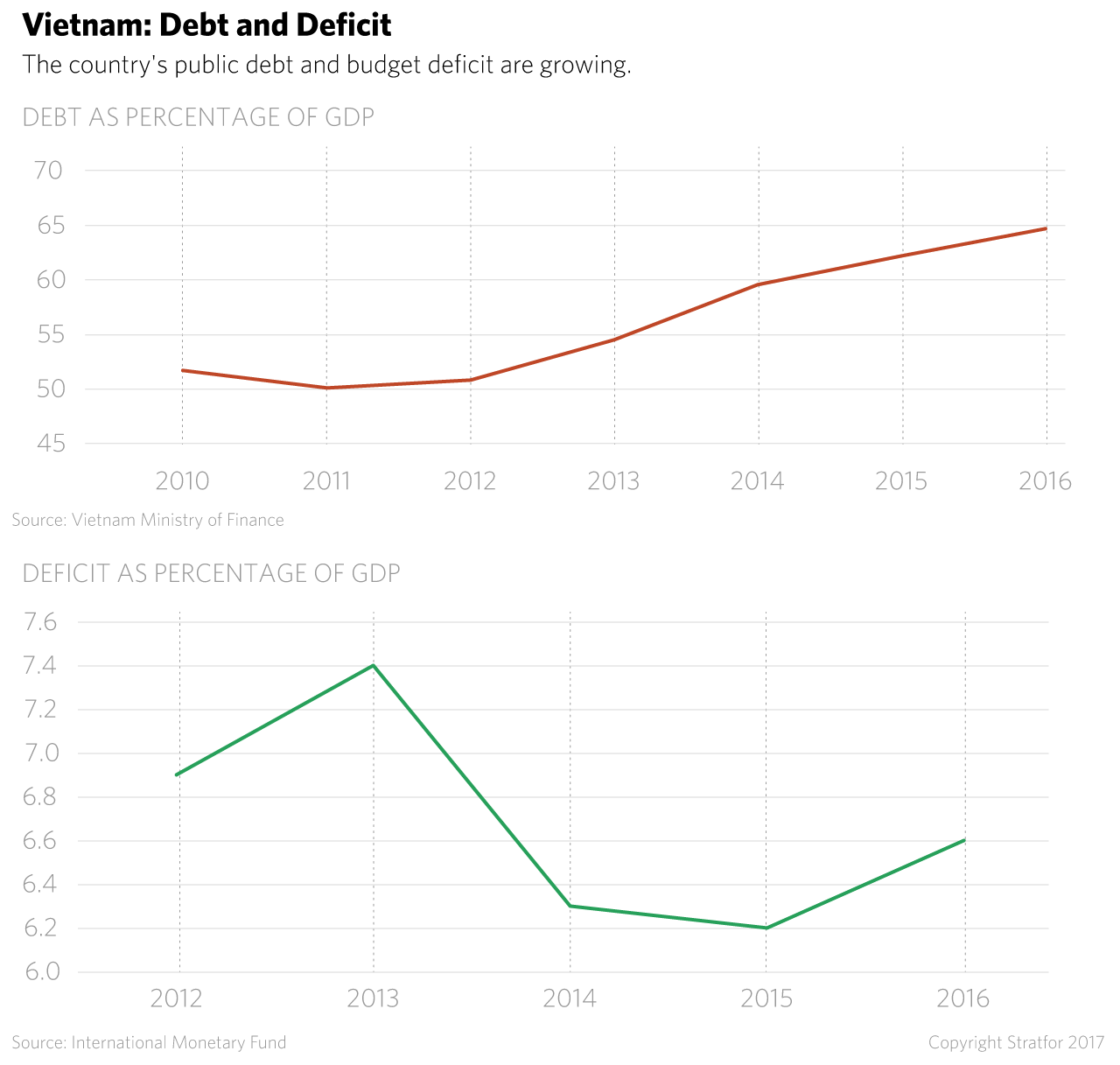
Together, these problems (among others) have given Vietnam a renewed sense of urgency in its long-standing reform campaign. The country's government is determined to mobilize the capital necessary to finance its deficit, at least in part. To that end, Hanoi has redoubled its quest to partially privatize, or equitize, unwieldy state-owned companies while seeking mergers and regulatory enforcement to help rid its banking system of debt. The government has sold off shares of several companies formerly under its exclusive control, including state-owned oil and gas firm PetroVietnam, and selected others for initial public offerings by the end of the year. In addition, it released an ambitious plan in May to equitize 137 state-owned companies and divest a total of 250 trillion Vietnamese dong ($11 billion), by 2020.
Setting a goal and reaching it, however, are two different things. Hanoi may never be able to fully realize some of its loftier proposals, such as the divestment plan. Between 2011 and 2016, the government offloaded assets worth less than one-fifth its 2020 target, and already it has fallen well behind on meeting its annual divestment quota of 60 trillion dong. Given the size of the shares that will be up for grabs, moreover, and the restrictive ownership structures still in place in Vietnam, private investors may be hesitant to get onboard with Hanoi's equitization scheme — as they have been in the past. And overcoming opposition from various interest groups in the country will be no small feat.
Fighting Corruption: A Means to Many Ends
That's where the anti-corruption campaign comes in. Hanoi's anti-corruption drive, like that of the Chinese government, serves several political ends at once: restructuring the Communist Party, securing positions for select individuals or groups, and sidelining opposition factions. Though previous efforts to root out corruption in Vietnam have focused on the same objectives, the latest initiative reflects unusual agreement among the country's leadership about how best to fulfill them.
At the center of the current crackdown is retired Prime Minister Nguyen Tan Dung. In the decade before his premiership unexpectedly ended in 2016, Dung had been one of the most powerful politicians in Vietnam, and his influence extended to nearly every sector of the country's economy through sprawling patronage networks. His ties to Vietnam's financial system, state-owned firms and security apparatus, in particular, established him as a power broker in the Communist Party's leadership. The corruption probes currently underway aim to dismantle the remnants of Dung's networks to prevent his sphere of influence from affecting the balance of power in the current Vietnamese government. Many prominent officials from state and local banks, from the government, and from state-owned enterprises — including Dinh La Thang, former head of PetroVietnam and of Ho Chi Minh City's Communist Party — have fallen from power along the way. In place of Dung's style of leadership, which centered on his individual authority, officials in the Communist Party are returning to a more collective model for decision-making. The emphasis on consensus has helped Hanoi make progress not only with its reform agenda but also with its trade strategy.
Trading One Reform for Another
Vietnam has become one of the Pacific Rim's staunchest proponents of free trade deals. From Hanoi's perspective, free trade agreements are critical to promoting foreign investment and to finding new markets for its exports as competition in the region heats up. Vietnam's quest for trade deals, in fact, has provided the main impetus for its economic reforms as well as its liberal trade agenda. And its work has paid off: The country currently has a dozen free trade agreements in effect with partners near and far, including the European Union and the Eurasian Economic Union.
But as much as Hanoi wants to link its economy with the rest of the global market, its best efforts at reform and trade negotiation won't be enough to achieve that goal. Though the country's economic growth has outpaced even that of other rapidly developing states in the region such as Thailand, Indonesia and Malaysia, its reliance on exports and foreign investment makes its economy susceptible to external volatility. Furthermore, Vietnam's manufacturing sector relies on importing the raw materials it needs to produce the country's leading exports. Vietnam's incomplete supply chains, coupled with its lack of supporting and processing industries, have cut into producers' profit margins and limited their ability to add value. Without a long-term strategy to develop its industries and boost productivity, the country's economy will remain vulnerable, no matter how far the government gets with its reforms.
