
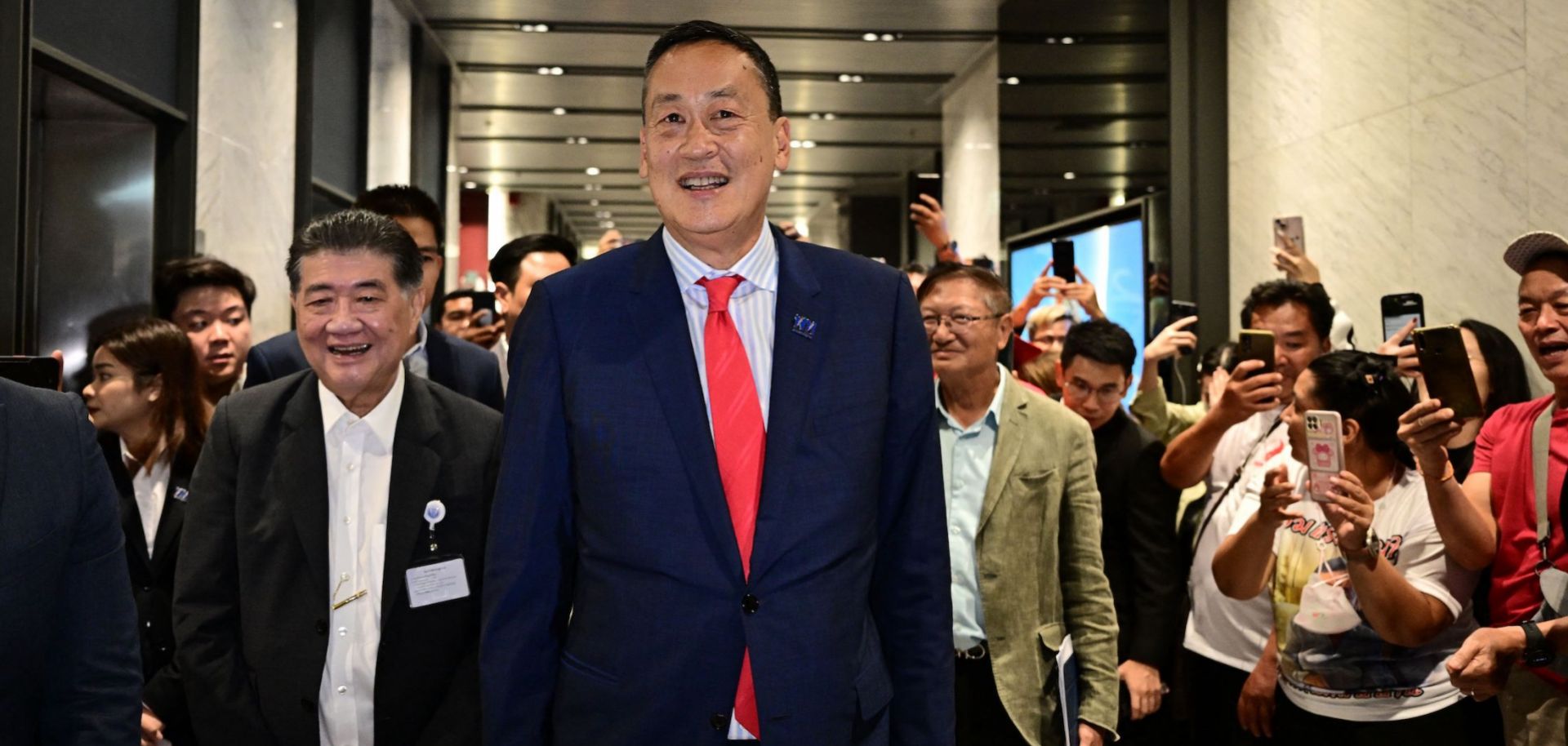
The new Thai government represents a compromise between erstwhile rivals and the marginalization of the pro-democracy movement, and though it is breaking months of political deadlock, economic recovery will prove challenging. Thailand will form a new government after the bicameral National Assembly elected former property tycoon Srettha Thavisin of the Pheu Thai Party (PTP) as prime minister on Aug. 22. Needing a 375-vote simple majority, Srettha secured 482 lawmaker votes, including 152 from the military-appointed Senate. On the same day, former Prime Minister Thaksin Shinawatra, the PTP's founder and de facto leader, returned to Thailand after 15 years of self-exile following his overthrow in a military coup in 2006. With three abuse of power and corruption convictions in absentia, Thaksin was arrested upon his arrival and potentially faces eight years in prison.
- Almost all the votes against Srettha came from the Move Forward Party (MFP), the PTP's former coalition partner and incoming opposition leader.
- Srettha is a political novice but a long-time personal confidant of the Shinawatra family.
- The 74-year-old Thaksin was hospitalized mere hours after his arrest for several chronic health issues.
Srettha's appointment is a political compromise that breaks more than three months of government deadlock in the wake of the May 14 election. The MFP won the May election with 151 House seats but ultimately failed to form a government after being stymied by the Senate and legal challenges brought against it by conservative activists. The PTP, which came out in second place (with 141 seats), initially partnered with the MFP in its bid to form a government but then abandoned the party to form a new coalition once it became clear that the Senate would not willingly accede to an MFP-led government. The PTP's new coalition consists of 11 parties holding 314 House seats, including the two military parties — the Palang Pracharat Party (PPRP) and United Thai Nation Party (UTN) — as well as the moderate Bhumjathai Party (BJP). All three refused to vote for an MFP government, formally because of the MFP's intention to abolish laws criminalizing criticism of the monarchy, but also due to political calculations. This led to two failed premiership votes in July and a government standstill. The PTP's abandonment of the larger pro-democracy movement in favor of its former enemy in the military establishment emerged as the only viable path toward government formation. As a result, the military establishment likely reached a power-sharing deal with the PTP, possibly as far back as May following the election (when the PTP was still in a coalition with the MFP). Now that the PTP-military coalition is final, the PPRP and the UTN will receive important cabinet posts, likely the interior, defense and energy ministries, while the PTP will head Thailand's government. As part of this compromise, the timing of Thaksin's return — and his subsequent hospitalization — strongly suggests he'll receive a royal pardon as part of the government formation agreement.
- In a vote held in July, only 13 Senators voted for MFP prime ministerial candidate Pita Limjareonrat, while 152 voted for Srettha.
- Thaksin reportedly met with top officials from the military and monarchy on Malaysia's reclusive Langkawi island in May to negotiate a power-sharing agreement.
With the military establishment well-represented, the PTP-led government likely portends foreign policy continuity. Prior to the recent political compromise, MFP prime ministerial candidate Pita Limjareonra had pledged to rebalance Thailand's foreign relations in favor of democratic governments and had also made antagonistic remarks toward China, Russia and Myanmar. This indicates an MFP-led government would have likely brought Thailand in closer alignment with the West. But with the military establishment not only retaining a presence in the government but maintaining control of key ministries, the Southeast Asian country is now set to continue its current approach of non-alignment and balancing between the United States and China, which enables Thailand to hedge between the great powers, gain leverage, extract concessions, promote regional stability and maintain strong economic ties with both Beijing and Washington. Moreover, with the outgoing Prime Minister Prayuth Chan-ocha's UTN party maintaining control over the energy ministry, Thailand also looks set to perpetuate its natural gas and hydropower relationship with the junta in Myanmar (something the MFP would have looked to end or at least curb). Under Prayuth (who has a longstanding close relationship with Myanmar junta chief Min Aung Hlaing), the Thai government has continued to trade with Myanmar's military government in the wake of the February 2021 coup and the country's subsequent civil war. This has become a thorny issue given that energy revenues are critical to financing the junta's war efforts — with critics arguing that Thailand's own energy reserves and capacity to import supplies from other countries are more than enough to meet the country's energy needs without having to buy Myanmar gas and hydropower exports. The likely continuation of this controversial energy trade under the new Thai government will continue to strain Thailand's relations with some of its Southeast Asian neighbors that consistently call for Thailand to be more proactive in working with Myanmar on the Five-Point Consensus peace plan signed by all of the Association of Southeast Asian Nations (including Myanmar) in 2021.
- In January, environmental law NGO EarthRights International published a study purporting to demonstrate that Thailand is not reliant on Myanmar for energy security.
While the formation of a government will reduce political uncertainty in Thailand, policy disagreements will constrain the PTP's economic agenda. Thailand's economy grew by 1.8% year-on-year during the second quarter of 2023, compared with 2.6% in the first quarter and well below the previously forecasted 3.1%. Much of the slowed growth can be attributed to suppressed consumer demand in foreign export markets, but government deadlock is also impacting Bangkok's handling of domestic economic issues. Amid the stalemate, Thailand's caretaker government delayed unveiling the 2024 fiscal budget, which is now set to be released at the beginning of 2024 despite the fiscal year beginning Oct. 1, 2023. Budget delays create economic uncertainty among both investors and consumers in terms of fiscal policy direction, while implying reduced government services and higher borrowing costs. Such uncertainty also risks having spillover impacts throughout business sectors where the Thai government is active. In addition, Thailand is still coping with structural impediments, such as high levels of household debt and the economic fallout from the COVID-19 pandemic, which has negatively affected consumer spending and financial stability (in that an outsized number of people may not be able to pay down their debts). Against this backdrop, the recent months of political uncertainty had deterred investment. As such, the new government could stabilize the business environment, reinvigorating investor confidence. On the campaign trail, however, the PTP promised to raise the country's daily minimum wage to 600 baht ($17) and introduce a ''digital wallet'' that would give every Thai citizen 10,000 baht ($285) — which would cost the government a total of $16 billion; the PTP has also pledged to hold a referendum on writing a new constitution to replace the 2017 military-authored constitution. Implementing the minimum wage hike and digital wallet proposal would require cooperation from the PPRP and the UTN to increase current deficit spending limits, a tall order given the conservatives' traditional antipathy to PTP's populist redistribution platform that they see as wasteful pandering. This — in combination with Strettha's own legal uncertainty — will likely limit the PTP's ability to enact its desired economic program.
- Srettha is being investigated per a complaint alleging tax evasion and his alleged involvement in two corrupt land deals during his tenure as CEO of the Thai real estate conglomerate Sansiri. Should the Constitutional Court rule against Srettha and disqualify his premiership, Thailand could be thrown right back into government deadlock.
- Foreign investors have been net sellers in Thailand's economy since the May election.
Government formation also lowers the risk of mass protests. In the coming weeks, MFP supporters will likely stage small-scale and sporadic localized protests against what they perceive as the PTP's betrayal of the pro-democracy movement by abandoning the MFP and siding with the military parties. However, much of the former mass protest pro-democracy movement of 2020-2021 was composed of PTP ''red shirt'' protesters, who — with PTP now set to lead the new government — have less reason to protest. As for MFP supporters, the vanquished but still influential Pita, along with others from the MFP leadership, has called for restraint. For the MFP, the hope is to serve as the opposition on the basis of its campaign platform. Owing to its strong electoral performance, the MFP is confident that adhering to its agenda as the opposition can propel the party to the premiership in the next election. This is because as of next year, the military-appointed Senate will no longer have voting power to determine the prime minister (and the MFP will be the strongest party in the House, which will have sole discretion to elect the next prime minister). For now, the MFP and its supporters thus have little interest in causing chaos.
- Thailand's military establishment was responsible for not only forestalling the MFP's rise to power, but for ousting two previous Shinawatra governments (2006, 2014) and preventing a third from coming to power (2019).
- The 2019 general election led to mass protests in a similar situation in which the PTP won the most seats but was denied the premiership by the military-appointed Senate. In the wake of the 2019 ballot, mass protest risk ran high until PTP decided to partner with its now-former nemesis.
- Per Thailand's 2017 constitution, the Senate will no longer vote for prime minister beginning in June 2024, leaving the process entirely to the lower chamber.
