
Thai flags March 4, 2023, on the side of the parliament complex in Bangkok.
Thailand is headed for early elections that favor continued military-backed rule, but a resurgent opposition portends a highly contentious election process and potential unrest, and has implications for alignment between China and the United States. On March 20, Thai Prime Minister Prayuth Chan-ocha dissolved the House of Representatives via a government decree endorsed by King Maha Vajiralongkorn, paving the way for early elections that are set for May 14. Prayuth is seeking a return to office and heads the upstart Ruam Thai Sang Chart (RTSC) party, which splintered off from the fellow military-backed and incumbent Palang Pracharath Party (PPRP) that is led by Deputy Prime Minister Prawit Wongsuwan, the PPRP's prime ministerial candidate and former longtime Prayuth ally. Prayuth and Prawit represent Thailand's two military-backed, urban-based conservative and royalist parties and oppose not only each other but also the broadly rural-based pro-democracy and technocratic opposition, led by the Pheu Thai (PT) party; other smaller parties are potentially positioned to play kingmaker in a coalition government.
- All 500 seats in the House, the lower chamber of Thailand's bicameral National Assembly, are up for grabs. However, members of the 250-seat Senate (the upper chamber) are unelected and handpicked by the military establishment. After the 500 House seats are determined, the 750 lawmakers will vote on the next prime minister. The eventual prime minister will need more than half of the votes (376) tallied from both chambers, as well as the formal endorsement of the king.
- The PT prime ministerial candidate is 36-year-old Paetongtarn Shinawatra, daughter of former Prime Minister Thaksin Shinawatra (removed in a military coup in 2006) and niece of former Prime Minister Yingluck Shinawatra (removed in a military coup in 2014). PT (together with its previous iterations) has won the most seats in every election since 2001.
- Prayuth came to power after he and Prawit ousted Yingluck in the 2014 coup, and he became a civilian prime minister after the 2019 election, which was conducted under the auspices of the 2017 constitution that was geared to return him to power. RTSC was formed in 2021 for the explicit purpose of keeping Prayuth in office.
Prayuth dissolved the House early to maximize his chances of returning to office by securing the most party-hoppers, mostly from the moribund PPRP. The House's term was set to expire naturally on March 23, but dissolving it early (even by a mere three days) triggered a niche election rule allowing party defectors a shortened 30-day window to be with their new parties before being eligible to run for office. Now Prayuth can take full advantage of party defections, as the RTSC has managed to peel away dozens of lawmakers from other parties, mostly PPRP, including high-profile and high-ranking party members. Allowing the term to expire naturally would have extended defectors' eligibility requirement to 90 days, thus disallowing the bulk of new RTSC members from running and thereby sinking Prayuth's chances of attaining strong elected support in the House.
- Parties need a minimum of 25 House seats to nominate one to three prime ministerial candidates.
- The PPRP made clear its intention to move on from Prayuth following a September 2022 Constitutional Court decision that stated his term began in 2017. Since each Thai prime minister is limited to two four-year terms, Prayuth would only be able to serve two years if he wins the election, absent an unexpected reversal of the decision.
- The moderate Bhumjaithai (BJT) party, which is in the governing coalition and is led by Deputy Prime Minister and Health Minister Anutin Charnvirakul, has also boosted its standing substantially via dozens of party defections. Anutin is rumored to be Prayuth's preferred mid-term replacement should he remain in office for two more years, and some expect Anutin to contend for the premiership himself.
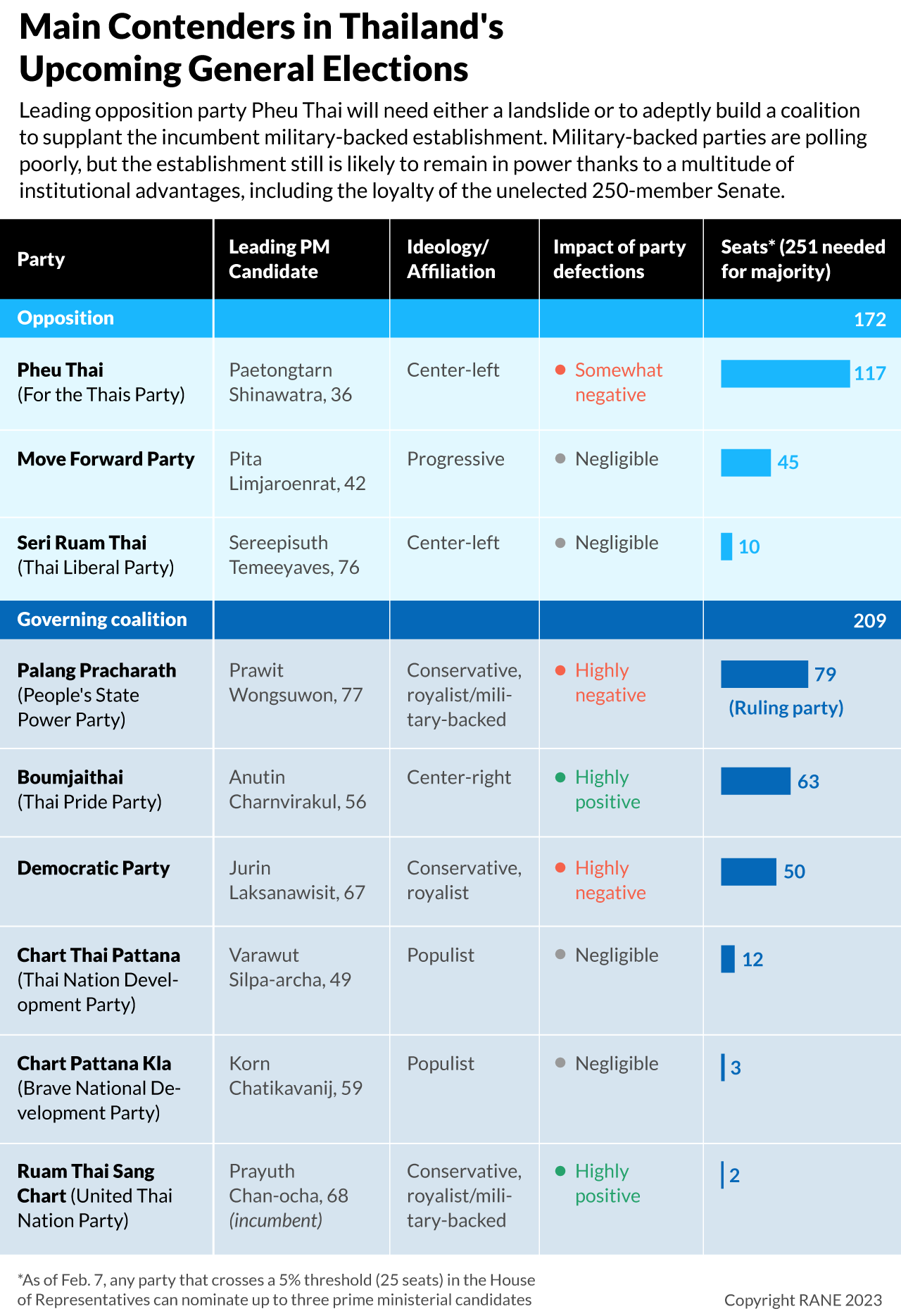
Heavily weighted institutional advantages mean that Thailand will likely continue to be ruled by a military-backed party or coalition, despite PT promising a landslide victory to curb military power. Thailand's 2017 constitution grants the military outsized power to determine the prime minister, as it empowers the Senate, handpicked by Prayuth and Prawit, to contest House votes, giving military interests a de facto 250-vote advantage out of 750 total lawmakers. Moreover, the 2023 House elections will feature 400 constituency seats (determined geographically by voting district) and 100 party-list seats awarded to parties with the most votes. The party-list component puts small parties at a major disadvantage that requires coalition building to overcome, but this dynamic still favors RTSC (despite its small membership) because Prayuth will be able to attract BJT and other potential kingmaker parties owing to his vast patronage network. Even the incumbent PPRP is open to forming a coalition, as Prawit's unfavorable polling numbers and the split with RTSC have driven him to declare that his party would be willing to partner with the opposition PT, which is resurgent and leading in every poll. This offer would have been inconceivable for a military-backed politician until now, and it may be the pro-democracy movement's best chance at securing policy-making power in the new government. So far, PT has not been receptive to Prawit's suggestion, as the elder Thaksin Shinawatra has said the party is not open to an alliance, and PT is still promising a landslide victory that would enable it to govern on its own. But since the chances of such a victory are slim (no party has ever secured the needed number of seats to rule alone), PT may yet change its mind.
- A March 20 poll by the National Institute of Development Administration showed PT's Paetongtarn comfortably ahead at 38.2%, up 10 points from the immediately preceding poll. The more radical and monarchy-skeptic Move Forward Party took second at 15.75%, with Prayuth's RTSC dropping to third at 15.65%.
- PT would likely need far more than a supermajority, 376 of 500 House seats, to neutralize Senate votes and form a government. Though this is the party's stated intention, it has never won more than the 265 it took in 2011.
- If House election results suggest Prayuth could be reelected, BJT is a likely potential RTSC coalition partner. Indeed, most of the six parties in the current governing coalition are likely to flock to RTSC if Prayuth's gambit with party defectors alters the balance in his favor.
If Thailand's military establishment intervenes in the election or is otherwise widely perceived as undermining the democratic process, social unrest is likely. The May 14 polling date coincides with university final exams. Some have taken this as a sign of meddling to suppress the youth vote, which is extremely unlikely to favor military-backed parties. More such moves are likely in the election's runup as unpopular conservative candidates seek to leverage electoral and institutional advantages. Structurally, the Senate has often made its military loyalties known, often blocking proposed House legislation. A similar scenario with respect to selecting the prime minister is thus a strong possibility, something that unfolded in the 2019 election when the PPRP fell well short of a majority in the House. The country's Election Commission and courts are also largely under the sway of military-backed interests. These stacked institutions are therefore well-positioned to override an electoral outcome unfavorable to their interests. Even another military coup is not out of the question — particularly in the event of a hung parliament — as Thai history has aptly demonstrated the military's willingness to forcefully fill a political vacuum. Yet even absent such a dramatic turn, a widespread perception that the military is once again undermining the electoral process — let alone if the military acts after the fact to forcibly reverse a result — widespread social unrest akin to the 2020-2021 protests may again materialize. While such unrest would be unlikely to overturn the result, it could cause major disruptions in Bangkok for months and to a lesser extent elsewhere in the country, portending business shutdowns, supply chain disruptions and stalled progress on the country's already lagging post-COVID economic recovery effort. Renewed protests would also likely reignite debate around the monarchy and the future of Thai society more broadly, particularly as younger generations remain highly skeptical of both the monarchy and its military backers.
- On March 24, Prawit said "if the country is in turmoil, [a coup] may be necessary." Prayuth has repeatedly stated that there will be no more coups, which indicates he thinks the risk is real, or at least that the public views it as such. Thailand has had 18 coups since 1932.
- Many of the grievances of the prior protest movement remain intact, such as strict application of lese-majeste laws that criminalize criticism of the monarchy. Moreover, the government delayed implementing key provisions of an anti-torture and arbitrary detention law in February, suggesting authorities intend to keep all protest suppression mechanisms viable.
- PT has yet to reveal whether it has a plan in the event it wins but is denied the premiership due to military meddling.
- Thailand's post-COVID recovery is the slowest in Southeast Asia at just 2.6% growth in 2022 compared with Malaysia (8.7%) and Vietnam (7.4%). Attendant rising living costs and record high household debt top voters' concerns.
While continued military-backed rule would do little to shift a foreign policy that has seen reengagement with Washington in recent years but generally leaned toward Beijing, a PT or other opposition party victory would nudge Thailand into Washington's orbit — but not into full alignment. In the immediate wake of the 2014 coup, the Prayuth government moved quickly into China's orbit, securing arms as well as surveillance and cyber technology while cratering relations with treaty ally the United States. Since then, however, Thailand's geostrategic value vis-a-vis Washington has driven a rekindling of partnership, and relations are by and large cautious but stable. This status quo would likely continue should Prayuth or Prawit secure victory, though it includes potentially isolating factors such as tacit support for the Myanmar junta. The United States would welcome a PT-led coalition — or less likely, an outright victory — as would other democracies, likely portending a boost in Western-Thai relations. Still, a PT-led government would also likely adopt the "bamboo diplomacy" prominent among the region's middle powers, meaning it could lean toward Washington but would ultimately seek to cultivate healthy relations with both great powers, and thus would not be likely to join U.S.-led China containment efforts full bore.
- Reinvigorated U.S.-Thai relations were on full display during the Cobra Gold military drills, the Pentagon's largest annual live-fire drill in Asia, which ended March 10. The drill had been on hiatus for three years owing to the COVID-19 pandemic, but the most recent iteration represented a return to form and was the largest and most technologically sophisticated to date.
- A shift in Thai foreign policy may have the most immediate impact on neighboring Myanmar, where the Prayuth government has been loath to undermine the governing military junta. PT would likely be less amicable, even antagonistic, toward the junta, particularly seeking out alternative energy suppliers to reduce revenue for the junta's war effort.
- Thailand's deteriorating democratic institutions and perceived inaction on human rights have isolated it to a degree, costing it all three invites to the now annual U.S.-led Summit for Democracy as well as free trade agreement negotiations with the European Union. Negotiations, suspended by Brussels following the 2014 coup, only resumed March 15. A PT-led government would be more likely to restore such institutions, at least partially, in the eyes of the international community, and therefore would stand a greater chance of deeper collaboration with the West and a revival of trade deals.
