
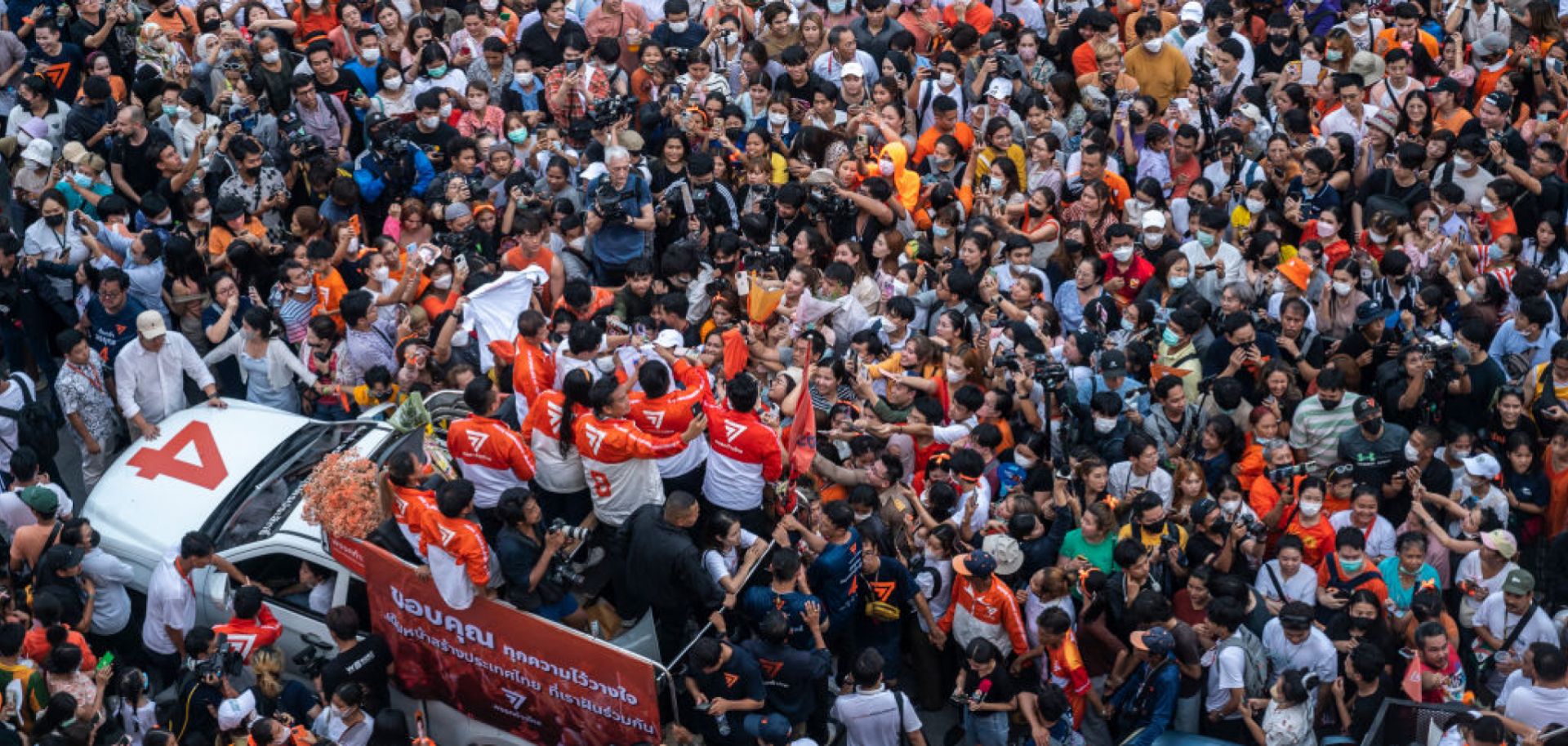
A car with members of Thailand's opposition Move Forward Party (MFP), including leader Pita Limjaroenrat, drives through a large crowd of supporters during a rally in Bangkok on May 15, 2023, to celebrate the MFP's strong performance in the general election.
Thailand's two main opposition parties dominated the country's general election, but the military establishment will seek to leverage its institutional controls to retain power. Thailand's opposition progressive Move Forward Party (MFP) — led by entrepreneur Pita Limjaroenrat — and the center-left Pheu Thai Party (PTP) — led by Paetongtarn Shinawatra, the daughter and niece of two former prime ministers – emerged as the top seat winners in Thailand's May 14 general election, securing 151 and 141 seats, respectively, in the country's 500-seat House of Representatives. The moderate and former governing coalition partner Bhumjaitai Party (BJP) placed third, securing 70 seats. The Palang Pracharath Party and Ruam Thai Sang Chart — the two military-backed parties — won 41 and 36 seats, respectively. On May 15, Pita declared victory and announced that the MPF and the PTP will form a governing coalition with four other small parties, none of which were in the previous governing coalition.
- The MFP's strong electoral performance ended a streak that saw the PTP (or its forerunner party) win the most seats in each election since 2001. The military ousted two of the PTP's four governments in 2006 and 2014. Paetongtarn had promised a landslide victory for the PTP throughout the campaign season; the result is thus seen by many in her camp as a failure.
Despite their strong electoral performances, the MFP and the PTP will likely struggle to form a coalition due to resistance from the military-appointed Senate. The election results will be finalized on Aug. 6, giving Thai parties 60 days of political horse-trading to form a coalition government. Despite securing the most seats, the MFP and the PTP will not have a clear path toward winning the premiership or leading a coalition. The combined total of the six parties Pita mentioned as members of the aspirational government coalition account for only 309 House of Representatives seats, still well short of the 376 needed to nullify the votes of the 250 military-appointed and unelected seats in the Senate, members of which have already begun vowing to withhold their votes from Pita. With all 250 Senate votes likely at their disposal, either of the two military-backed parties (Ruam Thai Sang Chart and the Palang Pracharath Party) could thus still cobble together enough of the 750 total lawmaker votes needed to take the premiership, most likely with efforts centered on the moderate third place the BJP and its 70 seats. However, the BJP was a member of the prior governing coalition, and the MFP has indicated it will not work with any such party. A non-military coalition without the BJP would very likely prove numerically insufficient.
- On May 15, Senator Jadet Insawang told reporters that he would not vote for the MFP due to the party's intention to repeal Thailand's lese-majeste laws, which outlaw the social taboo of insulting the monarchy. He also emphasized the Senate's tendency toward unified action, suggesting the military-appointed body will act in concert to deny Pita the premiership.
- Ahead of the election, the BJP swelled its ranks with dozens of party defections from across the political spectrum. Despite never being a frontrunner, the party has maintained good relations with both sides, positioning it well to play kingmaker. A play by the military-backed parties to build a coalition would thus also likely center around courting the BJP.
In addition to control of the Senate, Thailand's military establishment also has many other institutional levers it could utilize to prevent the formation of an opposition-led government. The military has repeatedly ruled out the possibility of another coup, with incumbent Prime Minister Prayuth Chan-ocha telling reporters he ''respect[ed] democracy and the election'' after the initial results of the vote started circulating on May 14. But that does not preclude Thai military leaders from using constitutional means to try to cling to power. In the coming weeks, Thailand's Constitutional Court (which backs the military) could move to dissolve either or both the MFP and the PTP — something that has a thorough precedent in Thai politics. Pita could be ensnared on the basis that he holds shares in a non-active and delisted media company inherited from his late father. If proven in court to be tantamount to owning a media company, those shares would disqualify him from contending for political office under Thailand's constitution, and his MFP could also be banned as a result. The PTP case will be more difficult to make, but with Paengtorn's father and former Thai prime minister Thaksin Shinawatra widely believed to be running the party from his exile in Dubai, the military establishment will look to prove that the PTP was aided from outside the political system, which is illegal as well. While the MFP's case is more likely to result in a ban, both opposition parties are vulnerable to being dissolved on technical grounds. However, the MFP's strong performance in the May 14 election (and the incumbent conservatives' poor performance) indicates that the Thai electorate has moved decisively against the military establishment. Military leaders' efforts to stay in power will thus run up against significant opposition and likely mass unrest akin to the months-long 2020-2021 protests should they act blatantly or be bold enough to dissolve either or both the MFP and the PTP.
- Thailand has had 13 successful and nine unsuccessful military coup attempts since abolishing its absolute monarchy in 1932, averaging one coup every seven years.
- In addition to banning the Future Forward Party in 2020, the Constitutional Court also banned the PTP's forerunner party, the Thai Rak Thai Party, in 2007.
- Citing unnamed sources, the Thai Enquirer reported on May 5 that both military-backed parties were preparing ''war chests'' of cash to attract lawmakers from both the MFP and the PTP should either party be dissolved.
