
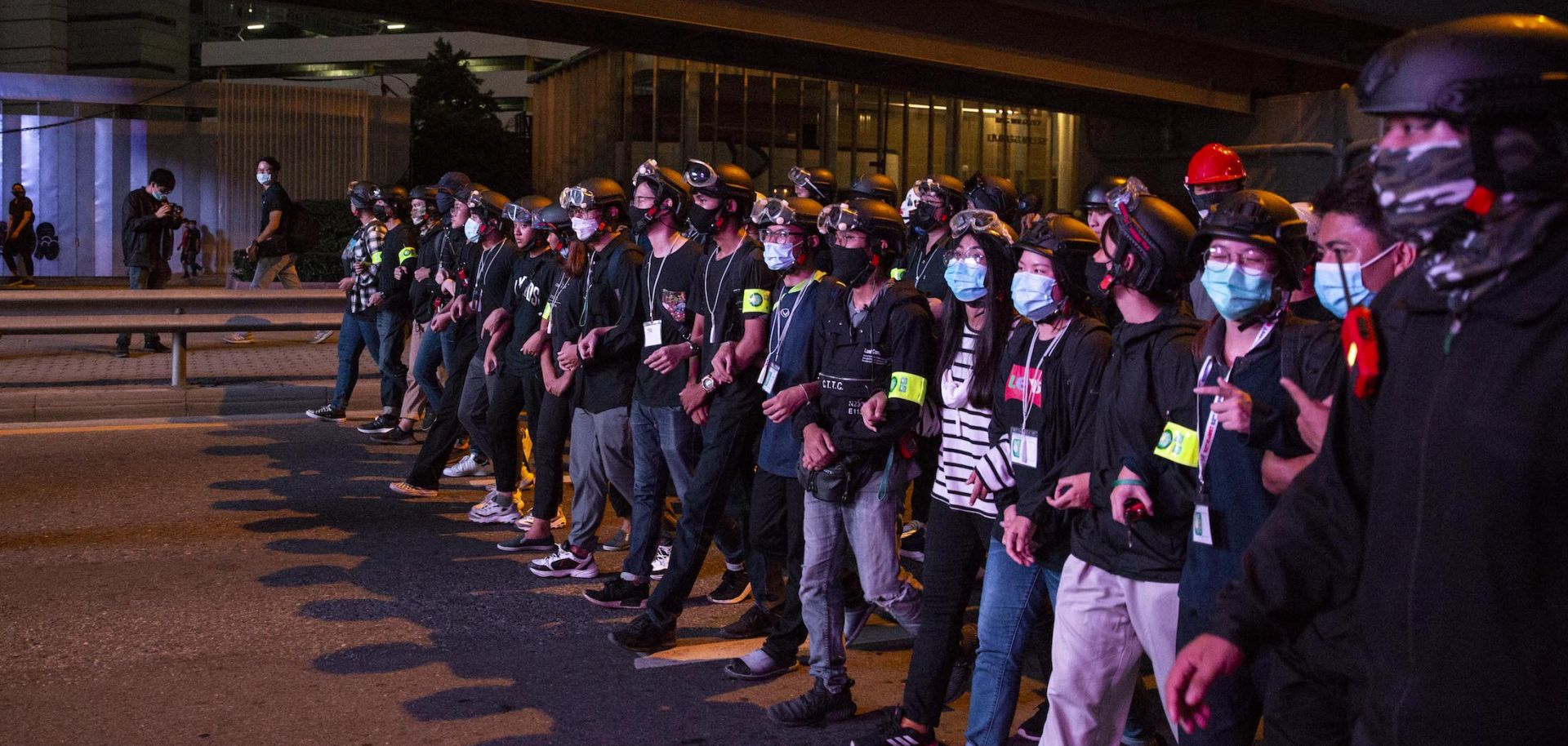
A group of pro-democracy protesters gathers at an intersection in Bangkok, Thailand, on Oct. 26, 2020.
The current protests in Thailand will not threaten the stability of the country’s military-led government, but they will accelerate a limited constitutional reform process and prompt Bangkok to impose more restrictions on the political opposition. Protests that began in July and escalated in recent weeks represent the greatest political challenge to the Thai government since the country transitioned out of five years of direct military rule in mid-2019 to a political system still dominated by the military. But while they may be disruptive to particular parts of the capital city, these student-led actions are unlikely to build into the paralyzing unrest seen in the years leading up to the country’s 2014 military coup.
The Thai government is pursuing moderate constitutional reforms that address some of the grievances driving this cycle of protest, but without deeper popular support, the protesters are unlikely to compel deeper changes that would erode the military and monarchy’s power. Thai protests have been ongoing for months but have been largely limited to students, particularly those in Bangkok, having as yet failed to bring in a broader swath of the country or public in a sustained manner. As a result, the student protest movement remains a highly polarizing phenomenon, and one that actual opposition parties in power are wary of aligning too closely with given its confrontational rhetoric toward the king (criticism of the king has long been a taboo topic in Thailand due to the monarchy’s centrality in the Thai political order and national identity). This makes the current protest movement less politically and practically impactful than the tumultuous red shirt and yellow shirt protests that toppled governments and paralyzed the capital in the 15 years before the 2014 coup.
- Beginning in earnest in July, the protest movement has seen regular attendance at rallies largely in Bangkok with notable spikes on Aug. 16, Aug. 27 and Sept. 19, with smaller turnout in provincial cities.
- On Oct. 14, however, the movement appeared to enter a new phase of sustained, large turnout on the streets under a leaderless resistance model — a shift partly triggered by the government’s emergency declaration and subsequent heavy-handed crackdown.
- Protesters are demanding the resignation of Prime Minister Prayuth Chan-ocha, elections as well as a constitutional rewrite to limit the military and monarchy.
For now, Thailand’s military-led government currently has adequate constitutional and parliamentary power to keep the protests from posing a true threat.
- Since the March 2019 elections, Thailand’s military-allied civilian party, Palang Pracharath, has steadily consolidated a ruling coalition in the Thai parliament, currently commanding 55 percent of votes (269) in the lower house. Wielding influence over the powerful constitutional court, the military-aligned government has also managed to significantly weaken the Thai opposition through the ban of the popular Future Forward Party and a voting system that strongly favors easily-controlled, one-seat parties.
- In addition to its elected seats and allies, under the constitution, the military has a guaranteed dominant position. Of the 750 seats in the Thai National Assembly, the military directly appoints a 250-seat Senate, meaning the military only needs 126 lawmakers while any anti-military group would need 376.
- The military and the monarchy are broadly aligned, with the monarchy also deeply entrenched in the Thai political system as a longstanding pillar of stability. Protesters’ centering of their demands on taboo criticisms of the monarchy alienates broad swaths of mainstream Thai society and leaves them vulnerable to stiff legal consequences under Thailand’s lese-majeste laws, which forbid insulting the monarchy.
Although the protests themselves may not rattle the military-led government, the ruling coalition will still be compelled to address protesters’ demands in some manner to avoid weakening itself in the long term. With an eye towards 2023 elections and beyond, the military still wants to maintain a solid foothold in elected civilian power. Given Thailand’s history of disruptive coups and political polarization, the military sees its civilian party as a stopgap to avoid such outcomes and maintain stability. This requires it to maintain a degree of legitimacy with the public by responding to its citizens’ will and limiting itself to working within the strictures of Thailand’s current political system — which, in the current context, translates to quelling mass protests without a draconian crackdown or outright coup. If the military badly mishandles the protests, or if Thailand’s economy collapses further due to COVID-19 and political disputes, the parliament could fragment into pro- and anti-military factions, eroding the military control on power.
- Despite its current strong foothold in parliament through its coalition allies and its constitutional powers, the military still faces challenges. It currently holds its position through alliances with the Democrat Party and Bhumjaithai Party, which together control 23 percent of lower-house seats. These two Thai establishment parties have aligned with the military because of their distaste for the opposition Pheu Thai (which controls 27 percent of lower-house seats).
- The military is also internally divided, with factions intent on challenging Prime Minister Prayuth, as well as forwarding their own interest and those of the military as an institution. In June 2020, internal factions within the military-aligned Palang Pracharath party managed to force the resignation of the prime minister's economic team, compelling a disruptive reshuffle. Elements within the ruling party are still dissatisfied with the prime minister and could take the protests as an opportunity to disrupt Prayuth’s foothold if he does not adequately handle the demonstrations.
Even if Bangkok is able to defuse the political risks, the protests still present a risk to the Thai government’s efforts to restore economic growth in the face of COVID-19. If the demonstrations sustain momentum and begin appearing uncontrolled, they may deter much-needed investment and post-pandemic tourism.
- The Thai economy is currently projected to shrink by 7.1 percent in 2020, with a recovery in 2021 dependent on Thailand’s ability to avoid long-term economic scarring, restore consumption and attract tourists and investment.
The next phase of the Thai political crisis will center on government efforts to carefully shape constitutional changes that show it remains responsive to the people’s will without meaningfully eroding the military or monarchy’s power. Bangkok will tailor its reforms to avoid jeopardizing the military’s institutional power and the standing of the Thai monarchy, despite the fact that reforming those very institutions are the center of protester demands. Such efforts — combined with targeted crackdowns — will dissipate broader public support for the protests, easing pressure on the government. The process of constitutional reform will last well into 2021, with ample opportunities for the military to shape the outcome and ignite debate that further peels off support for protesters’ extreme demands. This will also serve to help civilian establishment parties allied with the military-aligned ruling party, ensuring some level of political continuity for Thailand by securing the current government’s place in power.
- On Oct. 28, the Thai lower house moved towards forming a “reconciliation committee” that would include the government and its allies, senators, protesters, counter-protesters and the opposition.
- A vote on constitutional changes was delayed amid protesters' outcry when the parliament decided to set up a special committee to study draft amendments in late September. In early November, parliament will begin debate on six current constitutional rewrite proposals, although it may wait until Nov. 12 to allow civil society group Internet Law Reform Dialogue to finalize the submission of its own.
- The prime minister says the process of discussing amendments should be completed by December following the passage of bills that pave the way for a national constitutional referendum and the setting up of a Constitution Drafting Assembly (CDA) for a rewrite. In early 2021, the government aims to hold a referendum for public approval of the proposed amendments, with submission to the king for approval within 90 days.
- The current military-drafted constitution grants a strong hand to the military’s government proxies to prevent any unwanted amendments. A majority of both houses of parliament must pass the motion, including one-third of military-appointed Senators.
