
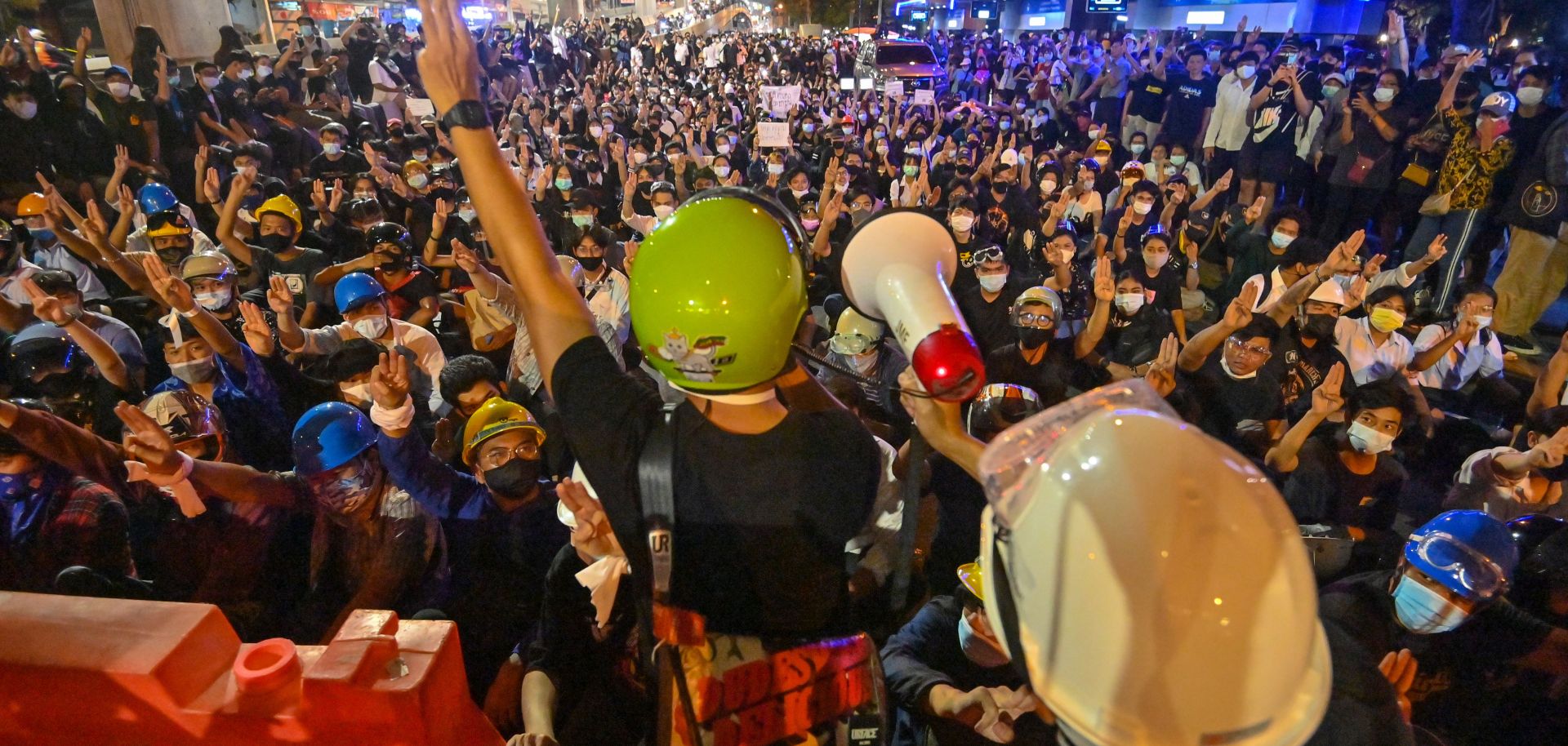
A protester uses a loudspeaker to talk to the crowd during an anti-government rally in Bangkok, Thailand, on Oct. 19, 2020.
The recent escalation of the monthslong Thai student protest movement will compel the government to step up its restrictions on dissent and intensify efforts to co-opt the protesters’ less controversial demands through a limited constitutional reform process. This could cause protests to drag on amid continued controversy over the scope and pace of such amendments, even as it eases overall public support for demonstrations. Between Oct. 13 and Oct. 19, Thai protesters turned out on the streets of Bangkok for the most sustained period of protest-related disruptions since the movement kicked off in earnest in July. Demonstrators also appeared in 20 other locations nationwide in smaller numbers.
- Thai protests have coalesced around three demands: resignation of Prime Minister Prayuth Chan-ocha, constitutional amendments to reduce military power and reforms to the Thai monarchy.
- Protesters have adopted "Hong Kong tactics” in recent days, shifting from clearly delineated and centrally planned marches to more fluid demonstrations. Police estimated that about 20,000 participated in the Oct. 19 protest, though media and protesters estimated far more.
- On Oct. 15, the Thai government imposed a state of emergency that will last through Nov. 15, allowing it to restrict public gatherings to under five people and ban online posts and media reports deemed harmful to national security. This has been accompanied by stepped-up arrests of protest leaders, the partial shutdown of the Bangkok metro and blockage of certain communication apps.
Where possible, the Thai government will try to avoid sharp crackdowns that risk further inflaming protests and delegitimizing the military's attempts to create an enduring foothold in civilian politics. The government will likely continue to intimidate protesters and undermine their ability to attract support, gather and organize by arresting key leaders and having police adapt to new protest tactics. The government will also try to blunt the broader appeal of protesters’ cause by co-opting their demands, such as limited constitutional reform. Still, many members of the public will refrain from supporting protesters given the anti-monarchy stance and concerns about stability affecting economic growth.
- Suan Dusit Rajabhat University’s most recent opinion poll on the protest demands (released in late August) found that while 63 percent of Thais supported constitutional amendments of some kind, while 42 percent said such changes should not touch the monarchy. Over 41 percent of respondents said they did not support the demonstrations and worried they jeopardized public order.
There is room within the Thai constitution for a reform process that could bring some limited charter changes in a process tightly controlled by the military. The Thai cabinet will hold a special session Oct. 20. Lawmakers will then meet Oct. 23 to decide whether to recall parliament for a special session — a move that Prime Minister Prayuth Chan-ocha has supported. Three parties within Thailand’s ruling coalition, including the military-backed Palang Pracharath Party (PPRP) and establishment Democrat Party, have also voiced support for constitutional change. However, the PPRP has said it would never support changes to the protections and powers of the monarchy.
The insulation of Thailand’s military-aligned government shields the ruling coalition from public pressure, meaning substantial political disruption is unlikely. With many tools to entrench itself and avoid policy changes that are against its interests, the Thai government will not be forced to concede to most protests demands. However, the military’s long-term goal is to build a strong, legitimate foothold in parliament through its civilian proxy parties, which will require avoiding any actions that seem too heavy-handed, maintaining support from its allies and getting economic growth back on track.
- The military has carefully engineered the Thai constitution to limit civilian power and prevent political instability. This has included the establishment of a powerful constitutional court that can ban troublesome opposition parties, a Senate hand-picked by the military, a king with the power to declare martial law and a very high bar for constitutional revision.
A sustained standoff between protesters and authorities, however, could dampen economic growth and bring continued security disruptions in Bangkok. If crackdowns do not work and protest activity is massively disruptive for a period of months, the military could have Prayuth step down in favor of an alternative ruling party or ruling coalition leader, removing a key target of criticism. This is unlikely, given the prime minister’s power base and the risk of emboldening protesters. The choice of last resort would be a military coup, which the military would engage in only if it had no other option — a situation it is not yet close to facing.
- COVID-19's impact on vital tourism flows, exports and domestic consumption has badly damaged Thailand's economy, which the International Monetary Fund now expects to shrink by 7.1 percent in 2020.
- There are hopes of a rebound to 4 percent growth in 2021, but the recent protests have already seen institutions such as Japan's Mizuho Bank downgrade their GDP estimates for 2020. Thai political dysfunction has a history of suppressing growth, including during 2011 and 2014 unrest as well as a late 2019 budget battle.
