
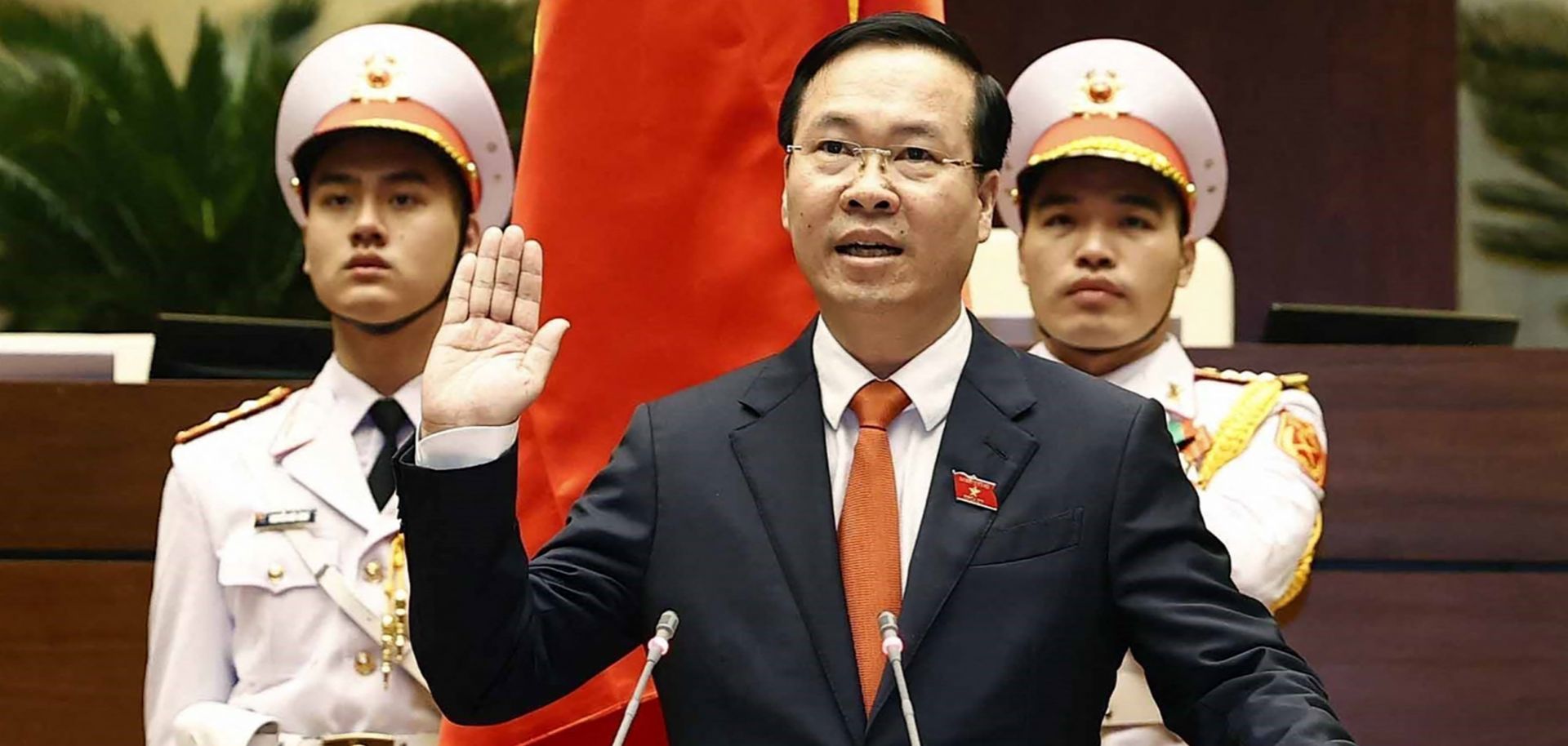
Vietnam's new president Vo Van Thuong takes an oath during an extraordinary meeting in the National Assembly in Hanoi, Vietnam, on March 2, 2023.
The appointment of Vietnam's new president signals a doubling down on the country's ideological direction under the Communist Party and the continued escalation of the government's anti-corruption campaign, which will increase economic uncertainty in the short term. Vietnam's National Assembly elected Vo Van Thuong as the country's president on March 2, less than two months after former President Nguyen Xuan Phuc was forced to resign on Jan. 17. At 52 years old, Thuong is the youngest member of the Vietnamese Communist Party's Politburo and is the first one born after the Vietnam War to be elevated to such a high-ranking post. In addition to representing a new generation of leadership, Thuong is regarded as among the primary thought leaders with respect to Communist Party conduct and ideology, underscored by his six years serving as the party's propaganda leader. He is also widely seen as an acolyte and ally of General Secretary Nguyen Phu Trong, Vietnam's most politically significant actor and the architect of Hanoi's ongoing ''blazing furnace'' anti-graft campaign, which saw the removal of former President Phuc and two deputy prime ministers earlier this year.
- On March 1, the Politburo Central Committee formally nominated Thuong1 to serve the remainder of former President Phuc's 2021-2026 term.
- Thuong has spent his entire career in the Communist Party apparatus and not the government, which he is now tasked with administering. He is currently the standing secretary of the elite Politburo Secretariat, the fifth-highest position in the party's hierarchy. From 2015 to 2021, Thuong also served as the head of the party's Central Propaganda Department, where he helped spearhead efforts to reform the sentiments of both elites and rank-and-file party members to exercise discipline and more closely adhere to party ideology.
- On Jan. 5, deputy prime ministers Pham Binh Minh and Vu Duc Dam were forced to step down due to their alleged involvement in several high-profile corruption scandals. Less than two weeks later, President Phuc was then also forced to resign after the Communist Party's Central Committee found him responsible for ''violations and wrongdoing'' related to the corruption of officials under his purview when he was prime minister from 2016-2021. Phuc was the first Vietnamese president to be effectively ousted from office, and the highest-ranking government official to be implicated in Trong's growing anti-graft campaign.
Thoung's elevation to president solidifies a decisive shift in the balance of power in Vietnam, as General Secretary Trong seeks to reorient the state bureaucracy under the auspices of the Communist Party ahead of his anticipated resignation in 2026. Vietnam's single-party politics is often characterized as a power struggle between the more conservative- and ideological-leaning Communist Party and the country's more technocratic state faction. During his tenure, former President Phuc's extensive power base afforded him an unusual degree of agency in the post, which saw Vietnam's state bureaucracy (led by Phuc) strike a leadership balance with the Communist Party apparatus (led by Trong). But this balance of power when Phuc was forced out in January, along with two former deputy prime ministers — all of whom had extensive experience running various levels of Vietnam's state bureaucracy. Newly elected President Thuong, by contrast, has no such experience and has only held positions in the Communist Party apparatus. Thuong's elevation and the replacement of Phuc thus represent a takeover of the presidency by the Communist Party apparatus. Compared with his predecessor, Thuong is likely to be more closely controlled by Trong, which will reduce the significance of the presidency to what it was before Phuc held the post by reorienting the office to serve the purposes of the party apparatus. Having a loyal subordinate as president will also vastly improve Trong's ability to lay out a favorable succession plan before the general secretary's expected retirement in 2026. Indeed, Thuong is now the favorite to take over for Trong as general secretary, but his tenure as president will serve as a test of his leadership capabilities.
- Trong is 78 years old and in poor health. He is expected to retire at the end of the current term in 2026 and is thus prioritizing positioning those who share his convictions into positions of power to steer the direction of Vietnam's leadership into a new era. In 2018, following the in-office death of President Tran Dai Quang, Trong tried and failed to elevate a chosen successor to the position and subsequently finished out the term in the position himself.
More broadly, Thuong's appointment also signals a tighter adherence to an emerging state ideology. Thuong's ideological bent was on full display during his inauguration speech, during which he strongly advocated for ''steadfastness in the application and creative development of Marxism-Leninism and Ho Chi Minh thought'' — signaling a sharp contrast with Thuong's ousted predecessor Phuc, who was known for his business acumen and friendly relations with Western countries. Given his background and experience as the Communist Party's former propaganda leader, Thuong is more likely to focus on the philosophical and theoretical underpinnings propping up the party's legitimacy compared with Phuc's non-ideological approach to policymaking and focus on deepening Vietnam's integration with the global economy. But this political shift is unlikely to impact Vietnam's booming economic growth as officials will still face pressures to ensure economic development, even if they're more focused on ideological discipline.
- Trong launched his anti-graft campaign in 2016 with an aim to weed out endemic corruption, which the general secretary attributes to ideological rot — a vision shared by newly elected president Thuong. In recent years, requirements that Communist Party cadres familiarize themselves with classical socialist texts, as well as Trong's own writings, have grown exponentially.
- Increased party control over Vietnam's state apparatus has historically not impacted private sector activity.
Thuong's appointment portends an intensification of Vietnam's anti-graft campaign as well, perpetuating a constraint on business in the short term. In recent years, Thuong has served as a loyal lieutenant in Trong's anti-corruption campaign, which has recently intensified and expanded in scope by targeting officials in increasingly high-level positions in the Communist Party, along with executives in the private sector. With an ally as president, the general secretary's anti-corruption drive will likely continue to expand, spreading further into the private sector as more business moguls are targeted along with party cadres and civil servants. Since it was launched in 2016, Trong's push to clean up Vietnam's business environment has largely failed to address the structural drivers of widespread corruption, instead relying on a reactive approach. Vietnamese officials have, in turn, become increasingly wary of signing off on investment projects for fear of being ensnared in the ever-evolving anti-graft drive, creating a bureaucratic bottleneck that has hit the country's infrastructure and real estate sectors hardest. Vietnam will remain interested in attracting foreign investment, especially as companies continue to diversify their supply chains away from China. But the increasingly expansive and reactive nature of Trong's anti-graft campaign will constrain this ambition by leaving officials unsure of what may trigger a violation (particularly with respect to public procurement). As a political theorist, Thuong may eventually help reorient the anti-graft campaign into a more proactive push that addresses the underlying cultural drivers of endemic corruption within Vietnam's business environment, such as gift-giving and off-the-books transactions. But for now, authorities appear unlikely to provide a more straightforward and comprehensive set of norms and ethics needed to shift away from the current reactive approach. Foreign direct investment will, in turn, continue to suffer as spooked government officials delay new business deals.
- Two real estate conglomerate executives were arrested on fraud convictions in 2022 as the anti-graft campaign hones in on private sector actors.
- Vietnam's real estate sector will likely see intensified scrutiny in the short-to-medium term, placing business relations with foreign investors in jeopardy. The country's investment approval bottleneck is also contributing to a cash crunch in the real estate sector, which could undermine the country's 2023 economic growth target of 6-6.5%.
