
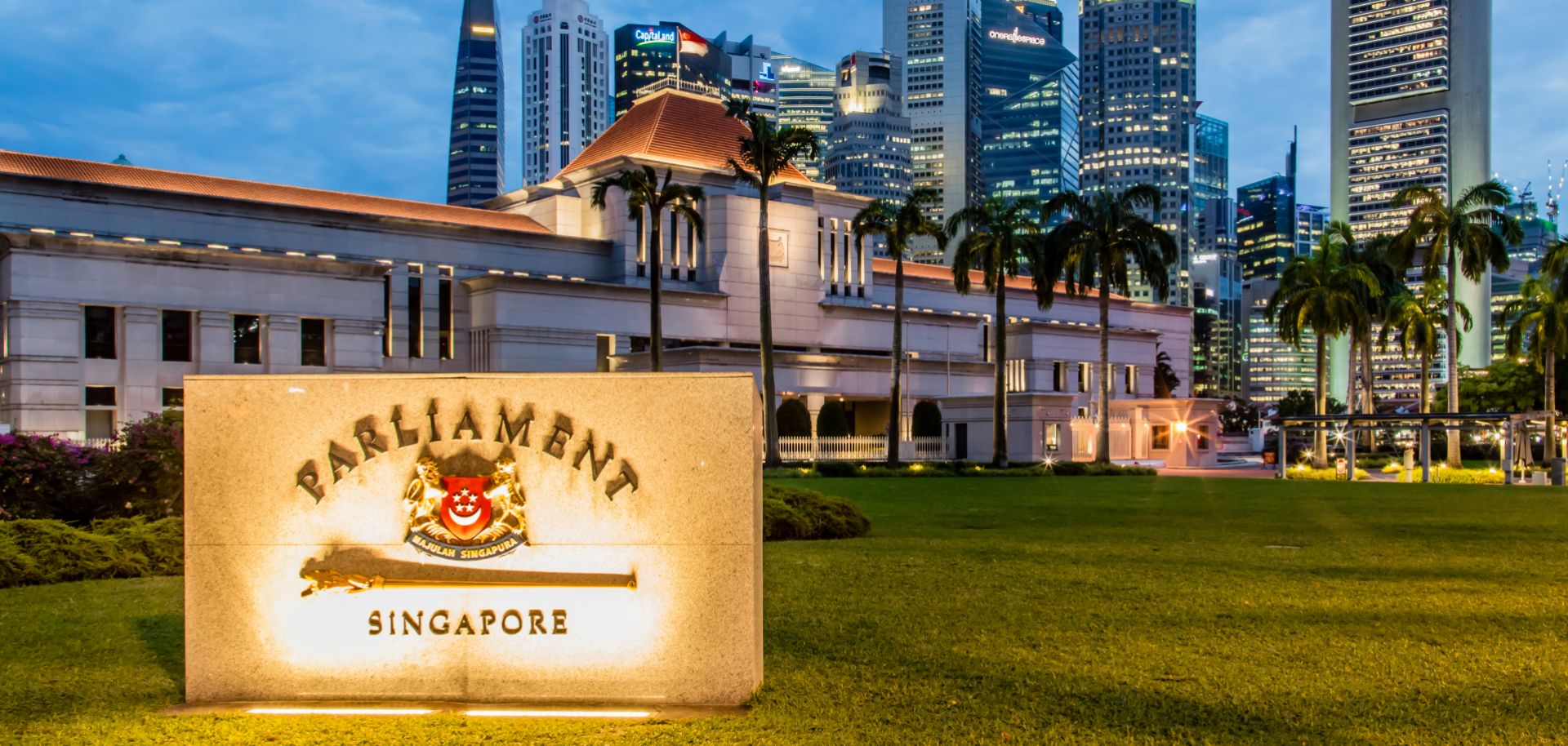
While an impending leadership change in Singapore portends short-term policy continuity, it could lead to a snap election and may signal that the ruling party's monopolistic political leadership is gradually waning. On April 15, Singaporean Prime Minister Lee Hsien Loong announced that he would step down in favor of his chosen successor, Deputy Prime Minister and Finance Minister Lawrence Wong, who will become the country's fourth prime minister since 1965. The transition is set for May 15. After the transfer of authority, Wong will lead the ruling People's Action Party, or PAP, in preparation for the city-state's next general election, which is due by November 2025. Lee will serve as a senior minister in Wong's Cabinet following the handover.
- Lee has been Singapore's prime minister for nearly 20 years, taking over in 2004 for Goh Chok Tong, who served in the office for almost 14 years. Lee is also the eldest son of Singapore's first prime minister and founder Lee Kuan Yew, who governed the country from 1965-90. All Singaporean prime ministers have represented the PAP, which has been the dominant political force in Singapore for the country's entire independent history.
- Wong was the chief executive of Singapore's Energy Market Authority before entering politics in 2011. Since then, he has led the ministries of state defense, culture, communications, national development, education, and community and youth, among other positions, including PAP deputy secretary-general. As co-chair of the Multi-Ministry Taskforce from 2020-23, Wong earned a reputation during the COVID-19 pandemic as a competent administrator given the city-state's relatively low death rate. Wong is also a close confidant of Lee and has served as his private secretary.
The transition has been several years in the making, though the particular timing of the handover could signal that the PAP intends to call for early elections. Lee's resignation has been expected since 2017 when he publicly announced his intention to step down in the next several years, and Wong has been Lee's presumed successor since April 2022 when the PAP elected him as the leader of the party's "fourth-generation" team. This history shows that Singapore's transition of power has been long anticipated, as has Wong's eventual leadership. However, Lee may have chosen this specific moment to announce the date of his forthcoming resignation to lay the groundwork for a snap election amid favorable conditions. For instance, the PAP has had almost a year to recover from several scandals that shook public support and, thus far, has successfully forestalled additional bad press in the intervening months. Moreover, growing geopolitical uncertainty in the region and beyond would play to the PAP's advantage by convincing the voting public to look to its well-established leadership rather than unproven rival parties. Additionally, Wong's early appointment will enable him to establish a mandate and continue rebuilding voters' confidence in the party by effectively implementing the 2024 budget. If these circumstances continue to favor the PAP, the government will likely call for an early snap election.
- The PAP underperformed in the 2020 general election, dropping from 70% to 61% in the popular vote. It also lost seats to the rival Workers' Party, though it maintains a supermajority in Parliament with 83 of 93 seats.
- Recent PAP scandals include a corruption trial against former Transport Minister S. Iswaran in January 2023, leading to 35 criminal charges and a resignation from Parliament. The party was then hit with the revelation of an affair between two PAP parliamentarians in July 2023, including the speaker of parliament, leading both to resign. Singapore also confronted its largest-ever money laundering case in 2023, totaling more than $740 million in seized assets mostly due to unlicensed money lending and illegal gambling in the wake of a large influx of Chinese money into the country.
- An early snap election would also fit Singapore's prior established pattern. For example, Goh took office in November 1990, and a snap election followed in August 1991; Lee took office in August 2004, and a snap election followed in May 2006.
Wong's imminent ascension to prime minister portends policy continuity for the rest of the parliamentary term and likely beyond. As Lee's handpicked successor and private secretary, Wong is well positioned to continue existing government policy, namely by pursuing pro-business, investment and free trade (i.e., not protectionist) policies to advance Singapore's status as a global financial hub. Wong will also likely maintain the previous administration's efforts to expand government services to account for growing wealth inequality and attendant voter dissatisfaction, primarily by implementing the 2024 budget, which Wong oversaw as finance minister. The budget aims to address wealth inequality and social mobility by providing generous subsidies and allowances and expanding the social safety net. Since Singapore's high cost of living, high taxes, and rising wealth and housing inequality top the list of voters' concerns, this strategy will help Wong build support for the PAP. In terms of foreign policy, Wong will continue to balance Singapore between the United States and China while advocating for diplomatic solutions to the nearby territorial dispute in the South China Sea and the civil war in Myanmar.
- According to a February poll by Singaporean intelligence firm Blackbox Research, voters broadly approve of the PAP's performance concerning defense, education, crime and race relations, though they disapprove of the party's performance regarding the cost of living, taxes and wealth inequality.
Although the PAP will likely maintain control over Singaporean politics in the next general election, Lee's departure could accelerate a long-term decline in the party's power. The ruling party's recent scandals, paired with growing wealth inequality that has accelerated over the last several years of high inflation, may cause support for the PAP to slip over the long term. While Wong's goals of addressing some aspects of wealth inequality via the 2024 budget could allay some economic concerns, Wong said in April 2023 that the country will continue prioritizing "pro-growth" policies and not embark on a path of "welfarism," signaling that the PAP will not match the more populist notions of the opposition Workers' Party. As a result, Singaporeans may grow increasingly discontent with the status quo, especially amid accusations that the judiciary affords favorable treatment to the wealthy. Lee's departure may accelerate this trend, as his resignation removes the strong unifying force that the Lee family has typified throughout the decades. In this context, support among young Singaporeans for the Workers' Party may grow strong enough to mount increasingly serious challenges to the PAP's political hegemony over the medium to long term. Even so, such momentum would likely take several years to build, making a Workers' Party victory in the next election highly unlikely.
- The Lee family is embroiled in an internal familial dispute around patriarch Lee Kuan Yew's home, leading Lee's brother to flee the country amid a police investigation into whether he falsified his father's will.
- Lee's four adult children are unlikely to perpetuate the family's political dynasty, with Lee stating in 2018 that "none of them have shown any interest in politics."
- In a November 2022 Facebook post, Wong said the PAP "cannot assume that it will form the next government" in a warning that its political monopoly could be in jeopardy.
- The PAP's dominance in electoral mechanisms has driven the U.S.-based nonprofit Freedom House to rank Singapore's political environment as "partly free," though democratic. This duality shows that although the party has used its outsized power to stay atop the political ranks, it could not have done so effectively without genuine popular support.
