
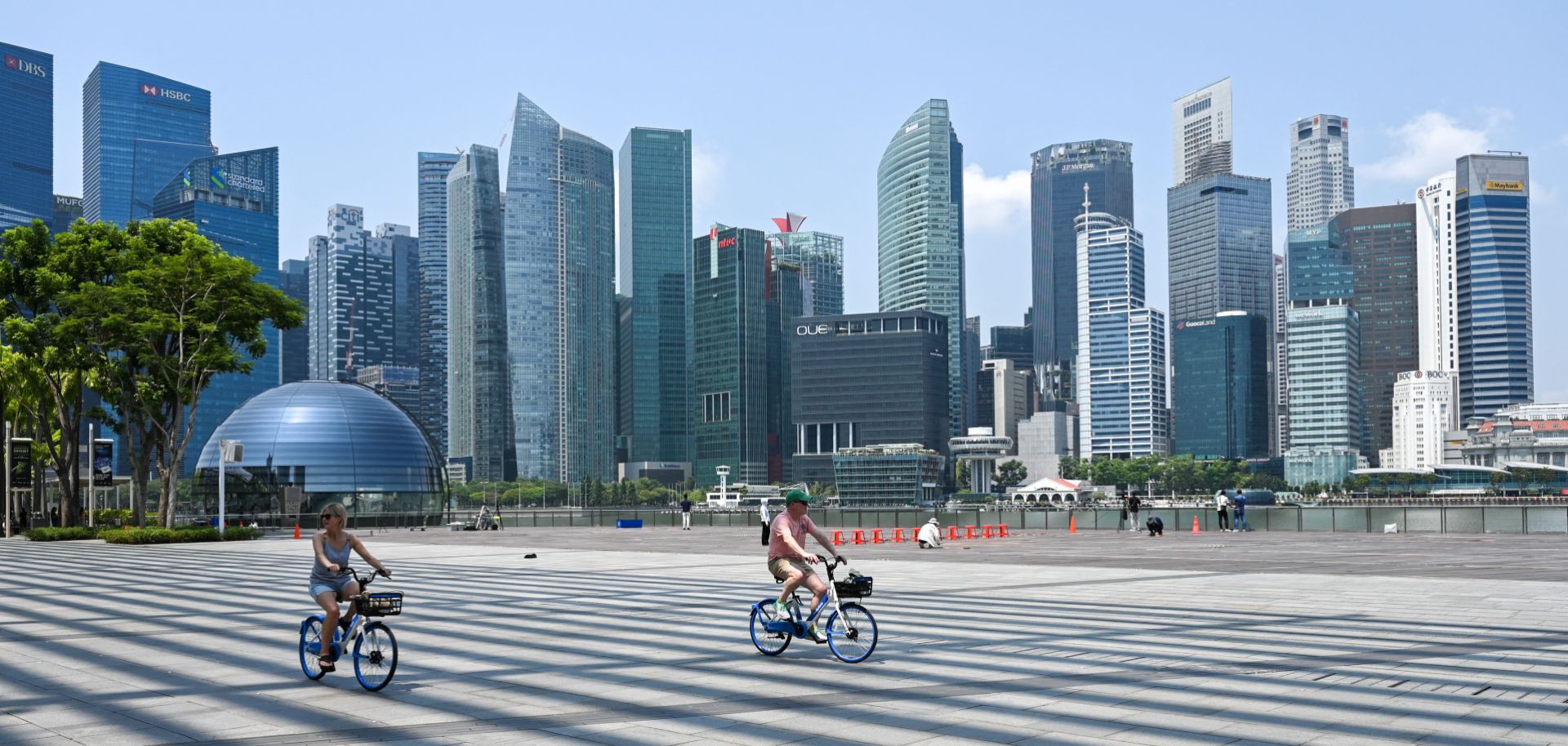
An ongoing money laundering investigation is denting Singapore's reputation as a clean financial hub, but while short-term readjustments could slow its financial sector, the city-state's clampdown will lead to long-term stability. Beginning in October, reports emerged that Singapore intends to review its legal framework with respect to financial crimes. The government will appoint an inter-ministerial panel to address flaws in the city-state's financial system. Singapore is grappling with its largest-ever money laundering case, involving around $2 billion worth of seized assets thus far, though additional seized assets have reportedly not been disclosed. Foreign and local banks are among those being investigated, including ten Singaporean financial institutions. Arrests have been made following a two-year government investigation over allegations of laundered money made from illegal activities that occurred either in Singapore or abroad (and then brought into Singapore), including gambling, forgery, illicit online gaming and unlicensed moneylending. After financial firms reported a series of suspicious activities, raids undertaken by 400 police officers in mid-August netted 10 foreign nationals — all of whom were of Chinese descent but holding various passports — as well as luxury real estate, cars, gold bars, designer handbags and jewelry, among other assets like cryptocurrency. Several wanted individuals remain at large. The Monetary Authority of Singapore (MAS), the country's financial regulator and central bank, has called on bankers to exercise robust due diligence, particularly when dealing with single-family offices (SFOs), in response. Arrests and seized assets may expand as the probe remains ongoing.
- Banks under investigation include Credit Suisse, local units of CitiGroup and Bank Julius Baer, and Singapore's three largest lenders: DBS Group Holdings, Oversea-Chinese Banking Corp. and United Overseas Bank.
- SFOs are corporate entities that manage the assets of single families. One or more of the arrested suspects are believed to be linked to SFOs that receive tax incentives from the MAS.
Since 2021, Singapore has received a large influx of investments and private wealth, particularly from Chinese seeking a safer investment environment and an escape from prior pandemic restrictions, which has overwhelmed Singaporean financial regulators and exposed loopholes. In 2022, $1.5 trillion of cross-border cash inflows came into Singapore. The city-state received capital expenditure commitments totaling $17 billion in 2022, more than doubling the 2021 amount. In the first quarter of 2022, Singapore also saw an increase of over $36 billion in foreign direct investments (FDI). Much of those investments came from the growing number of ultra-high-net-worth-individuals (UHNWIs) in the city-state, mostly from mainland China. Indeed, Chinese buyers alone accounted for nearly a quarter of all luxury real estate sold in 2022, more than doubling that purchased by U.S. buyers. This was reflected in Singapore's real estate market, where prices jumped 14% in 2022 — contrasting sharply with rival financial hub Hong Kong, which saw real estate prices fall that year. However, this influx of wealth, investments and assets has also increased Singapore's susceptibility to illicit funds and transactions, particularly when it comes to SFOs, which have increased nearly threefold since 2020, most from Chinese individuals. The SFO structure saw loose regulatory oversight, lax compliance enforcement and anti-money laundering requirements, and poor disclosure and reporting standards.
- The massive influx of new wealth, assets and investments started in 2021, when rich individuals from mainland China and Hong Kong began flocking to Singapore to escape their home territories' strict COVID-19 lockdowns and uncertain political and investment environments. That year, Singapore's foreign direct investment net inflows totaled $332 billion — an increase of 16% from 2020 — and have since continued to rise. The city-state's UHNWI population also increased by 8.6% in 2021, and now totals 4,206 individuals.
- China, for its part, is also eager to stem the outflow of wealth from its country to Singapore, aiming to prevent brain drain as well as financial flight. The city-state has been accused of undertaking its clampdown on behalf of Beijing, but Singapore's leadership denies this.
- China's real estate sales and home values have stagnated since mid-2021 amid the government's strict ''zero-COVID'' restrictions (which were only lifted in December 2022), along with Beijing's ongoing crackdown on debt in the real estate sector. In this environment, Chinese retail and institutional investors have sought other opportunities to grow their wealth, including in overseas real estate markets like Singapore's. The city-state's more open regulatory environment, along with its position as a gateway to other Southeast Asian markets, has also made it an attractive destination.
Singapore's financial sector faces reputational risk amid the scandal, and the impending tightening of regulations could briefly slow its economy, but the impact will be short-lived as the city-state will ultimately prioritize restoring its reputation as a zero-tolerance destination for white-collar crime. Singapore's economy relies on its financial sector (13.5% of GDP in 2022), which likewise relies on a reputation for clean and stable governance and strict enforcement of cross-border financial crimes. The ongoing money laundering case is also a political liability for the ruling People's Action Party (PAP), which faced separate scandals earlier this year that already somewhat dented its image, meaning the government is motivated to solve the problem. Singaporean banks are already increasing scrutiny for potential clients. Additional changes will likely include subjecting luxury assets to stricter anti-money laundering and due diligence controls, as well as imposing stricter immigration controls, particularly with respect to the financial verification process. The MAS will likely also increase scrutiny of SFOs, which are run by privately owned entities and are relatively secretive and loosely regulated. In the short term, such increased scrutiny could slow Singapore's financial engine and foreign capital inflows, though Singapore is conscious that tightening rules too much could repel investment. The revelation of the money laundering case and the hit to Singapore's reputation as a clean business hub with a strong rule of law means that in the long term, Singapore will prioritize cleaning up the sector and closing loopholes to protect its main industry and economic engine.
- The ruling PAP faced two separate scandals in July that somewhat rattled confidence in Singapore's political stability, including the arrest of the transport minister on corruption charges and the revelation that two PAP parliamentarians were in an inappropriate relationship, leading both to resign.
- Prime Minister Lee Hsien Loong, in office since 2004, will retire following Singapore's next election, which is mandated to occur by November 2025. But the reputational hit from the flurry of recent scandals, as well as turbulence within the PAP, could complicate Lee's succession plans, further motivating the government to ensure its financial sector is well-regulated.
