
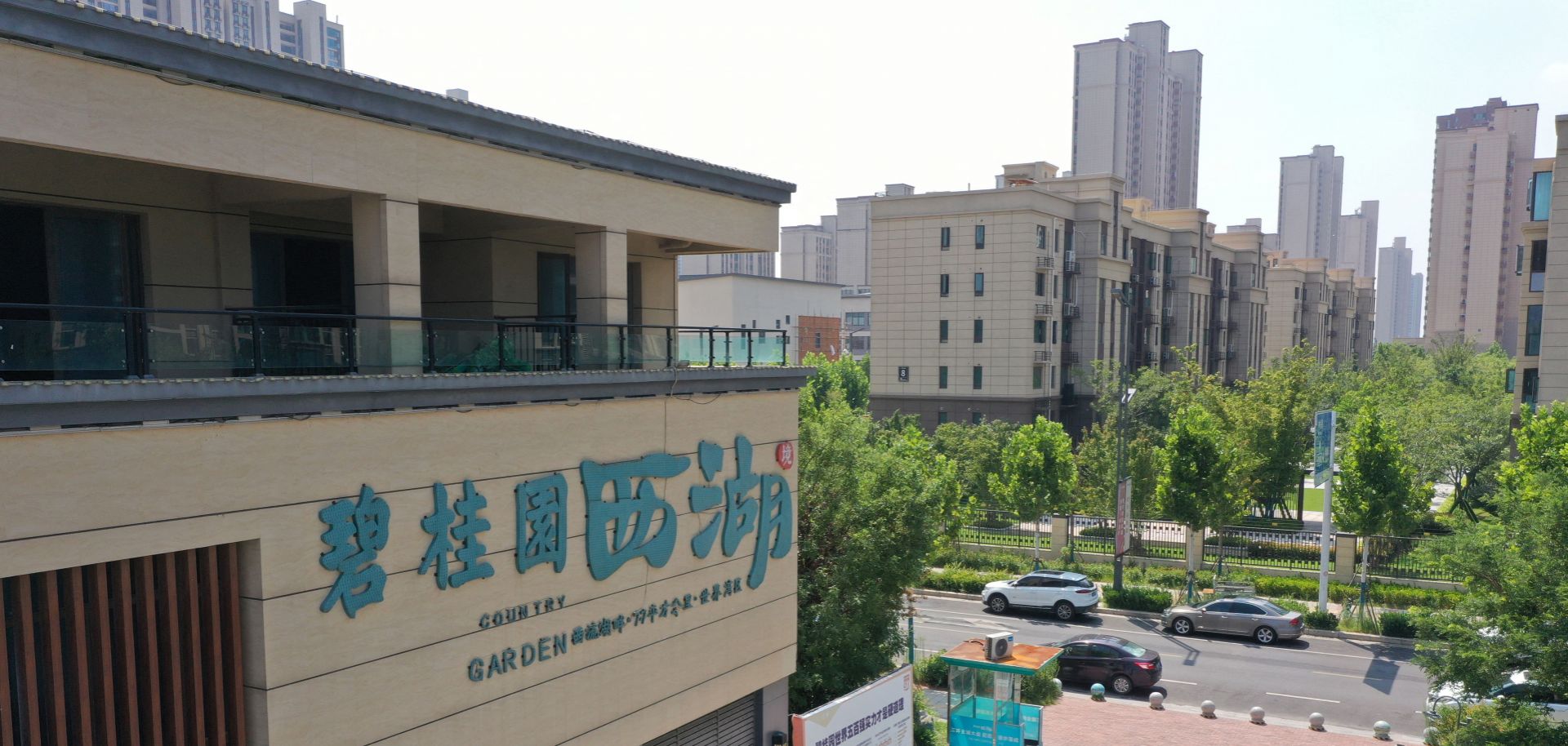
Facing mounting real estate problems, the Chinese government will likely pursue a modest intervention that would cause financial losses for investors and further slow economic activity. But large-scale social unrest or the imminent collapse of a systemically important company could trigger a heavy intervention that would stabilize the economy in the short term but plant the seeds for a far worse financial crisis in the future. Country Garden, China's largest real estate developer, missed debt payments and suspended onshore bonds in early August, fueling expectations of a coming debt restructuring. Chinese trust firm Zhongrong International Trust Co. — which is heavily exposed to real estate investments — also missed payments for dozens of investment products in July, prompting protests outside its office in Beijing. At best, these missed payments suggest the continued stagnation of China's real estate sector and the financiers thereof. And at worst, they presage a financial crisis as debt dominos fall in the real estate, finance and banking sectors, as well as in local government balance sheets and household savings. Beijing has been dealing with the issue of excessive real estate debt for decades, but in the last few years, the sector's sales have consistently dropped after China introduced its Three Red Lines policy of debt limits in August 2020, which short-circuited the real estate sector's debt-fueled growth model. In addition to Country Garden and Zhongrong's large debt issues, property developers representing over 40% of China's home sales are also estimated to be having trouble servicing their debts, which means that the sector as a whole is facing increasing financial risks. Moreover, China's current debt problems are taking place amid slowing economic growth, which may push Beijing to stray from its standard response to such issues in recent years: namely, the prioritization of debt sustainability over short-term economic growth.
- On Aug. 18, Chinese real estate developer Evergrande filed for bankruptcy protection in U.S. courts, though the company clarified that it hadn't filed a bankruptcy petition. As of the end of 2022, Evergrande's outstanding debt had risen to $340 billion, surpassing Country Garden's $196 billion.
Lower-than-expected economic growth in 2023 has fueled Beijing's concerns about the real estate sector by reducing the Chinese economy's tolerance for a debt crunch and elevating risks of social unrest. Since Beijing ended its strict ''zero COVID'' lockdowns in late 2022, domestic and global expectations of a surge in economic growth have largely been unmet. China recorded only modest growth in the first quarter of 2023, which then gave way to a slowdown in activity in the second and third quarters. The much-anticipated rebound in domestic consumption after COVID-19 has yet to translate into a boom for retail sales, while foreign direct investment into China hit a 25-year low in the second quarter. Youth unemployment also hit a record 21.2% in June before the authorities stopped publishing the figure in July. In addition, industrial production continues to lag amid low Western demand for Chinese exports, while the yuan recently fell to a 15-year low against the U.S. dollar. Moreover, fixed asset investment — a perennial source of ''easy growth'' for the Chinese economy — hit a 15-month low at 5.3% year-on-year growth in July. Meanwhile, as of March, two-thirds of China's local governments had surpassed severe debt stress indicators set by Beijing. On top of official debt, the International Monetary Fund estimates that local governments' off-balance-sheet debt will hit $9 trillion this year. This dire situation prompted Beijing to send debt auditors to its 10 poorest provinces in August to get a better grasp of the scale of these obligations. But despite these manifold headwinds, Beijing refrained from announcing major stimulus at its mid-year economic policy meeting of the Politburo in July. Local government revenues and household savings, as well as corporate investment and lending portfolios, are all heavily tied up in real estate investments and physical housing, and thus these groups would be hit the hardest if real estate companies continue to miss debt payments. These vulnerabilities could spur social unrest, given the high concentration of household wealth in real estate, putting more pressure on Beijing to intervene somehow in this latest round of debt issues.
- A government-affiliated think tank of Guizhou, one of China's poorest provinces, published an article in April claiming that it was ''impossible to effectively solve'' the province's debt problems on its own. The article was quickly taken down and Beijing has since urged the nation's economists to limit discussions of ''negative'' information.
- Earlier this month, the U.K. bank Barclays and the Swiss bank UBS both downgraded their 2023 growth forecasts for China, with the former now expecting the Chinese economy to grow by 4.5% this year (down from 4.9%) and the latter now expecting it to grow by 4.8% (down from 5.2%).
- The elevated social unrest China saw in 2022 has persisted into 2023, including the Wuhan pension protests in March, the August protests against the Bazhou city government for its botched flood response and, most recently, the Beijing protests over Zhongrong's missed debt payments.
Beijing's most likely course of action is a light intervention that lets some companies go under without massive bailouts, but significant social unrest or the risk of a systemically important company collapsing could force the government to intervene more heavily. Despite the real estate sector's financial struggles over the past two years, the Chinese government has held firm on its debt restrictions in the sector, which suggests long-term debt management remains a top priority for Beijing. Beijing will thus likely let some smaller real estate, banking, and investment companies undergo painful restructurings or even go bankrupt without offering major assistance via capital injections and other bailout measures. This strategy could perpetuate volatility in Chinese stock markets and prompt financial losses, primarily among investors as Beijing urges banks and developers to prioritize repaying household depositors and fulfilling housing construction contracts for first-time mortgage holders. But it could also trigger a broader downturn in business confidence in China. Beijing would only intervene heavily in restructurings if the collapse of a systemically important company seemed imminent, like it did in mid-2021 with Huarong, one of China's four national asset management companies. But if debt troubles simultaneously struck enough financial and banking companies, these troubles could hit households (despite Beijing's efforts to protect them) and spur protests that cross city and provincial borders. For Beijing, such widespread unrest — as seen in the ''white paper'' protests of November 2022 — would make a heavy intervention more attractive. Such an intervention would involve large bailouts of many companies, which would ameliorate current debt struggles and largely prevent the aforementioned, near-term downturn in markets. But it would also elevate China's long-term risks of financial crisis by delaying debt mitigation measures and reinforcing the belief that Beijing will deploy a safety net whenever the market is headed for a downturn, thus encouraging further risky lending and investments among stakeholders in the real estate, banking and finance sectors, as well as among households.
While still unlikely, it is possible that a wave of real estate defaults spurs a nationwide financial crisis that undermines President Xi Jinping's solitary position of power in Beijing and rattles the global economy. Such a crisis would also set back China's economic transition even as it somewhat eases the U.S.-China strategic competition. The Chinese Communist Party (CCP) has proven moderately successful at averting financial crises and softening economic downturns via state interventions. But these interventions required issuing significant local government debt, which is now Beijing's top economic concern alongside real estate debt. In the current real estate downturn, the country's leaders are unsure of the true scale and sectoral interconnectivity of China's domestic debt problems. Thus, a light intervention may risk letting seemingly isolated solvency issues evolve into a cross-sectoral debt crunch. Such a poorly executed intervention could prompt a heavy intervention or even a financial crisis, if Beijing's efforts prove incapable of stopping an avalanche of defaults in China's $52-trillion real estate industry. For scale, China's 2022 gross domestic product was $18 trillion. The fragility of China's economic recovery elevates this risk of Beijing mismanaging a light intervention effort. This is because local governments and businesses — with their assets either tied up in under-water real estate or their revenues stricken by low demand for land sales — have a lower tolerance for bearing additional liquidity strain, and the fact that Chinese households are already highly concerned about the future of their nest eggs, given three-fifths of household savings are in real estate. A true financial crisis could spur an economic recession in China and the world, making it harder for China to avoid the middle-income trap and surpass the United States in military and economic might. This crisis would also spur massive unrest in China, reducing President Xi Jinping's ruling legitimacy in the CCP and increasing the chance that Xi's outsized influence over the party is diffused across a broader cohort of top leaders, whom Xi must rely on to help steer China out of its dual social and economic crises. A more consensus-based leadership would make China's domestic and foreign policy more predictable and less national security-focused than under Xi alone, easing the rapid deterioration in China's relations with its neighbors. Still, China's technological and economic competition with the United States would persist, albeit at a slower pace as Beijing reprioritizes economic stability.
- A Chinese financial crisis could start with a wave of real estate defaults, including some large bankruptcies, followed by solvency problems for the banks and third-party lenders that lent money to those developers, before finally hitting depositors and corporate investors that store wealth in the banking and real estate sectors, as well as in the countless wealth management companies overexposed to real estate investments.
- In the 2008 global financial crisis, Beijing buoyed consumption by releasing $586 billion worth of stimulus spending on infrastructure, with much of this debt falling on local governments. And in 2015, a stock market crash wiped out 30% of the value of China's class A shares in just three weeks, prompting Beijing to spend $500 billion in reserves to buy up the market, which continued to fall a couple of months later.
