
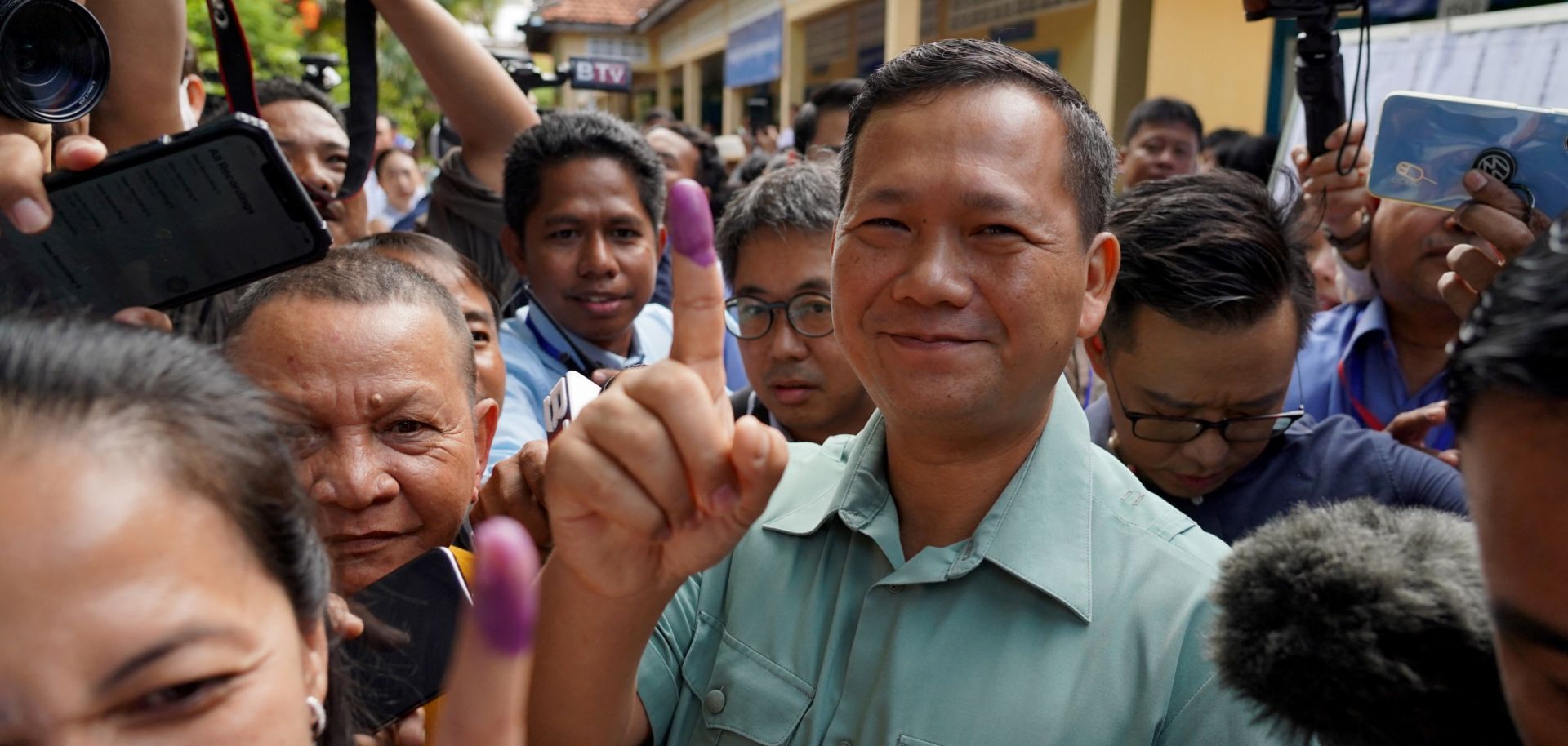
The incumbent Cambodia People's Party (CPP) secured a dominant electoral victory, paving the way for dynastic rule that will likely bring political stability at the cost of further isolation from the West. But the country's close ties with China will absorb the economic fallout from any new EU and U.S. sanctions. The roughly 8.1 million Cambodians who voted in their country's July 23 election awarded the CPP 120 of the 125 seats in the National Assembly (with the remaining five seats going to the royalist Funcinpec party). The ruling CPP ran nearly unopposed thanks to its years-long crackdown on political opposition and independent media, which has effectively sidelined all credible challengers. The election outcome means that Prime Minister Hun Sen, who has ruled over the country since 1986, is assured another five-year term. But Hun plans to step down in the coming weeks and let his eldest son, Gen. Hun Manet, serve in his stead. This succession plan has long been underway, with the CPP formally endorsing the younger Hun's eventual takeover at a central committee meeting back in 2021. However, the party seems to have accelerated the timeframe for power transfer, with Hun Sen previously suggesting he will stay on as prime minister until 2028.
- On July 21, two days before the election, Hun Sen said that his son could take over as prime minister ''three to four weeks'' after the vote.
The landslide electoral outcome is the result of a yearslong crackdown on political opposition and independent media. The perceived need for the CPP to contain the opposition first became evident following the 2013 general election, which saw the Cambodia National Rescue Party (CNRP), a merger of prior opposition parties, win 55 seats in the National Assembly. Those concerns then pushed the government to launch a full-blown crackdown on political dissent in 2017, after the CNRP made even broader gains in local commune elections. In September of that year, the government jailed or forced into exile most of CNRP leadership and charged its founder Kem Sokha with treason. It then went on to dissolve the CNRP that following November, clearing the way for the ruling CPP to win every single legislative seat in the 2018 election. In 2017, the government also began cracking down on independent media, bookended by that year's banning of Cambodia Daily and the shuttering of Voice of Democracy in February 2023. In 2018, opposition leaders then formed the Candlelight Party (CP) from the dissolved CNRP's remnants. But in May 2023, the CP was barred from fielding candidates in the 2023 general ballot over an alleged issue with the party's registration paperwork. In June, the Cambodian government then passed a law barring anyone who does not vote in the 2023 election from running in future elections in an effort to further narrow the opposition's path to power, given that the CP/CNRP's imprisoned or exiled leaders weren't able to participate in the July 23 ballot. To discourage a boycott of this year's election, the all-CPP National Assembly also amended election laws in June criminalizing telling others not to vote as ''incitement'' to ''impede'' the ballot.
- In March, CNRP leader Kem was convicted and sentenced to 27 years of house arrest. Another of CNRP's founders, Sam Rainsy, was charged with incitement in 2016 and has lived in exile ever since.
- In May, Cambodia's election commission disqualified the CP from participating in the July ballot due to the party filing insufficient paperwork in May. The CP, however, alleged the missing document in question was taken by authorities during a prior raid on its headquarters.
- According to the CPP, 84% of registered Cambodian voters participated in the July 23 election thanks to the government's get-out-the-vote campaign. But some voters testified that they cast ballots for fear of government reprisals, while others protested by destroying or vandalizing their ballots, resulting in several arrests. The election commission subsequently counted 5.7% of the ballots cast in the recent vote as invalid.
A broad generational transition of power will likely forestall factionalism in the CPP, while the older Hun's continued involvement and recent constitutional amendments will limit political challenges, suggesting continued political stability. The CPP's dismantlement of democratic institutions over the past decade has been aimed at easing the path for Cambodia's eventual transition to dynastic succession as the country's graying old guard (most of whom are in their 70s) collectively seek hereditary entrenchment of their statuses and the elevation of their male descendants (all in their 40s). To forestall factionalism, the CPP is pursuing a broader generational transfer of power that will institutionalize the influence of both the Huns and other politically powerful families in the coming years. In addition to Hun Manet's ascension to prime minister, Interior Minister Sar Kheng and Defense Minister Tea Banh — who both hail from Cambodia's wealthiest families after the Huns and the royal family – will also see their oldest sons inherit their respective positions. Once he hands over the reins to his son, Prime Minister Hun will stay on as CPP chief — a position in the National Assembly made even more powerful by constitutional amendments passed in July 2022 that grant the majority party in the legislature full authority to elect a prime minister (thus bypassing official opposition and debate). While this will help ensure a smoother transition, the beginning of the younger Hun's tenure will likely still see a brief uptick in political turbulence, given his relative lack of experience compared with his long-ruling and politically adept father. But the party elite has coalesced around the broader succession plan, which though anti-democratic, suggests political continuity and stability in the country in contrast to some of Cambodia's more turbulent Southeast Asian neighbors.
- 23 of the 30 cabinet positions in Cambodia's government will change hands after the July 23 election, with most of that turnover going from father to son.
- The older Hun's long-term dynastic ambitions (and intentions to permanently undo Cambodian democracy) are clear. Upon declaring victory on July 23, he said he will ''become the father of the prime minister after 2023 and grandfather of the prime minister in the 2030s.''
Cambodia's undemocratic turn will harm its ties with the West, likely resulting in targeted sanctions against individuals that will impact the country's economic climate. Prime Minister Hun's son is a graduate of West Point Academy, New York University and the University of Bristol in the United Kingdom. But despite his Western education, Hun Manet is unlikely to advocate for democratic reform once he assumes power, which will likely further strain Cambodia's relations with the United States and its allies. At the very least, the United States will maintain its 2021 arms embargo against Cambodia. But more U.S. restrictions are likely; indeed, in response to the CCP's latest electoral sweep, Washington on July 24 announced it was taking steps to begin reducing aid to Cambodia and imposing visa restrictions as well as issue sanctions against individuals involved in the government's election rigging. The European Union, which has consistently criticized Cambodia since its heavily manipulated 2018 election, could impose additional sanctions as well. If they target much of Cambodia's top leadership, such EU and U.S. sanctions could constitute a wall between Western investors and their Cambodian interlocutors, as the country's ruling elite is also deeply intertwined with Cambodia's business environment. In addition, the United States and the European Union are Cambodia's top textile export markets, indicating leverage over the situation that could lead to reduced textile exports.
- On July 18, a bipartisan group of U.S. lawmakers in Congress reintroduced a sanctions bill targeting individuals who ''directly and substantially prevent'' free and fair elections in the country. Earlier this year, lawmakers in the European Parliament also called for targeted sanctions against Cambodia should it refuse to release opposition leader Kem Sokha from house arrest. Cambodia responded adversarially to both of these calls for sanctions, accusing them of being politically motivated, which has further damaged the country's relations with Brussels and Washington.
- After the CPP won all 125 National Assembly seats in Cambodia's 2018 election, the United States issued targeted sanctions against Cambodian officials and, along with the European Union, withdrew donor support for the country's election commission. In 2020, the European Union also revoked much of Cambodia's trade privileges under the Anything But Arms framework, which granted Cambodian products tariff-free access to the EU market, particularly impacting textile exports.
- In March, the United States, European Union, France and Japan announced they would not send observers to oversee Cambodia's July 23 election due to the ballot being fixed. However, election observers from the Association of Southeast Asian Nations (ASEAN) participated and reported no problems, suggesting that the bloc's relationship with Cambodia will be unaffected.
Tense relations with the West will likely see Cambodia strengthen its economic ties with China. Knowing that Cambodia’s export-dependent economy makes it highly vulnerable to sanctions, there will be an upper limit to U.S. and EU sanctions for fear of driving Cambodia deeper into China’s orbit, both from an economic and geopolitical standpoint. But that is bound to happen to a degree regardless, as the country’s turn toward dynastic rule — combined with Europe and especially the United States’ increasing competition with China, Cambodia’s key partner — further isolates it from the West. In 2018, Cambodia's trade with China skyrocketed to help offset the impact of the West's post-election sanctions. And that trend has only accelerated since then, particularly following the implementation of the China-Cambodia free trade agreement in 2022. As the information space in the country shrinks exponentially, circumstances could bode poorly for new Western foreign investments in Cambodia, which is now looking to expand beyond textile production into the automotive and electric industries. However, Phnom Penh will continue its outward-facing pro-business policies, which will primarily attract Chinese investment. And that inflow of Chinese cash will enable Cambodia to keep growing at its nominal 6-7% annual growth rate, despite reduced trade and political cooperation with the West.
- Chinese state media said the outcome of Cambodia's July 23 election laid ''a solid foundation for the stability and further development of future [bilateral] relations.''
- The sanctions bill introduced by U.S. lawmakers also seeks to target Cambodian individuals who support a Chinese military presence in the country. The United States has long suspected that the Chinese-built Ream Naval Base on the Gulf of Thailand will host the Chinese navy, an allegation Cambodia has consistently denied.
