
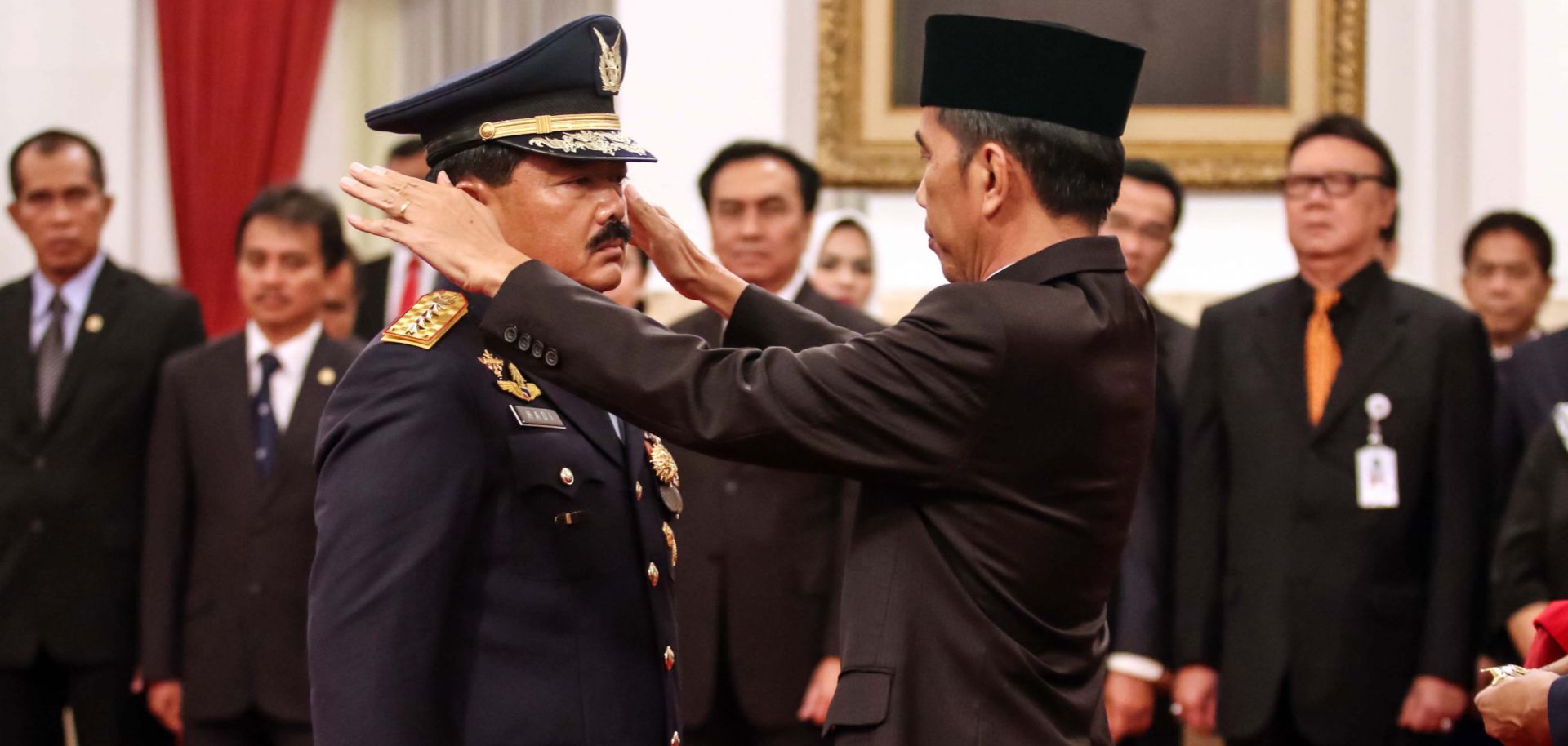
Indonesian President Joko Widodo (right) installs Air Chief Marshal Hadi Tjahjanto as head of the armed forces at the presidential palace in Jakarta on Dec. 8, 2017. Tjahjanto has since reshuffled several key positions to put his own stalwarts in place and signaled that the military backs the president.
Throughout the 20th century, internal conflict ripped apart Southeast Asia again and again. Thanks in part to growing economic prosperity and the end of the Cold War, however, stability has largely replaced the chaos of yesteryear. But the biggest reason for this relative success story is the strength of certain monolithic institutions in each country that have managed crises and prevented any return to disorder. Without question, there have been disruptions to the calm, periods of unrest and notable outliers (such as Myanmar), but the parties, monarchies and militaries that have directed many countries in Southeast Asia have largely retained internal cohesion. The massive economic and demographic shifts that make the region a bright spot in global growth have tested these institutions time and again — and forced them to improvise and adapt. Now, a series of elections over the next six months will test the long-term durability of these institutions, which have done so much to stabilize the region.
In Malaysia, the iconic United Malays National Organization (UMNO) will fight to reverse decay that has seeped into the party over the past decade. Across the Strait of Malacca, Indonesian President Joko Widodo will strive to enlist the support of the military and clerical establishment to continue his rule. And in Cambodia, the Cambodian People's Party (CPP), which has defined the nation's politics since the 1990s, will attempt to cement de facto one-party rule as the country changes beneath it. While radical change is not likely in the cards in any of these countries, the polls will set the trajectory for years to come — and provide a sign of whether these institutions can hold the center they have held for decades or whether their grip will begin to slip.
Malaysia's Rulers Stack the Deck
UMNO has been a fixture of Malaysia's political scene since independence, but demographic changes have begun to eat away at its edges. For 40 years, the ruling Barisan Nasional coalition (of which UMNO is the most prominent member) wielded a supermajority in parliament by knitting together the ethnic Malay, Chinese and Indian political establishments under a single umbrella, allowing it to dole out patronage and keep the communal balance in check. Barisan Nasional lost its supermajority in 2008 before ceding further ground — and the popular vote — to Anwar Ibrahim's Pakatan Rakyat (PR) coalition in 2013 elections. However, it retained the parliament largely because it had delineated the electoral boundaries in its favor. Now, Prime Minister Najib Razak will face the opposition once again in polls promised before the hajj begins in mid-July.
The vote will pit Barisan Nasional against a series of parties that have coalesced under the opposition Pakatan Harapan (PH) umbrella. With Anwar imprisoned on politically motivated charges until June, Mahathir Mohamad, who spent 22 years as prime minister for UMNO, will run as head of his PH-affiliated Malaysian United Indigenous Party (PPBM). With strong appeals to the interests of ethnic Malays and indigenous groups, PPBM represents the political force that is making inroads against Barisan Nasional as the country's Chinese and Indian populations slowly shrink due to lower birthrates.
If the opposition emerges victorious in the upcoming polls or further degrades Barisan Nasional's position, Malaysia will enter a period of further political turbulence. But even if it becomes a minority in parliament, UMNO will remain a formidable force due to its entrenched patronage networks that no successor can easily root out. In terms of external behavior, Mahathir has campaigned on a platform that strongly opposes Chinese investment in Malaysia, meaning that a post-election role for him could hinder Beijing's infrastructure and investment ambitions in the country.
But such an outcome is unlikely, because the ruling coalition has redoubled its efforts to maintain its majority ahead of the polls. In December 2017, Malaysia's courts permitted Barisan Nasional to redraw the electoral boundaries in 120 of 222 parliamentary districts in a move that could impinge on the opposition's future success, because the new districts will concentrate the opposition in some urban constituencies and dilute the electoral power of ethnic minorities. The ruling coalition has also courted Islamist forces in the country, namely the Pan-Malaysian Islamic Party (PAS), which broke off from the opposition bloc in 2015 and enjoys a strong following in rural areas.
Shoring Up Power in Indonesia
To the south, Indonesians in 171 jurisdictions will go to the ballot box on June 27. Amid the deluge of elections, three matter most: the gubernatorial races in East Java, West Java and Central Java. With presidential elections scheduled for 2019, winners from any number of the local gubernatorial races could become vice presidential candidates for next year's race. With President Joko "Jokowi" Widodo already slated to run on behalf of his Indonesian Democratic Party of Struggle (PDI-P), speculation has turned to the identity of his potential running mate — and to the ticket of the opposition Great Indonesia Movement Party, or Gerindra. For the latter, it appears likely that Gerindra head and former Kopassus special forces group commander Prabowo Subianto will contest the race against Jokowi after previously doing so in 2014. Still, another potential opposition figure could emerge in place of Prabowo to challenge Jokowi by June.
Regardless of its ultimate candidate, Gerindra plans to focus its campaign on bulking up the defense budget, boosting Indonesia's lackluster GDP growth to 7 percent and reducing Jakarta's reliance on Beijing — goals that are likely to resonate with Indonesia's powerful armed forces. Additionally, retiring Gen. Gatot Nurmantyo could run for governor of Central Java and perhaps even find a place on an opposition ticket. Gatot has crafted his image by maintaining a hard line against cooperation with Australia. All of this could result in an Indonesia that is even more nationalist and inward-looking — to the detriment of both Chinese and American-led regional initiatives.
At the same time, Jokowi faces the threat of hard-line Islamists who have allied with the opposition. The PDI-P suffered a major setback when one of the president's primary allies, Jakarta Gov. Basuki Tjahaja Purnama — a Christian who is ethnically Chinese — lost his post and went to prison for blasphemy after a campaign by opposition parties and Islamists that brought thousands onto the streets, ultimately resulting in the politician's downfall. And in the general welter of these elections, there will be opportunities for the opposition to mobilize hard-line Islamist forces to bring down Jokowi's potential allies.
With the enemy at the gates, Jokowi has increasingly turned to his country's twin pillars of legitimacy to consolidate his rule: the clerical establishment and the military. In order to emphasize Jokowi's religious credentials, his ruling coalition has backed reforms to the criminal code to usher in tighter control of social issues while simultaneously moving to disband hard-line Islamic groups, pursue their leadership and increase the monitoring of suspected extremists. The president is also considering vice presidential candidates who possess a strong influence over the Islamic establishment, including a potential reappointment of current Vice President Jusuf Kalla, Bandung Mayor (and West Java gubernatorial candidate) Ridwan Kamil and Transportation Minister Muhaimin Iskandar. In terms of his overtures to the military, Jokowi — the first president from outside Indonesia's elite or military echelons — has moved to appoint longtime ally Air Chief Marshal Hadi Tjahjanto as head of the armed forces to replace Gatot, a potential rival. Tjahjanto has since reshuffled several key positions to put his own stalwarts in place and signaled that the military backs the president. At the same time, Jokowi has succeeded in smoothing over issues so the United States can renormalize ties with the special operations group Kopassus, which has languished on a blacklist since 1999 due to alleged human rights violations in East Timor.
Cambodia's CPP Calls All the Shots
Elsewhere in the region, Cambodia's coming elections may not be as hotly contested as those in Indonesia, yet the July 29 polls will provide a crucial bellwether regarding Phnom Penh's future direction. Aging strongman Hun Sen has been at the highest echelons of Cambodia's government for nearly 40 years, and his Cambodian People's Party (CPP) has maintained stability since the 1990s by alternatively cracking down on opponents and cultivating patronage networks. During that time, he has presided over a period of stable economic growth and the buildup of a sizable garment sector in Phnom Penh. Hun Sen's long tenure and the personalistic nature of the CPP itself, however, mean that the core of Cambodian politics has become brittle. Late last year, the prime minister took the radical step of completely neutralizing the longtime thorn in his side by obtaining a court ban against the political opposition Cambodian National Rescue Party (CNRP). The CPP completed a dress rehearsal for the nationwide polls with Senate elections in late February, predictably winning a landslide thanks to the lack of competition.
But Hun Sen does not lack challenges just because he has eviscerated the opposition. The past two decades of economic growth have incubated an urban class with new demands that extend beyond those of the CPP's traditional rural backbone. Even without the CNRP to represent them, such city dwellers will continue to harry Hun Sen. The CPP's endurance has also come with a (literal) price tag in the form of increasing concessions on garment sector wages. Since 2013, when the CNRP enjoyed a spike in its share of the vote, the government has doled out incremental wage hikes that have amounted to a 70 percent rise. Accordingly, Cambodia's wages far exceed those of neighboring competitors such as Vietnam, Laos and even the Philippines. With continued questions regarding the CPP's legitimacy, Cambodia's rulers will need to develop ways to placate this demographic without jeopardizing the viability of the country's garment industry.
Over the long term, the July polls will provide the first indication as to whether the CPP can survive as an institution. Moreover, the vote will signal whether Cambodia will remain as a de facto one-party state and ultimately manage a peaceful handover of power, particularly as the 66-year-old Hun Sen begins to decline in the coming years.
Whether in Malaysia, Indonesia or Cambodia, none of the rapidly approaching elections are likely to upset the political order, challenges on the fringes notwithstanding. After all, it is the key institutions at the heart of each country — not necessarily the vagrancies of election cycles — that define politics in Southeast Asia. Still, this year's polls will test the resilience of these aging monoliths, which are critical to long-term internal stability. For the moment at least, it's steady as she goes.
