
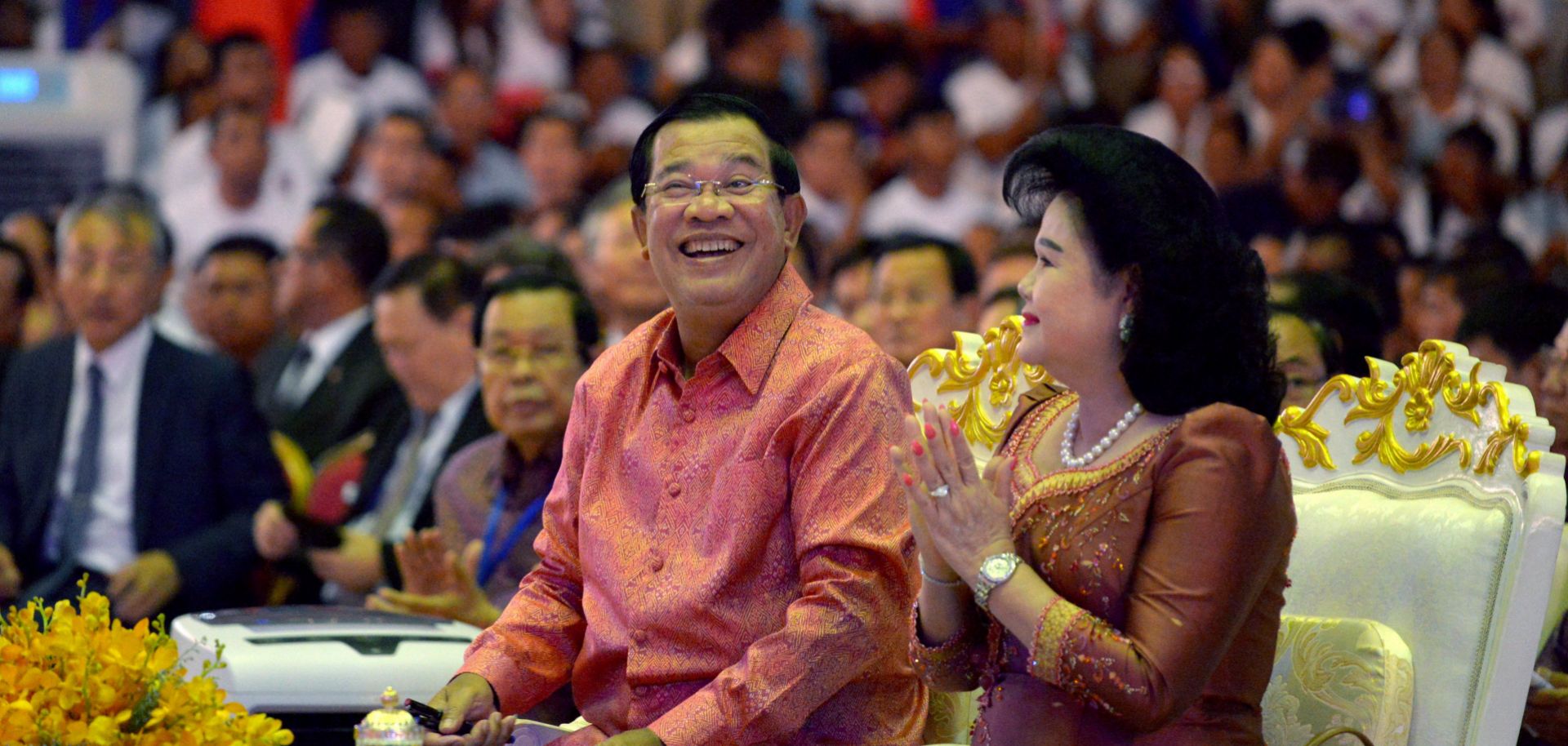
Cambodian Prime Minister Hun Sen (L) and his wife look on during a ceremony at the Olympic national stadium in Phnom Penh on July 17, 2017. Challenges began to emerge to Hun Sen's rule in 2013.
After over three decades in power, Cambodian Prime Minister Hun Sen is pulling out all the stops to stay there. On Dec. 26, the longtime leader vowed to keep his post for another decade, an ambition that may not be as far-fetched as it seems. The ruling Cambodian People's Party (CPP) currently controls the country's military, heavily influences the courts and maintains a robust patronage network. Moreover, the party has recently begun to prune its biggest rival from the political system, effectively resulting in a one-party state.
As Cambodia prepares to hold nationwide elections in July, the ruling party appears to be on track to extend its enduring reign. But the CPP's ongoing struggle against its opponents over the past few years is symptomatic of the deeper demographic and economic challenges that will continue to dog the embattled party for years to come.
A Country Torn Apart
For much of its modern history, Cambodia has been the sick man of Southeast Asia. Though the country occupies a strategic location between the eastern and western coasts of the Indochinese Peninsula, conflict tore it apart between 1945 and 1991. As the Indochina Wars engulfed nearby Vietnam as well, Cambodia became an important swing state poised between Vietnam's burgeoning sphere of influence and the Western-oriented Association of Southeast Asian Nations (ASEAN).
Cambodia's attractive geopolitical position made it uniquely vulnerable to foreign meddling. During the peninsular wars, the country shuffled through several royalist, nationalist and communist governments. Among them was the Khmer Rouge, which was responsible for the deaths of some 30 percent of its citizens. The Khmer Rouge's rule ended when Vietnam invaded Cambodia in 1978, setting up its own puppet government in Phnom Penh. The new administration battled insurgents backed by Thailand and the United States in the Cambodian hinterlands until a 1991 peace deal, sponsored by the United Nations, initiated a transition away from communist rule. Throughout this volatile period, Cambodia shed hundreds of thousands of refugees and exacerbated instability in the region.
From the maelstrom emerged Hun Sen, first as a leader of the Khmer Rouge and then as an official chosen by Vietnam. As he gradually undermined his adversaries, Hun Sen ushered in a period of stability and economic growth, albeit on the CPP's own terms, that offered the country much-needed relief after the tumult of the 1990s. In 1999, Cambodia took a symbolic step away from its historical image as an unstable and impoverished nation by joining ASEAN. The country has slowly become more integrated with the bloc's economy and global supply chains ever since.
Ironing Out the Wrinkles
Yet in 2013, challenges began to emerge to the CPP's rule. A combination of stability, low wages and lax regulations allowed Cambodia's nascent garment industry to flourish, filling government coffers and accelerating the country's urbanization. With a new class of workers arose new demands that the ruling party struggled to meet. As a result, the CPP's opponents — who coalesced into the Cambodia National Rescue Party (CNRP), led by prominent politician Sam Rainsy, in 2012 — were able to amass more and more popular support. The party made an impressive electoral showing in July 2013, winning 55 of the National Assembly's 123 seats. Even so, the CNRP made allegations of voting irregularities and mounted protests in the capital that drew workers on strike into the streets. A year of crackdowns and attempts to quell the demonstrations ensued, culminating in an agreement in August 2014 whereby CNRP lawmakers took their seats.
Since then, the CPP has steadily tried to undermine its CNRP adversary. Amid a boycott by the opposition in February 2017, the National Assembly passed a bill that empowered the government to dissolve political parties. Four months later, the CNRP drew the ruling party's ire again when it swept local elections, threatening to present a stiff challenge to the CPP in national elections down the road. As political pressure built, the ruling party sought to tighten its hold on power, and in October 2017, Cambodia's Supreme Court found the CNRP guilty of a conspiracy to incite revolution and ordered its dissolution. All of the 489 party officials elected in June 2017 lost their jobs, and 118 CNRP figures were banned from politics for five years.
Left in disarray, the opposition has only inexperienced leaders to rely on within its ranks. With party chief Kem Sokha imprisoned for treason and co-founder Rainsy in self-imposed exile, the CNRP has little chance of regrouping before the national elections this year. To make matters worse, the court's decision granted the CNRP's seats to other opposition parties rather than leaving them open; the largely irrelevant FUNCINPEC Party now holds 41 of those 55 seats. Aware that his rivals have few options to choose from, Hun Sen has invited the CNRP's remaining members to join the ranks of his party or form a new, smaller and weaker organization.
Concessions With a Steep Price Tag
In stark contrast to the heated protests of 2013, the CPP's actions in 2017 drew a muted response from both the public and the international community. Because nearly 60 percent of Cambodia's exports go to the United States and the European Union, the country is vulnerable to serious sanctions, should the West choose to enact them. And indeed, Washington and its European allies have already withdrawn the funding they promised for upcoming elections because of the ruling party's actions. The United States also slapped sanctions on a handful of Cambodian officials, citing the CNRP's dissolution. But Washington is aware that in doing so, it risks pushing Phnom Penh into the arms of China, and it will likely forgo more draconian measures, as it has with Thailand, Myanmar and the Philippines for the same purpose. Furthermore, because Cambodia's internal issues are a relatively low priority for the United States, they are unlikely to attract much domestic attention or calls for punitive action in the West.
This doesn't signal an end to the CPP's troubles, though. Cambodia's growing garment sector will continue to spawn demands for greater concessions from the government. The CPP has tried to placate these demands by announcing an 11 percent hike in the monthly minimum wage to $170 in 2018. (This increase is significant, considering wages stood at only $61 per month when unrest worsened in 2012.) But in the midst of intensifying competition among Southeast Asia's low-end manufacturers — including nearby Laos, Vietnam and Myanmar — it's unclear how long the ruling party can afford to appease garment workers without putting the Cambodian economy at a disadvantage.
