

New relations are being forged and old ties reinvigorated in the Asia-Pacific as regional countries adapt to rising security concerns, uncertainty surrounding U.S.-China relations and policies, and the return of a multipolar world system.
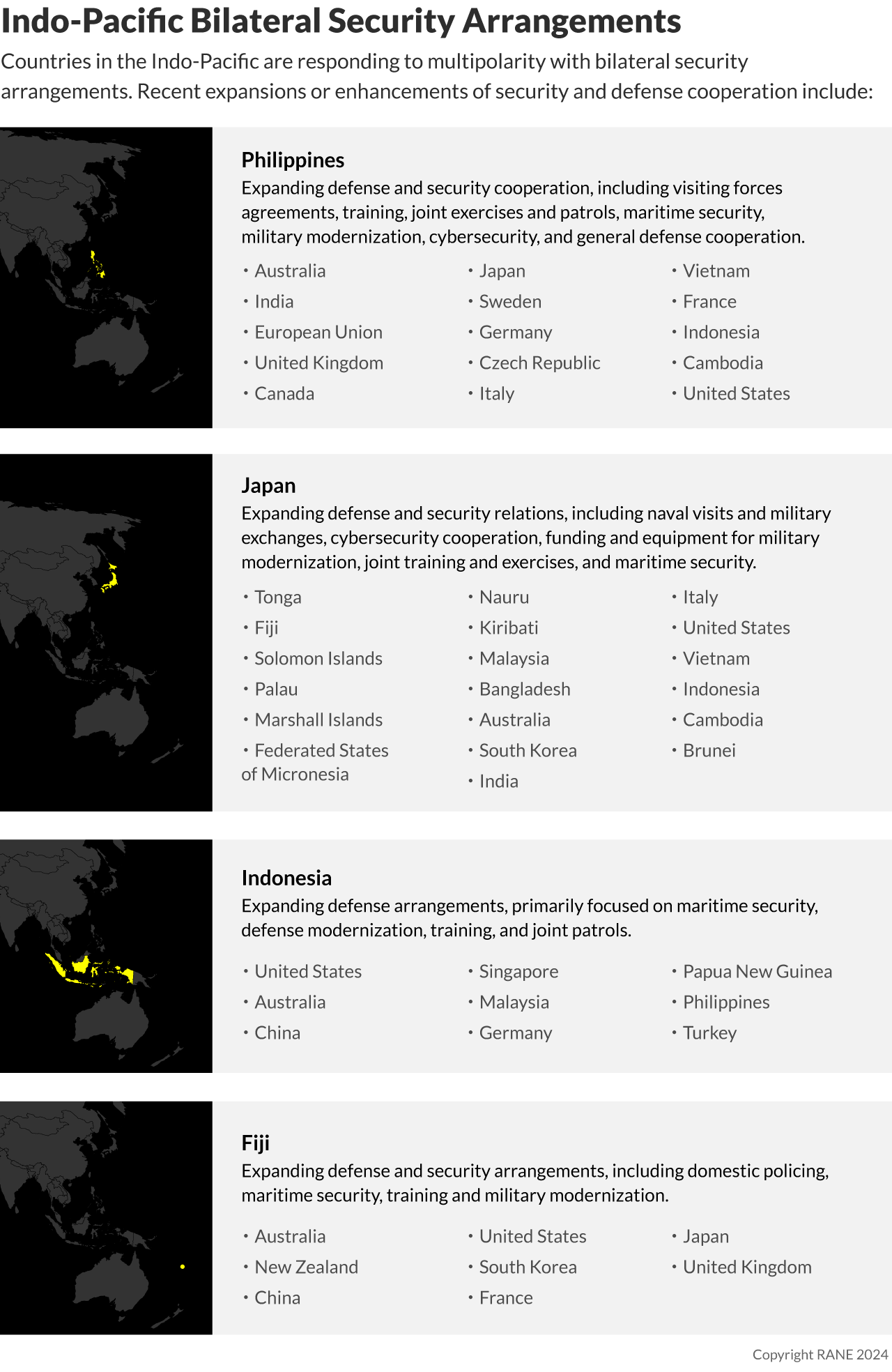
Following the inauguration of Philippine President Ferdinand Marcos Jr. in June 2022, Manila rapidly restrengthened its security cooperation with the United States and began discussions that ultimately expanded the footprint of U.S. forces in the Philippine archipelago. But the Philippines, a U.S. treaty ally and long a key component of the U.S. security architecture in Asia, is not focusing its security ties solely on Washington. Instead, Manila is also expanding its defense and security relationships with neighboring Indonesia and Vietnam, regional powers (including Australia, India, Japan and South Korea), and European countries like France and Germany.
Manila's attempts to secure a multinational network of security ties reflect a pattern increasingly common across the region. Rather than being forced into a U.S. or China "camp," or trying to remain independent and non-aligned, many countries are pursuing security, economic and political ties that perhaps best fit what has been dubbed "multi-alignment." In a multi-alignment strategy, countries seek as many partners as possible to insulate themselves from the vulnerabilities of putting all their eggs in one basket.
Unlike NATO in the North Atlantic, the Indo-Pacific region does not have a singular regional security framework. Past attempts such as the 1954-77 Southeast Asia Treaty Organization failed, while other regional frameworks are centered on the United States, including the Quad (Quadrilateral Security Dialogue) between Australia, India, Japan and the United States and the newer AUKUS between Australia, the United Kingdom and the United States.
For much of the post-Cold War period, the United States sat firmly in the center of any regional security architecture, whether through its strong forward presence in South Korea and Japan, its rotational presence in the Philippines, or its historic ties with Singapore and Australia. While Australia maintained select security cooperation agreements with several Pacific Island nations, many security ties into Southeast Asia or between Northeast Asia and Oceania were made via the United States. South Korean defense ties with Japan, for example, take place in a trilateral context (when they take place at all), with the United States as the center point. Additionally, Australia's forays north of the Indonesian archipelago were often in concert with the United States. Even much of India's regional engagement falls under the Quad framework.
That dynamic has been changing over the past decade, particularly over the last few years, amid growing Chinese regional power and assertiveness. For example, countries like Indonesia, which in the past were content to remain relatively neutral and concern themselves little with the troubled security environment in the South China Sea, found themselves facing new challenges as China further normalized its claims to areas within, and at times beyond, the so-called nine-dash line. Australia, South Korea and even New Zealand, which had sought to retain close economic ties to China and stay out of regional security disputes or questions of Taiwanese sovereignty, began to rethink their ability to remain isolated from regional security challenges and started reshaping their defense postures and policies. And Japan, which has been slowly but steadily increasing its military capabilities and capacity and expanding its areas of operation, has stepped up its more active regional engagement, expanding its definition of permissible arms exports, and negotiating arrangements for joint training and operations in Southeast Asian countries.
China's "rise" is a partial explanation for expanding regional defense ties, but there is also concern about the potential political cost of closer defense integration with the United States and Washington's questionable reliability as a primary partner. Many regional countries have sought to keep their bilateral military ties with the United States separate from broader global U.S. military actions. South Korea, for example, does not allow U.S. forces based in its territory to deploy to other international contingencies, and in 2004, amid a spat with Seoul over this restriction, the United States drew down its forces in South Korea to divert them to Iraq. Around the same time, Seoul and Washington were engaged in broader talks about an even greater future reduction of U.S. forces in South Korea, a plan that officials began but ultimately curtailed in 2008 amid uncertainty around then-North Korean leader Kim Jong Il's health and the inauguration of then-President Lee Myung-bak in South Korea, who was less inclined to appease the North.
South Korea may be a unique case, given the large number of U.S. forces stationed there and the ongoing conflict with its neighbor to the north, but the Philippines is often served up as the object lesson for over-reliance on, and under-delivery by, the United States. Under former Philippine President Rodrigo Duterte, Manila delayed and threatened many defense arrangements with the United States, despite the previous Philippine government bringing and winning a case against China for seizing and developing islets in the South China Sea. Duterte's key argument was that there was a high political and economic cost to supporting the U.S. military alliance (particularly as it strained economic ties with China), but there was little actual security benefit to the Philippines, as the United States had done little to stop China from occupying, building up and ultimately fortifying key positions in the South China Sea on reefs and islets claimed by the Philippines. For Duterte, the lesson was that support for the United States cost economic opportunities with China, while still losing Manila key territories vital for fisheries and national defense.
In many ways, Duterte's argument, though more open and forceful, has been the prevailing view in the region, even among countries with formal treaty alliances with the United States. Japan, for example, has repeatedly sought assurances from Washington that its disputed Senkaku/Diaoyu islands fall under the U.S.-Japan defense agreement. However, Washington has been reluctant to give concrete assurances, as it officially takes no side in most regional territorial disputes and maintains an element of strategic ambiguity regarding what "red lines" may trigger U.S. intervention. Additionally, South Korea raised concerns in 2010 after North Korea sank the navy corvette Cheonan, as Washington appeared to refuse to send an aircraft carrier to the Yellow Sea in a joint show of force over concerns about China's response. The United States eventually deployed the USS George Washington to the Yellow Sea later that year, but only after Pyongyang had shelled an outlying South Korean island.
Seoul also faced significant economic pressure from China in 2017 after allowing the deployment of a U.S. Terminal High-Altitude Area Defense battery onto the peninsula, but it did not receive any special economic or trade concessions from the United States to mitigate the impact of China's measures. And during the administration of U.S. President Donald Trump, South Korea faced significant political difficulties in renewing basing agreements, as Washington asked for a major increase in South Korean payments and questioned the number of U.S. troops deployed to the Korean Peninsula.
The examples of South Korea and the Philippines, both key U.S. treaty allies, resonate with other countries in the region that are not necessarily as integrated into the U.S. defense architecture. Indonesia and New Zealand, for example, have questioned whether tying themselves closer to U.S. security arrangements would provide any real benefit while putting lucrative trade ties with China at risk. This hasn't stopped all military cooperation, particularly in the maritime space, nor has it deterred increasing civilian and law enforcement coordination with the United States in targeting illegal, unreported and unregulated fishing in the region. But no countries are seeking a NATO-like organization, and many continue to diversify defense cooperation, even maintaining ties with China and Russia as they work with the United States and its partners and allies.
In many ways, this should not be unexpected. As we have highlighted several times over the past decade, the world is moving back into a more traditional multipolar system instead of the anomalous bipolar structure of the Cold War. A multipolar system is more complicated and less predictable, but it also offers more opportunities for the middle and smaller powers to maneuver between the larger powers. By building multipolar security arrangements, countries can avoid being dragged into another country's conflicts in distant theaters, reduce vulnerabilities to single-source supply shocks and, if they are clever, limit the economic and political fallout from third countries that often accompany more formal multifaceted alliances. In the Asia-Pacific, where there has never been a strong NATO-like entity, it is easier to build multifaceted security arrangements, as there is no strong pull from a central organization.
In addition to maneuvering among big powers, the drive to create more complex networks and webs of security arrangements also serves to focus attention on local priorities, rather than the priorities of a single larger partner. For many Southeast Asian nations, for example, protecting their access to marine resources (particularly fish, squid and crabs) is a critical concern that pits them against large and aggressive Chinese fishing fleets. At the same time, they have little interest in taking on China itself, either militarily or economically. Focusing collaboration with the United States, the Europeans or other outside powers on fishing issues without joining more assertive regional patrols near or through the Taiwan Strait can insulate these Southeast Asian nations from being drawn into untenable positions in great power competition while still serving their local interests.
These security relationships are not solely with outside powers. For instance, bilateral and mini-lateral defense ties among members of the Association of Southeast Asian Nations have expanded in scale and scope in recent years, and ASEAN even held its first joint maritime drill, the ASEAN Solidarity Exercise, in 2023, marking a new foray into intra-ASEAN security cooperation. Pacific Island nations, concerned with the impact of climate change and limited control over their vast maritime resources, are also expanding their multi-directional security relationships, with some even considering forming their own national armed forces. Many Pacific Island nations focus not only on expanding their range of security partners but their economic and political relationships as well.
Countries are not only seeking to diversify partners, they are also seeking to diversify suppliers of military equipment. Western sanctions on Russia and Moscow's focus on reinforcing its position in Ukraine, for example, have significantly impacted maintenance and resupply for Southeast and South Asian countries that have been large-scale purchasers of Russian equipment. U.S. and British constraints on the use of certain weaponry in internal anti-terrorism and anti-insurgency conflicts also limit supply options, and uncertainty over future Western priorities and human rights considerations may put future supplies at risk. As a result, several countries, including formal U.S. allies, are expanding their indigenous defense industries and coordinating regionally or extra-regionally to build up their domestic economies and technological capabilities, shape resources to their particular needs, and reduce cost and vulnerability over time to outside suppliers. South Korea's joint development of the KF-21 fighter jet with Indonesia is just one of many intra-regional examples.
This evolving regional security mesh is perhaps the best China can hope for, as this strategy continues to reduce the likelihood of any strong U.S.-centered multilateral regional security alliance (an Asian NATO), leaving Beijing more room to maneuver. China's counter to the U.S. military presence regionally has been an attempt to build China-centric networks via regional and international economic initiatives, including the Belt and Road Initiative, the Asian Infrastructure Investment Bank and the BRICS forum. Washington initially sought direct counters and tried to force countries to choose between itself and China, but the United States is increasingly comfortable with remaining outside the center of intra-regional and even extra-regional security networks. These relationships, while harder to control, still strengthen regional military capability and capacity, and they require minimal costs (economic or political) from the United States. Many key U.S. allies and partners in the region can play a more active role in broader regional security, with Japan at the lead, and even amid the shifting regional security environment, the United States can work closely with and expand its position in key allied states, with the Philippines taking center stage.
As the region continues to adapt to a multipolar world, multi-alignment will likely continue to expand, not only in the military/security space but also in economic and political relations. This will make it complicated for Washington (and Beijing) at times, as regional countries' abilities to remain vital to both powers may reduce U.S. and Chinese leverage, and reduced sole dependence on either power frees local countries to further expand their policy options. However, multi-alignment is also in some ways a less stable environment, as both Washington and Beijing may at times test the limits of this strategy and each other's willingness to intervene. For both the United States and China, demonstrating the aggressiveness and unreliability of the other will be an important component of shaping regional perspectives and relations. This will test the resilience of local countries and risk turning some parts of the region into increasingly intense areas of proxy competition, adding to regional political, economic and security volatility.
