
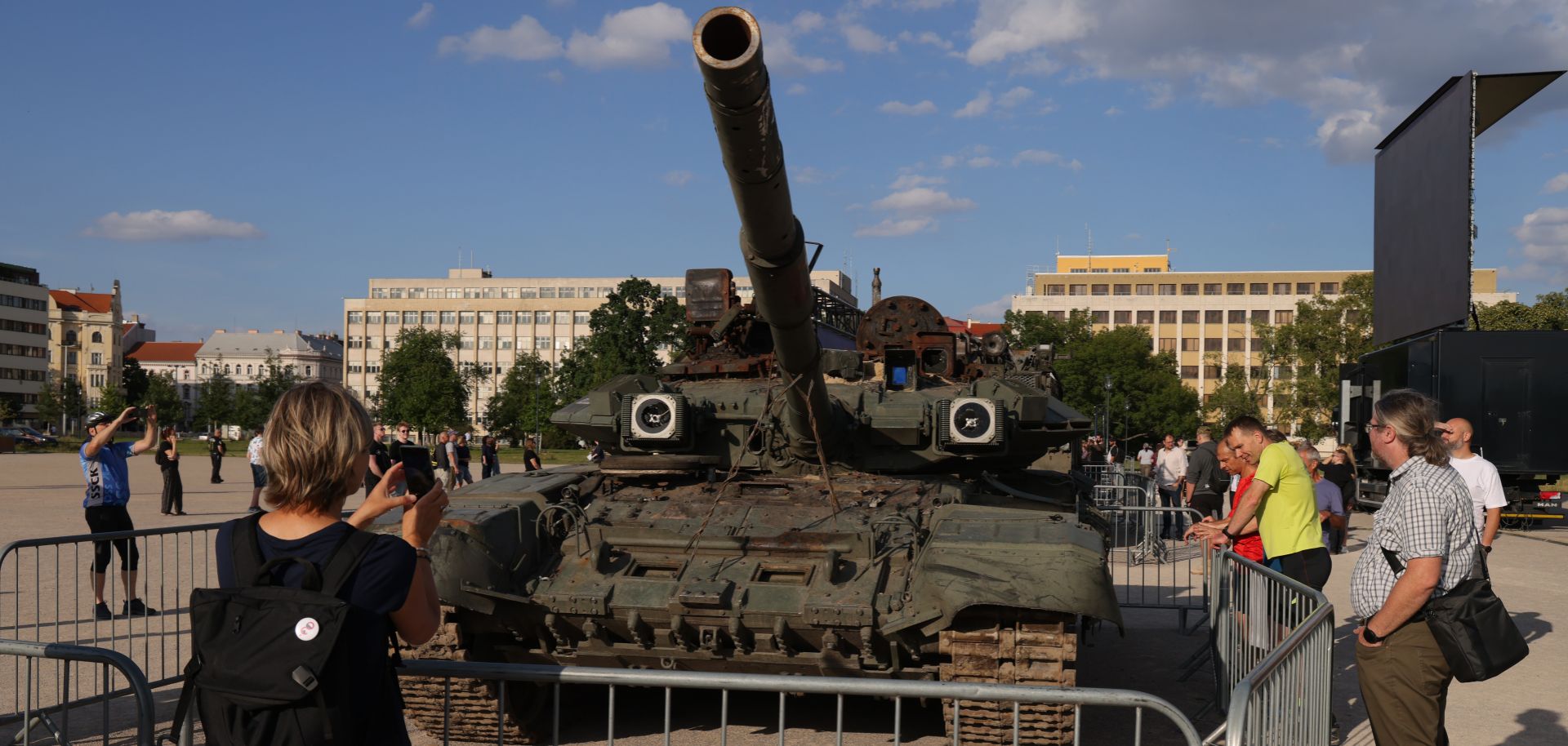
People look at a Russian T-90 tank in Prague, Czech Republic, as part of a display of Russian military equipment destroyed in the war in Ukraine.
Russia's dominance as a global arms exporter will likely continue to fall as a result of the Ukraine war, weakening a key element of Moscow's foreign policy and creating opportunities for other states to bolster their arms industries. The need to backfill its own losses in Ukraine, doubts about its weapons' performance, and declining Indian sales have seen Russia's arms exports plummet over the years. And recent signs suggest this trend will only continue. On June 5, India and the United States finalized a landmark roadmap for defense industry cooperation in the coming years that will significantly boost India's incentive to ramp up its domestic arms production and, in turn, further reduce its reliance on Russian weapons. This follows a report published by the Stockholm International Peace Research Institute (SIPRI) earlier this year that revealed Russia's share of global arms sales (in terms of actual deliveries of major arms as opposed to announced deals) dropped from 22% in 2013-17 to 16% in 2018-22 — largely because India, the largest purchaser of Russian arms, imported 37% fewer weapons over the past five years. On June 5, Nikkei Asia also reported that Russia is buying back components (including tank optics) that it previously shipped to India and other key partners like Myanmar, instead of fulfilling new arms deliveries to those countries, as Moscow struggles to replace the equipment it has lost in Ukraine.
- The SIPRI report, which was published on March 13, found that Russia remained the world's second-largest arms exporter behind the United States between 2018 and 2022, but that its gap with the United States widened.
- Since the start of the Ukraine war in February 2022, Russia has been relying on weapon deliveries from nearby partners to overcome its arms deficit. Belarus, for example, reportedly sent over 100,000 tons of munitions to Russia in the first year of the invasion. Russian troops in Ukraine have also become increasingly dependent on Iranian drones and loitering munitions — further highlighting the Russian arms industry's failure to meet Russia's needs amid the ongoing war.
- In March, Indian military officials indicated they expect delays in Russian arms deliveries, including S-400 Triumf missile systems, Mi-17 military transport helicopters, Grigorovich-class stealth frigates, and even Kalashnikov AK assault rifles.
Russia's need to backfill its own losses in Ukraine, along with several other factors both related and unrelated to the war, are fueling its decline as a global arms exporter. According to an open-source analysis conducted by the Dutch website Oryx, Russia has lost an estimated 10,600 pieces of military equipment, including over 2,000 tanks, since launching its invasion of Ukraine in February 2022. Indeed, modern equipment deficits are likely a major reason Russia has so far not declared another large-scale mobilization, despite Putin recently threatening to do so. But while major, Russia's need to replace that destroyed equipment is just one of many factors likely contributing to the country's declining share of the global arms market. For one, the Russian military's struggle to defeat Ukraine, despite having a significant size and manpower advantage over the country, has fueled the perception that some equipment and systems Moscow makes have underperformed on the battlefield, which is likely hurting demand for those Russian products, and could even hurt demand for systems not accused of poor performance. But Russia's dominance as a global weapons producer began eroding long before Moscow decided to invade Ukraine, due largely to reduced demand from Russia's two top arms buyers: China and India. According to the Stockholm International Peace Research Institute, Russia's arms exports started falling in 2019 and were already down nearly 20 percent relative to 2011, the best year for Russia's arms industry. The largest reason for this was India and China's longstanding efforts to reduce their militaries' reliance on foreign equipment by building more robust domestic defense industries — a trend that is only likely to continue (if not accelerate) in the coming decades. The loss of these two key markets means that Russia is losing market share it will likely never be able to replace, even under the best circumstances. In 2017, the United States also began imposing financial sanctions on any country that makes a ''significant transaction'' with Russian arms manufacturers under the Countering America's Adversaries Through Sanctions Act (CAATSA), which has helped fuel the decline in Russian arms sales in recent years as well.
- Russia has preferred deploying and producing modernized versions of older T-90 tanks over its new T-14 Armata battle tanks. This signals that Moscow has doubts over its ability to mass produce newer tanks, as well as over the T-14 tank's effectiveness and performance in combat in Ukraine, which could alarm Moscow's weapons buyers.
- India alone has accounted for around 35% of Russia's overseas arms shipments over the past decade. But under Prime Minister Narendra Modi, the country has sought to reduce Russian imports and increase domestic production.
- Serbia, a staunch Russian supporter and buyer of its arms, is reportedly in talks with the French aircraft manufacturer Dassault Aviation SA about replacing its Russian jet fleet, which U.S. sanctions have made difficult and expensive to maintain.
Russia's declining arms exports will impact Moscow's geopolitical strategy and damage its foreign policy. Arms sales have long enabled Russia to develop close military-to-military and government-to-government relationships in far-flung regions in Africa, Latin America and Asia, where Moscow's interests and influence would otherwise be scant. Countries in these regions are particularly important to Russia's efforts to foster support for its actions in Ukraine among international bodies such as the United Nations, as well as supporting global efforts to build coalitions of countries opposed to Western influence. Russia's relationships with African, Latin American and Asian countries can also serve as springboards for commercial deals, in particular in the energy sphere. And like Russia's energy sales, arms sales are a crucial source of hard cash for Moscow, increasingly important as the heavily- sanctioned country runs a deficit to finance its war in Ukraine. For these reasons, Moscow will seek to counteract the fallout from its declining arms sales by not announcing delays to weapon shipments, and by not commenting on or downplaying reports that highlight its defense industry's struggles, in order to put the risk and onus on foreign buyers to either quietly accept the delays or make the decision to curtail cooperation with Moscow. Moreover, to diversify its customer base, Moscow will likely seek out new relationships with countries increasingly in line with its geopolitical vision such as Saudi Arabia, which has expressed increased interest in Russian arms since the Ukraine invasion and faced political headwinds to its previous reliance on U.S. arms.
- On May 29-30, representatives of sanctioned Russian arms makers attended a first-of-its-kind trade event in Saudi Arabia. The wealthy Arab Gulf state's investment ministry is also exploring the possibility of opening an office in Moscow. Other countries in the region also remain interested in Russian arms.
- Russia is reportedly exploring new opportunities for ''military-technical cooperation''— which is Russian jargon for arms sales — with Southeast Asian, African, and South American countries as well.
But even if its global market share continues to shrink in the coming years and decades, Russia will likely remain a significant arms exporter due to several reasons:
- Russia's arms production will likely grow in the coming years amid the necessity to expand production for the Ukraine war and the associated political pressures on the Russian officials in charge. President Vladimir Putin and former President Dmitry Medvedev, currently in charge of military production, have both thrown out large but likely exaggerated figures regarding how much Russia is increasing its military production. On June 13, Putin claimed military production of Russia's ''main'' weapons systems increased 2.7 times, and by 10 times for the ''most needed'' weapons, though he also admitted to shortages of drones and tanks. The need to replace its losses in Ukraine means that, even using the upper bound of Russian military production estimates, Russia's arms export market position will not normalize for at least three to five years — depending on Western sanctions and the speed of Russian industry domestication and import replacement programs, which often depend on unpredictable flows of illicit components and stole technology.
- Russia's arms industry, just like its civilian industries, will eventually adapt to and find ways around the limitations placed on its access to key assets and the willingness of foreign buyers to cooperate with sanctioned entities. Russia, for example, is currently facing significant challenges in sourcing key components — particularly crucial electronics — for defense production. But over time, Russia will likely find new ways to skirt Western sanctions on electronics exports, including by simply convincing Chinese exporters to provide components.
- The intensity of the Ukraine war will likely decrease in the coming years, which will enable Moscow to begin to reconstitute its losses in Ukraine while maintaining exports.
- Russia will likely still prioritize maintaining arms exports to some extent rather than more quickly rebuilding its armed forces, calculating that a land war with NATO is not imminent and it can rely on its nuclear arsenal as an effective deterrent.
- Institutional inertia and longstanding relationships will make it hard for many of Moscow's minor partners to reduce their reliance on Russian arms, particularly those where Russia has always been the overwhelmingly dominant supplier and domestic industries are minimal (such as Algeria or Vietnam). These countries may tolerate significant delays with Russia as deals with new Chinese or Western producers or domestic production prove intractable.
- Demand will remain strong for products where Russia retains a large competitive advantage. Russia, for example, is one of only a few major producers of 5th-generation fighters, air defense systems and anti-drone systems — all for which global demand will remain strong.
Russia's decline as an arms exporter will create opportunities for other states, including China and Western arms producers, to capture Russia's market share and boost their industries' profitability in the mid-to-long term. Large arms producers — including China, France, Germany, Italy, Spain, the United Kingdom and South Korea — are most poised to benefit from Russia's declining sales in the near term. The extent to which these countries can capture pieces of Russia's market share will be crucial in determining Moscow's future ability to regain some of its dominance as a global weapons supplier. China, in particular, stands the most to gain because, unlike the other aforementioned weapons producers, it isn't already devoting a significant proportion of its budget and its arms industry's future capacity to orders related to the Ukraine war. Moreover, China's systems are more interoperable with the legacy Russian systems used by Russia's clients compared to Western systems, and, outside of a few exceptions, former buyers of Russian equipment are more predisposed to increased Chinese influence compared with Western influence that would come with new deals. A potential arrestor to this trend is China's need to stockpile key systems for contingencies in the Taiwan Strait, which may limit the amount of equipment it sells. But China remains unlikely to invade Taiwan anytime soon. Japan and Israel could also benefit from Russia's dropping arms sales, as both countries have large domestic arms industries that will find significant demand for their products — especially if Israel and Japan each continue their trends of steadily relaxing previously stringent rules and restrictions on exports.
